Jujutsu
Daitō-ryū Aiki-jūjutsu

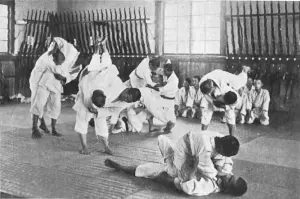
Image: Unknown photographer / Wikimedia Commons · Public domain
Overview
A documented teaching network stands beside a much older transmitted genealogy.
Daitō-ryū Aiki-jūjutsu (大東流合気柔術) is a Japanese martial tradition centred on joint controls, throws, pins, balance disruption, and methods described through aiki. Its public history is closely associated with Takeda Sōkaku, whose enrolment books and teaching records document activity from the late nineteenth century onward. The school’s own genealogy reaches further back through the Takeda family and Aizu domain, but that earlier history rests substantially on transmitted tradition. Sōkaku taught widely rather than through one permanent dōjō, producing several later lines. His instruction of Morihei Ueshiba made Daitō-ryū a major technical source for Aikido, while the two remain distinct traditions.
Important to school identity; earlier details require attribution to lineage tradition.
Travel, seminars, enrolment books, students, locations, and fees.
- Japanese
- 大東流合気柔術
- Public transmitter
- Takeda Sōkaku
- Documented activity
- From 1892 onward
- Training format
- Primarily paired kata
- Technical range
- Controls · throws · pins · posture breaking
- Modern connection
- A principal technical source for Aikido
01Name & category
The labels describe related layers of practice, not interchangeable arts.
Usage varies by organisation. A published mainline scheme is useful evidence for that line, not a universal dictionary for every branch.
Jūjutsu
Close-combat methods including throws, controls, pins, restraints, and responses to attacks.
Aiki-jūjutsu
Places aiki-related teaching inside the Daitō-ryū jūjutsu system.
Aiki no jutsu
A distinct catalogue in one current mainline ranking system; other branches organise material differently.
Aiki-jūjutsu, aikijujutsu, and aiki jujutsu are often spacing or romanisation variants. None is simply another spelling of Aikido.
02Historical record
Sōkaku’s travelling seminars created an unusually traceable network.
Surviving enrolment and payment records identify students, locations, and fees more clearly than the early genealogy.
- Before the 19th century
Transmitted genealogy
The school relates its methods to the Minamoto and Takeda families and preservation within Aizu.
- 1892 onward
Public teaching record
Documents associated with Sōkaku record seminars and students across Japan.
- Early 20th century
Wide professional network
Police, military personnel, judges, officials, and martial artists appear among those taught.
- After Sōkaku
Multiple organisations
Senior students and family succession carried different emphases, catalogues, and explanations forward.
03Curriculum & training
Paired kata links entry, balance disruption, control, and conclusion.
Exact catalogues differ, but the training problem repeatedly concerns how structure and timing create control at close range.
Training begins from a specified relationship and direction.
Use alignment, timing, angle, and whole-body movement.
Direct the opponent without depending on collision alone.
Conclude with stable control appropriate to the kata.
04Aiki
The word names a training problem, not one universally defined trick.
Branches and teachers use different pedagogical language. The recurring technical concerns are more reliable than a single slogan.
Organise the body
Maintain usable alignment while affecting the opponent’s frame.
Act inside the response
Coordinate contact with the instant posture or intention changes.
Remove stable support
Create control before a large visible throw or lock is required.
Name the teacher
Definitions become testable when attached to a curriculum and organisation.
05Relationship to Aikido
The teacher–student connection is clear; the later arts are not identical.
Ueshiba studied under Sōkaku and received formal teaching credentials, then developed different terminology, institutions, curriculum, and ethical emphasis.
Takeda Sōkaku
Daitō-ryū instruction and credentials establish direct technical transmission.
Morihei Ueshiba
Practice changed through teaching, religion, personal development, and new institutions.
Aikido
Historically connected, but not merely Daitō-ryū under another name.
06Branches & verification
Succession, syllabus, and aiki explanations are branch-specific.
Prominent routes include the line associated with Takeda Tokimune, the Takumakai, and groups connected with Sagawa Yukiyoshi and Horikawa Kōdō. This is not an exhaustive list.
- 1Organisation
Name the group making the claim.
- 2Teacher–student route
Identify documented instructors and credentials.
- 3Published syllabus
Check catalogue names and date rather than generalising from another branch.
- 4Succession claim
Treat headmastership and generation counts within their organisational context.
07Common misconceptions
Three distinctions keep the history accurate.
Independent evidence is strongest from Sōkaku’s public teaching career.
Terminology and training explanations vary.
They share a documented historical connection but developed as distinct traditions.
Sources and further reading
Last updated: