Performing Arts
Onnagata
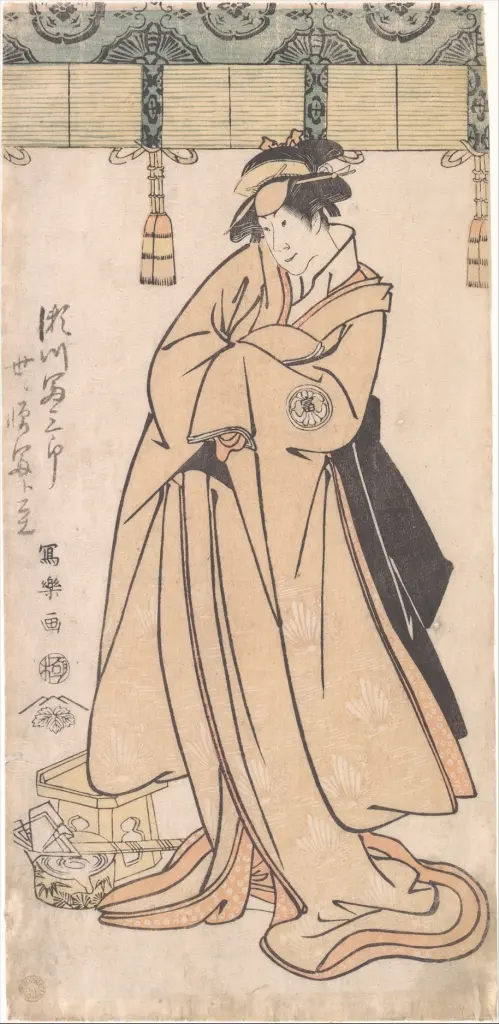
Image: Tōshūsai Sharaku; The Metropolitan Museum of Art / Wikimedia Commons · CC0
Overview
Female roles through a language of performance.
Onnagata (女方 or 女形) is the kabuki term for female roles and the actors who specialise in performing them. Also called oyama, the tradition developed within the male performance world that followed restrictions on women appearing in kabuki during the seventeenth century. Its artistry involves a coordinated language of movement, voice, costume, wigs, and relationships with other actors. An onnagata does not portray one universal type of woman: a princess, a town girl, and a household attendant require different theatrical choices. The term describes work on stage and a field of training; it does not, by itself, describe an actor’s private gender identity or sexuality.
Age, status, and story distinguish one role from another.
Movement, costume, wigs, and voice make the role legible.
Each performer brings timing and relationships to the stage.
At a glance
- Japanese forms
- 女方; 女形
- Alternative reading
- Oyama
- Theatrical setting
- Kabuki
- Core practice
- Performance of female roles
- Historical figure
- Yoshizawa Ayame I (1673–1729)
01
Historical formation
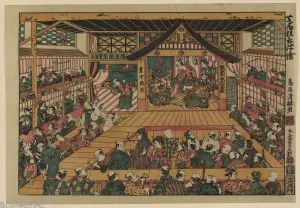
Women were banned from kabuki performance in 1629. As the theatre developed through subsequent restrictions and changes, male actors established specialised ways of portraying female characters. The Japan Arts Council identifies Yoshizawa Ayame I, active during the Genroku era, as a foundational figure. The tradition emerged through performance and transmission over time; it was not created as a complete, unchanging system by a single decree.
02
Acting and training
The role is made through an ensemble of choices: posture, steps, gesture, vocal delivery, and timing in relation to another performer. Historical teachings associated with Ayame, known through the Ayamegusa, describe an unusually demanding ideal of commitment. Such teachings are evidence of particular theatrical values. They should not be turned into an assumption that all modern onnagata organise their private lives in the same way.
03
Characters and costumes
Kabuki character types are distinguished by social setting, age, occupation, and dramatic circumstances. Costume and wig conventions help spectators recognise those differences before the dialogue has fully established them. A role category is a starting point for interpretation, not the whole character.
Akahime
- Typical setting
- High-ranking young woman or princess
- Recognisable convention
- A richly patterned red costume
Machimusume
- Typical setting
- Young woman of the town
- Recognisable convention
- Styling associated with an unmarried town girl
Katahazushi
- Typical setting
- Woman serving in a high-ranking household
- Recognisable convention
- A distinctive wig convention and formal bearing
04
Voice, movement, and dance
Onnagata work spans historical plays, domestic dramas, and dance. The setting changes what a gesture means and how a character occupies the stage. A ceremonial scene may emphasise measured formality, while a domestic scene asks the same performer to communicate intimate relationships and immediate emotional pressures. Costumes are active parts of this work: sleeves, hems, and the silhouette of the wig contribute to the character’s visible rhythm.
05
Specialists and role range
Onnagata is often translated as “female-role specialist,” but specialisation is not always an exclusive career boundary. The Japan Arts Council notes that some actors also perform male roles, while the term ma-onnagata can identify a performer devoted specifically to female roles. Cast lists, role names, and the production itself offer more reliable information than assumptions based on an actor’s appearance in one portrait or photograph.
06
Portraits and reception
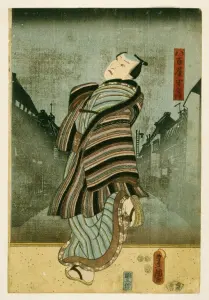
Edo-period actor prints helped circulate the public images of celebrated performers. The Sharaku print shown here depicts Segawa Tomisaburō II as the maid Wakakusa, a character who is actually Prince Korehito in disguise. Its layered role makes the image especially useful: an actor portrait records a theatrical appearance, not simply an everyday identity. Museum titles, dates, and character identifications are therefore essential when using such prints to understand onnagata.
Sources
Last updated: