Karate
Heian Yondan
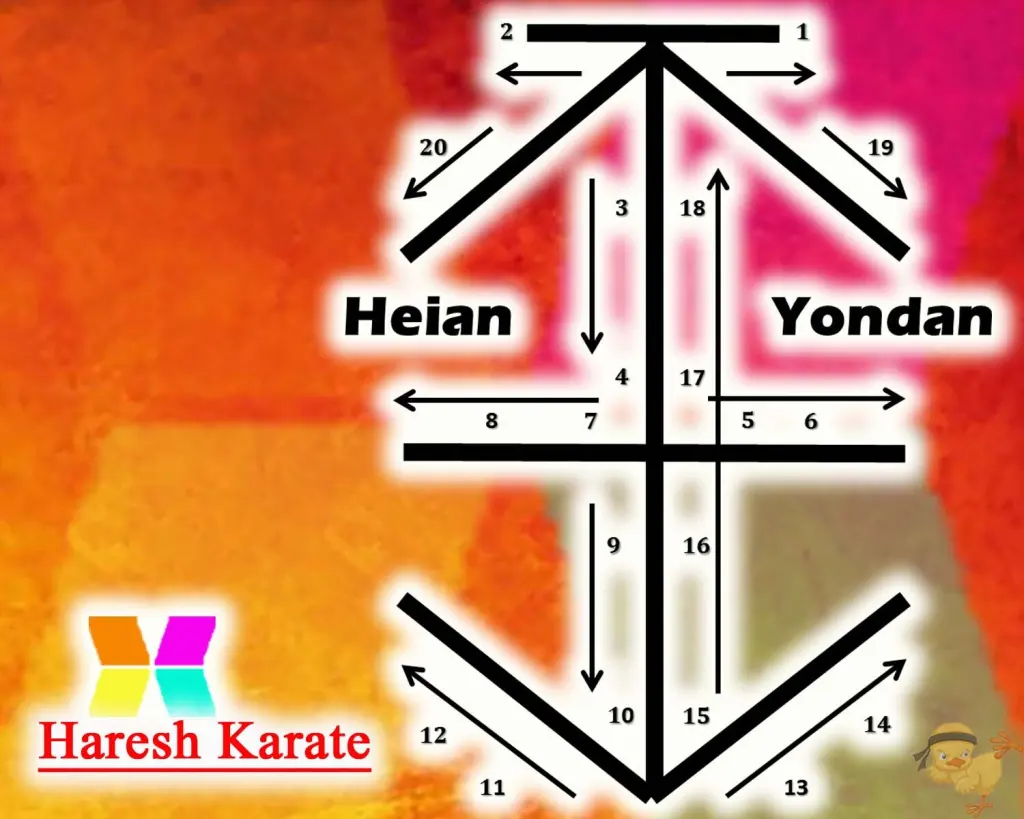
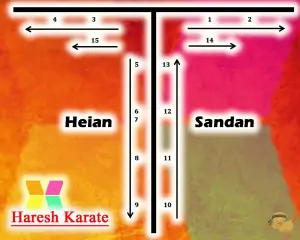
Image: Haresh karate / Wikimedia Commons · CC BY-SA 4.0
Heian Yondan (平安四段) is the fourth named form in the five-kata Heian family used by the Japan Karate Association and many Shotokan organisations. The JKA instructor manual counts 27 movements, and the organisation's grading guideline effective 1 April 2022 assigns the kata to 4th kyū. Neither value defines every school. Heian forms share historical connections with the Okinawan Pinan teaching tradition associated with Itosu Ankō, but modern Shotokan, Shitō-ryū and related versions can differ in sequence, stance, timing and emphasis. Yondan is therefore best studied as a named organisational pattern: compare direction and transition first, then investigate rhythm and application without treating a diagram or one official performance as a universal endpoint.
JKF official kata videos
Official reference
Use these federation reference films to compare named versions. Each video documents one JKF-published model for the named tradition; it does not define every dōjō or lineage.
Shōtōkan-ryū松濤館流
Heian Yondan
Karate Kihon Kata #3
Shitō-ryū糸東流
Heian Yondan
Karate Kihon Kata #2
JKF framework
Where this kata sits
Official competition placement and broader guide context are shown separately.Official JKF position
Basic kata
- Shōtōkan
- Shitō
The JKF Basic Kata reference places the five Heian forms in both the Shōtōkan-ryū and Shitō-ryū columns.
Guide context
Heian / Pinan
- Shōtōkan
- Shitō
Heian and Pinan are historically related name families. Modern sequence, numbering and execution remain version-specific.
Overview
| Japanese | 平安四段 |
|---|---|
| Reading | へいあんよんだん |
| Romanisation | Heian Yondan |
| Series position | Fourth in the Heian name sequence |
| Classification | Karate kata; Heian / Pinan family |
| Common association | Shotokan and related mainland curricula |
| JKA movement count | 27 movements |
| JKA grading position | 4th kyū, effective 1 April 2022 |
Name and scope
Yondan identifies the fourth level in the Heian title sequence. The number is useful inside a named curriculum but does not create one worldwide Karate order.
Heian and Pinan forms are historically connected. A correct comparison keeps modern style and organisation visible because shared family labels do not guarantee identical techniques, counts or applications.
Family and history
The JKF associates the five-form Heian or Pinan family with Itosu Ankō and Shuri-te teaching. Mainland publication and group instruction later gave particular versions a more stable institutional form.
That history is a transmission path, not a claim of perfect continuity. Names, teaching order and performance details should be traced through the sources used by the school in question.
The JKA reference
The JKA technical manual counts 27 movements for Heian Yondan. The same organisation includes it with the other Heian forms in Volume 1 of its kata book series.
The count provides a precise JKA checkpoint. It should not be used to label another association's segmentation or a related Pinan version as incomplete.
Direction and rhythm
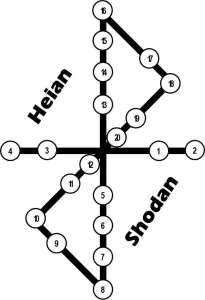
Begin by mapping changes of direction and the relationship between each transition and finishing position. Then compare where the named version accelerates, pauses or reorganises posture.
Rhythm cannot be recovered from an embusen alone. The two official videos provide version-labelled visual evidence, while instruction is still needed to understand local timing and body mechanics.
Position in the Heian study path
JKA places Yondan after Heian Sandan and before Heian Godan. Reading the forms together helps a student notice recurring foundations and different ways of connecting them.
The numeral should organise study, not replace it. Compare one dimension at a time—direction, stance, hand-foot timing or rhythm—and keep the organisation constant before drawing conclusions.
Bunkai and variation
Bunkai explores how the kata may structure angles, distance and partner response. The same solo shape can be tested through different relationships when assumptions are made explicit.
Do not present one application as historically proven by the performance alone. Name the instructional source and separate practical training value from documentary certainty.
Grading and competition context
The JKA grading guideline assigns Heian Yondan to 4th kyū. Belt colours, minimum experience and kata order can differ elsewhere, so the JKA placement should remain attributed and dated.
Competition use depends on current event rules. An official reference performance can clarify a named model but does not define every dojo's pedagogical sequence.
How to study it safely
Use sufficient space and practise new directions at a pace that preserves balance. Avoid forcing low stances, pivots or high ranges beyond comfortable control.
Compare the Shotokan and Shitō-ryū reference videos without mixing details mid-sequence. A qualified instructor should confirm the version, count and partner-practice conditions used in the dojo.
Sources
- All Japan Karatedo Federation, Heian / Pinan.
- Japan Karate Association, Technical Manual for the Instructor.
- Japan Karate Association, Dan Ranking and Kyu / Dan Grading Guideline.
- Japan Karate Association, KARATE-DO KATA books.
- Tooru Kadekaru, The origins of the modern kata in karate-do.
- National Diet Library, Funakoshi Gichin, Karate-do Kyohan.
Last updated: