Karate
Kankū Dai
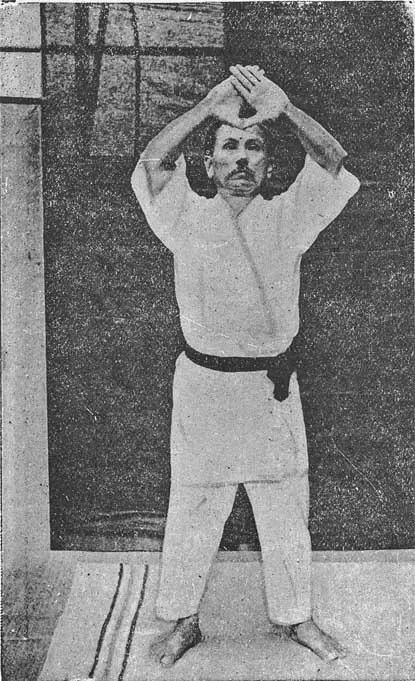
Image: Funakoshi Gichin / Rentan Goshin Karate Jutsu (1924), via Wikimedia Commons · Public domain
Kankū Dai (観空大) is a major Karate kata in Shotokan and related mainland traditions. The name belongs to the wider Kūshankū or Kōsōkun family, but those labels do not make every version identical. The All Japan Karatedo Federation classifies Kankū Dai as a Shotokan first designated kata and describes a Shuri-te line with attacks imagined from several directions. The Japan Karate Association counts 65 movements in its version and highlights turns, jumps, drops and contrasts of speed and force. Those are JKA-specific reference points. Historical publication and group teaching helped stabilise modern versions, so stance, count, rhythm, application and competition criteria should always be tied to a named organisation.
JKF official kata videos
Official reference
Use these federation reference films to compare named versions. Each video documents one JKF-published model for the named tradition; it does not define every dōjō or lineage.
Shōtōkan-ryū松濤館流
Kankū Dai
Dai-ichi Shitei Kata #6
Wadō-ryū和道流
Kūshankū
Dai-ni Shitei Kata #8
Name-family note: JKF labels this Wadō-ryū form Kūshankū. It belongs to the related name family discussed here, but is not presented as the same sequence as Shōtōkan Kankū Dai.
JKF framework
Where this kata sits
Official competition placement and broader guide context are shown separately.Official JKF position
First designated kata
- Shōtōkan
The dated JKF amendment places Kankū Dai in the Shōtōkan-ryū first designated pair. Wadō-ryū Kūshankū is separately listed as second designated.
Guide context
Kankū / Kūshankū
- Shōtōkan
- Wadō
The guide keeps the related Kankū and Kūshankū names connected while treating current versions as distinct.
Overview
| Japanese | 観空大 |
|---|---|
| Reading | かんくうだい |
| Romanisation | Kankū Dai; Kanku Dai |
| Name family | Kūshankū, Kushanku or Kōsōkun |
| Classification | Karate kata |
| Major association | Shotokan and related mainland lines |
| JKF context | Shotokan first designated kata |
| JKA movement count | 65 movements |
Name and scope
The modern Shotokan title Kankū is commonly explained as “view the sky,” and dai means large. The opening hand shape is often used to illustrate that reading, but a modern character interpretation is not by itself proof of the kata family's original name.
Other schools preserve related names such as Kūshankū, Kushanku or Kōsōkun. A shared family name supports comparison, not the assumption of one universal embusen or application set.
Kūshankū and the wider family
The JKF places Kankū Dai in a Shuri-te line and notes that other styles use Kūshankū or Kōsōkun names. Okinawan and mainland schools preserve several large, small or otherwise edited forms within this broad family.
Stories connecting the name to a Chinese visitor called Kūsankū are part of Karate historiography, but the path from historical person to every modern sequence is not documented movement by movement.
Funakoshi and mainland transmission
Funakoshi Gichin published photographs of Kankū in 1924 and used the form in his mainland teaching and demonstrations. Such records make comparison possible while also showing that kata presentation was adapted for books and public instruction.
Kadekaru's study of Funakoshi's publications explains how group teaching, physical education and demonstrations affected modern kata composition. It cautions against treating one printed version as an unchanged ancient original.
JKF and JKA contexts
In the dated JKF framework, Kanku Dai shares the Shotokan first designated pair with Jion; each page keeps the category, lineage and organisation-specific execution separate.
The JKF identifies Kankū Dai as a first designated kata in its Shotokan competition framework. The JKA separately publishes Kankū Dai in its kata series and provides technical reference points for its own organisation.
Federation designation, book placement and dōjō grading are different systems. A fact from one should not be converted into a universal rank requirement or judging rule.
The 65-movement JKA pattern
The JKA instructor manual records 65 movements for Kankū Dai and describes defence in eight directions, numerous direction changes, jumps, drops and turns. It also stresses contrasts between slow and quick motion, power levels, contraction and expansion.
A movement count depends on how actions are divided and numbered. Sixty-five is therefore a useful check for the JKA version, not a standard for every Shotokan or Kūshankū-related form.
Embusen, height and rhythm
Kankū Dai travels through many directions and includes marked changes of height. Turns, a jump and a drop require balance and spatial awareness; they should be learned progressively rather than treated as decorative athletic moments.
Rhythm emerges from the relation between actions. Pauses, acceleration and changes of force should follow the named version, while the Kime of one technique must not erase controlled transition into the next.
Bunkai and competition boundaries
Bunkai may examine receiving, striking, controlling and positional responses within the sequence. More than one drill can fit a similar solo movement, and usefulness does not prove historical exclusivity.
Competition performance is judged under current event rules. Strong presentation in a tournament does not turn one federation version into the technical authority for every school.
How to study it safely
Learn the full embusen slowly with enough space before increasing speed. Practise jumps, drops and pivots within comfortable ankle, knee and hip ranges, using progressive landing work where appropriate.
Partner applications require agreed distance, contact and resistance. Historical photographs are valuable evidence, but they cannot replace qualified instruction in transitions, timing or safe impact.
Sources
Last updated: