Karate
Heian Shodan
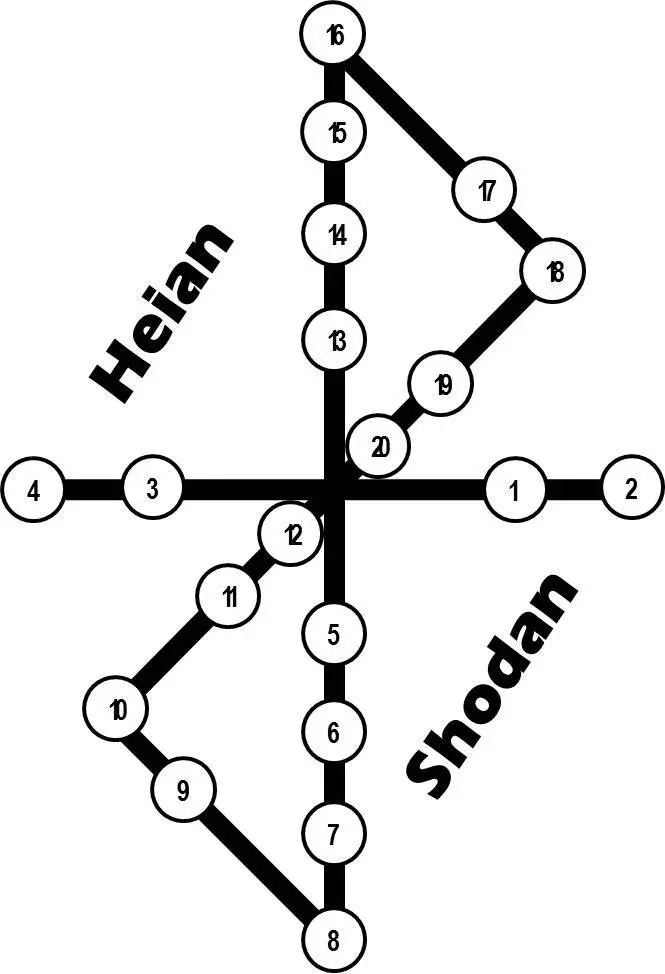
Image: Haresh karate / Wikimedia Commons · CC BY-SA 4.0
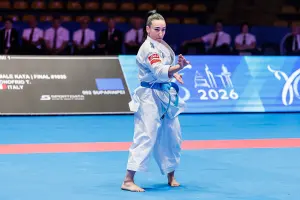
Heian Shodan (平安初段) is a foundational Karate kata taught in many Shotokan organisations. Its compact pattern commonly connects turns, front stances, lower-level receiving actions and straight punches, allowing beginners to study how separate Kihon elements form a continuous sequence. The Japan Karate Association counts 21 movements and examines the kata at 7th kyū, but those facts describe the JKA syllabus rather than every school. Heian belongs to a five-kata family historically related to Okinawan Pinan forms associated with Itosu Ankō; names, ordering and technical details changed as the material passed through different teachers and institutions. This article therefore identifies versions and sources instead of presenting one performance as universally original.
JKF official kata videos
Official reference
Use these federation reference films to compare named versions. Each video documents one JKF-published model for the named tradition; it does not define every dōjō or lineage.
Shōtōkan-ryū松濤館流
Heian Shodan
Karate Kihon Kata #3
Shitō-ryū糸東流
Heian Shodan
Karate Kihon Kata #2
JKF framework
Where this kata sits
Official competition placement and broader guide context are shown separately.Official JKF position
Basic kata
- Shōtōkan
- Shitō
The JKF Basic Kata reference places the five Heian forms in both the Shōtōkan-ryū and Shitō-ryū columns.
Guide context
Heian / Pinan
- Shōtōkan
- Shitō
Heian and Pinan are historically related name families. Modern sequence, numbering and execution remain version-specific.
Overview
| Japanese | 平安初段 |
|---|---|
| Reading | へいあんしょだん |
| Romanisation | Heian Shodan |
| Common translation | Peaceful Mind, First Level |
| Classification | Karate kata; Heian/Pinan family |
| Common association | Shotokan and related mainland curricula |
| JKA movement count | 21 movements |
| JKA grading position | 7th kyū |
Name and scope
Continue through the named Heian sequence with Heian Nidan, Heian Sandan, Heian Yondan and Heian Godan; each guide keeps counts and teaching details attached to a named organisation.
See Pinan Shodan for the related Okinawan and Wadō name tradition; current Pinan and Heian versions should not be assumed identical.
Heian is commonly translated as peaceful mind, while shodan means first level. The title identifies its position within the Heian series, not an ancient universal rank shared by all Karate traditions.
The JKF terminology reference links the five Heian or Pinan forms with Itosu Ankō. Modern schools preserve related material under different names, orders and technical conventions, so Heian Shodan and every kata called Pinan Shodan should not be assumed mechanically identical.
Historical transmission
The Heian family developed from the Okinawan Pinan teaching tradition associated with Itosu. Funakoshi Gichin later used the Heian name in his mainland Japanese publications and teaching.
Kadekaru's study of Funakoshi's books shows that modern kata presentation was also shaped by group instruction, demonstrations and physical education. That context supports comparison of documented versions rather than a claim that one modern sequence preserves an unchanged original.
The JKA pattern
The JKA instructor manual records 21 movements for Heian Shodan. Its version uses a compact directional pattern and repeatedly combines stance changes with receiving and punching actions.
A movement count depends on how an organisation divides and numbers actions. The JKA figure is useful for checking its own version but should not be transferred automatically to another association's syllabus.
Connections with kihon
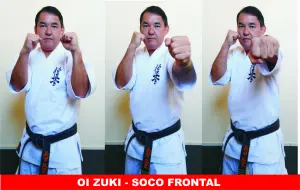
Heian Shodan reconnects basic elements that are often isolated in kihon: stepping, turning, front stance, Gedan-barai-uke and Oi-zuki.
The sequence makes transitions visible. Balance during a turn, the arrival of the stance and the timing of the hand action matter alongside the appearance of each finishing position.
Embusen and rhythm
Embusen describes the floor pattern traced by a kata. Heian Shodan's commonly published Shotokan pattern uses lateral lines and a longer central path, helping students organise direction and return toward the starting area.
An embusen diagram records travel rather than complete technique. It cannot show stance dimensions, gaze, breathing, transition speed or the rhythm taught by a particular instructor.
Bunkai and application boundaries
Bunkai examines possible functions of the kata's movements with partners. A lower receiving form, turn or punch can be studied through more than one tactical relationship.
The solo pattern does not prove a single historical application. Interpretations should identify the teacher, lineage and training conditions, especially when grips, close distance or takedowns are added.
Grading and competition context
The current JKA grading page assigns Heian Shodan to 7th kyū. Earlier and later examinations build through the remaining Heian forms and other parts of that organisation's curriculum.
JKA tournament rules effective 1 April 2025 also list Heian Shodan among designated basic kata. This dated competition status does not establish the grading order or tournament eligibility used by other Shotokan bodies.
How to study it safely
Begin with enough floor space to complete every turn without collision. Learn the local count, direction and stance dimensions from a qualified instructor before increasing speed or force.
Turns should stay within comfortable knee and hip range. Partner applications require agreed distance, target and contact, because the solo kata does not by itself establish safe resistance or impact.
Sources
- All Japan Karatedo Federation, Karate Terminology Dictionary.
- Japan Karate Association, Technical Manual for the Instructor.
- Japan Karate Association, Dan Ranking and Grading Syllabus.
- Japan Karate Association, Kata Books and Videos.
- Japan Karate Association, Tournament Rules and Regulations, effective 1 April 2025.
- Tooru Kadekaru, The origins of the modern kata in karate-do.
Last updated: