Games
Pokémon GO
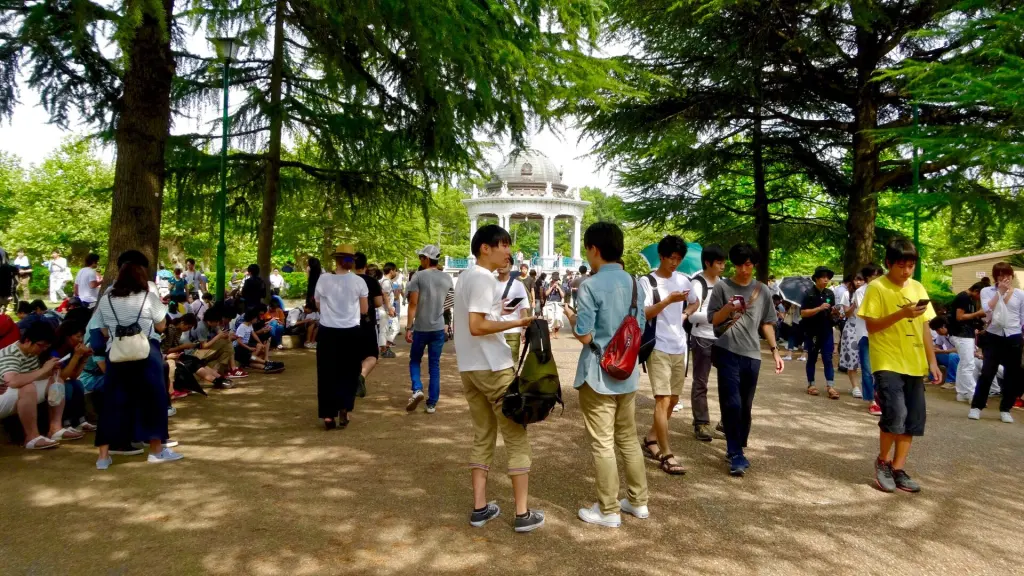
Image: KKPCW / Wikimedia Commons · Creative Commons Attribution-ShareAlike 4.0 International
Pokémon GO is a location-based mobile game that places the creatures and collecting systems of Pokémon onto a map shaped by the player’s physical surroundings. Released internationally in July 2016 and in Japan on 22 July, it was developed by Niantic in collaboration with The Pokémon Company and Nintendo. Players walk through real places to find Pokémon, visit mapped points of interest, battle, trade, and join timed events. Camera-based augmented reality is one visible feature, but location data, movement, and a shared geographic database are more fundamental to play. The game therefore belongs to both the history of Japanese video-game franchises and the wider development of global “real-world” games, public-space gatherings, tourism campaigns, and continuously updated mobile services.
Overview
| Japanese title | Pokémon GO(ポケモンGO) |
|---|---|
| Genre | Location-based mobile game with augmented-reality features |
| Developer | Niantic |
| Franchise collaboration | The Pokémon Company and Nintendo |
| Initial release | 6 July 2016 in Australia, New Zealand, and the United States |
| Japan release | 22 July 2016 |
| Platforms | iOS and Android |
Name and scope
The title combines the established Pokémon name with “GO,” emphasizing movement through the world outside the screen. The official Pokémon site classifies the game as a “Real World Adventure,” while research literature commonly describes it as a location-based or mobile augmented-reality game.
Pokémon GO is not a conventional main-series Pokémon role-playing game. It borrows catching, collecting, evolution, types, and battles, then reorganizes them around smartphone location services, a persistent online map, and scheduled live-service content.
Launch and Japanese release
Niantic announced the first public release on 6 July 2016 for Australia, New Zealand, and the United States. The launch post described a platform combining smartphones, location technology, a large geographic dataset, and social exploration. Further countries followed in stages as the service expanded.
Niantic and The Pokémon Company announced the Japanese release on 22 July 2016. Japan was therefore central as the home of the Pokémon franchise, but it was not the first release market. That distinction matters when placing the game within Japanese Video Games: Pokémon GO is a transnational collaboration built around Japanese characters and franchise systems.
Map, movement, and augmented reality
The game converts the player’s geographic position into movement on an in-game map. Pokémon encounters, walking distance, routes, and visits to specific points depend on location. PokéStops and Gyms associate game functions with landmarks and other mapped places, creating a layer of playable geography over streets, parks, stations, monuments, and businesses.
The camera view can make a Pokémon appear against the player’s surroundings, but camera-based AR can be optional in many encounters. Describing Pokémon GO only as an AR game can therefore hide the more consequential system: the link between server-managed game content, a real-world map, and bodily movement.
Collecting, battles, and live service
Players catch Pokémon, gather items, hatch Eggs by recording walking distance, develop collections, and participate in Gym, Raid, Max, and player-versus-player battles. Trading, friendship systems, teams, research tasks, and community meetups add cooperative and social layers to the core collection loop.
The rules and available creatures are not fixed like the contents of a boxed game. Seasonal rotations, Community Days, limited research, raids, ticketed events, balance changes, and new features continually reshape play. An encyclopedic account must therefore separate the durable design—location, collection, movement, and shared events—from temporary event details.
Pokémon franchise and Niantic platform
Pokémon supplied a world already organized around finding, collecting, training, and exchanging creatures. Niantic contributed experience from Ingress and a technical model for games played across physical locations. The resulting design made a familiar fictional activity—searching for Pokémon—legible as everyday walking and map exploration.
This combination differs from a simple mobile adaptation of a console title. It depends on coordination among intellectual-property owners, platform development, mapping infrastructure, app stores, event production, and local partners. The arrangement also demonstrates how a Japanese franchise can operate through a globally maintained service rather than through a single domestic studio and hardware platform.
Public space, mobility, and safety
Pokémon GO can redirect attention and movement toward parks, monuments, transit areas, shopping districts, and lesser-known points of interest. Studies have examined its effects on route choice, tourism, social interaction, and the perception of cities. These outcomes vary by place and player; the game does not automatically produce informed tourism or equal geographic access.
Crowds and screen attention also create practical responsibilities. Official notices repeatedly ask players to remain aware of their surroundings and local guidance. Playable map data may privilege dense or well-documented areas, while events can concentrate visitors in spaces that must also serve residents and non-players.
Real-world events and city partnerships
Large events turn the distributed mobile game into temporary urban programming. Organizers designate parks or citywide play zones, schedule exclusive encounters and research, sell or allocate tickets, and encourage travel. Municipalities and tourism organizations may treat the gatherings as visitor-economy projects, while transport, crowd management, weather, accessibility, and local communication shape the actual experience.
Japan has hosted major events in cities including Yokohama, Sapporo, Sendai, and Tokyo. These gatherings connect a game entry to the study of place: they can be read alongside transport networks, regional identity, parks, commercial districts, and the ways popular culture is used in tourism.
Sendai and Tohoku in 2026
Pokémon GO Wild Area: Sendai • Tohoku is scheduled for 6–8 November 2026, with in-person experiences centered on Sendai and gameplay across Miyagi Prefecture. The official event page connects the city to the wider Tohoku region and identifies Lapras, Miyagi’s official Support Pokémon, as part of the local program.
Interest registration for limited tickets opened at 8:00 a.m. Japan Standard Time on 11 September 2026 and runs through 7:59 a.m. on 15 September. This announcement explains the day’s sharp search interest, but the article’s broader significance is the recurring conversion of real cities into temporary game environments.
Legacy and boundaries
Pokémon GO helped make location-based mobile play visible to a mass audience and has persisted through a decade of feature changes. Its legacy includes new expectations about walking, shared raids, event tourism, and games that treat physical places as part of their interface.
It should not be presented as the first location-based game, as a wholly Japanese production, or as proof that digital play necessarily isolates people from public life. Its cultural position comes from the interaction of an older Japanese media franchise, Niantic’s mapping platform, global smartphone distribution, and the varied ways players and cities use the service.
Sources
- Break out the sneakers and Poké Balls! — Pokémon GO launch announcement.
- Pokémon GO、いよいよ日本で配信開始! — Pokémon GO.
- Happy 10th anniversary to Pokémon GO! — Pokémon GO.
- Pokémon GO Wild Area: Sendai • Tohoku — Pokémon GO.
- Why do people play location-based augmented reality games: A study on Pokémon GO — Computers in Human Behavior.
- Tourism Media Communication and Mobile Game: Redefining Tourism through Pokémon GO — National Diet Library Search.
- Japanese Seasonal Play: A Prehistory of Pokémon GO — American Journal of Play.
Last updated: