Karate
Enpi-uchi
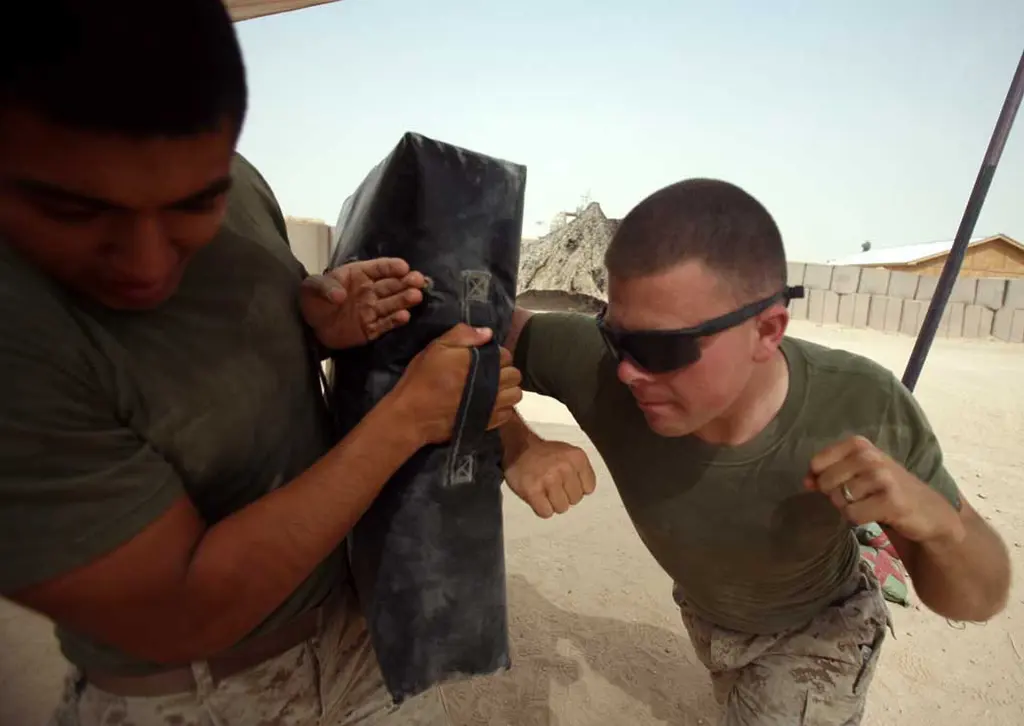
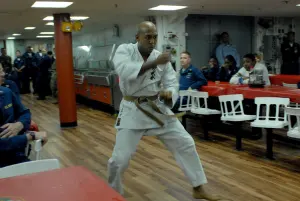
Image: Lance Cpl. Melissa A. Tugwell / U.S. Marine Corps / Wikimedia Commons · Public domain (U.S. Marine Corps)
Overview
Enpi-uchi is a close-range elbow strike whose direction must be named.
Enpi-uchi (猿臂打ち) is a Karate striking action using the elbow region, principally at close range. The All Japan Karatedo Federation gives vertical and horizontal examples; Japan Karate Association material names Tate-, Yoko-, Ushiro-, Otoshi-, and Mawashi-enpi in one directional model. Other schools may use different spellings, labels, contact emphasis, chambers, and body mechanics. Empi-uchi is a documented Romanisation variant, while the Shotokan kata Enpi is a separate subject written with different characters. Competition rules also matter: a formal elbow action in kihon, kata, or bunkai does not make actual elbow contact legal in sport kumite.
The elbow is not a long-range substitute for a punch.
Vertical, horizontal, rearward, downward, and circular models differ.
Forearm angle changes the contact region and joint relationship.
Close range increases the need for agreed speed, target, and contact.
- Japanese
- 猿臂打ち
- Reading
- えんぴうち
- Documented variant
- Empi-uchi
- Reference meaning
- Elbow strike
- Primary range
- Close range
- JKA examples
- Tate · Yoko · Ushiro · Otoshi · Mawashi
01Name & spelling
Enpi identifies the elbow action; uchi identifies the strike.
Empi-uchi is a documented spelling variant rather than proof of a different technique.
TokyoWaltz follows the enpi spelling used in JKF and JKA material. A WIKF Belgium handbook documents empi-uchi; spelling should be read with its source.
02Elbow surface & close range
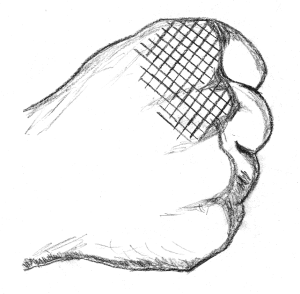
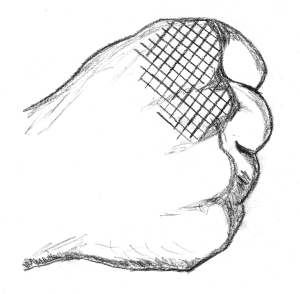
The defining region is the elbow, but the exact contact patch changes with angle.
Forearm position, flexion, direction, target, and body relationship matter.
Work inside ordinary punching distance
The JKF description places elbow use mainly at close range.
Do not reduce the elbow to one fixed point
Contact emphasis varies with direction and method; one static shape cannot define all enpi.
Connect shoulder, torso, and stance
A compact weapon still depends on whole-body organisation and comfortable joint motion.
03Directional models
One JKA map names five directions without claiming every school must do the same.
The label becomes more useful when the line is stated.
JKA’s yoko-enpi basic exercise specifies a sideways movement, forearm twist, starting position, and return path. Those details define one reproducible drill, not every horizontal elbow action.
04Technique and kata
A shared reading does not make the elbow strike and Shotokan kata the same topic.
Characters, evidence, and editorial subject remain distinct.
Enpi-uchi · 猿臂打ち
An elbow striking action. Direction, range, alignment, and training context must be named.
Enpi · 燕飛
A kata title written with different characters. A source about the form does not establish an elbow-strike path or target.
05Selected Uchi-waza family
Enpi-uchi changes the contact region from hand or fist to the elbow.
That shift also changes practical range, alignment, and safety requirements.
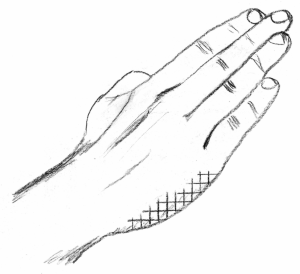
The little-finger side of an open hand supplies the named striking surface.
Closed fistUraken-uchi裏拳打ちBack-fist knucklesThe index- and middle-finger knuckle area is used from the back-fist side.
Closed fistTettsui-uchi鉄槌打ちHammer-fist edgeThe outer fist beside the little-finger ball creates the hammer-like surface.
Arm segmentEnpi-uchi猿臂打ちElbow regionThe elbow becomes the contact region, principally at close range.
06Kihon, grading & bunkai
Organisation-specific combinations show how a direction is taught, not a universal rank law.
Close-range partner study requires especially explicit control.
Isolate direction and compact alignment
Study elbow line, forearm relationship, torso, stance, range, and recovery.
JKA combinations document one syllabus
Yoko-enpi appears with chūdan soto-uke, yoko-uraken-uchi, and gyaku-zuki at named levels.
Name the sequence and partner task
Striking, framing, clearing, control, or transition readings need a specific kata, lineage, and safe drill.
07Evidence, variation, rules & safety
Static contact mapping cannot prescribe a dynamic Karate elbow strike.
Research scope and competition prohibitions are essential parts of the explanation.
Seventy-six adults made light static contact
A non-Karate-specific study used a transparent plate; it illustrates angle-dependent contact but not enpi force, execution, or safety.
Cross-sport results remain heterogeneous
A broader review does not isolate Enpi-uchi or establish one optimal mechanic or safe impact threshold.
Actual elbow attacks are prohibited
JKF rules distinguish uchi terminology yet explicitly prohibit actual elbow attacks in competition kumite.
Close range leaves little margin for error
Use pads, qualified supervision, controlled speed, and agreed targets; avoid uncontrolled contact to head, throat, spine, ribs, or joints.
Sources and further reading
- All Japan Karatedo Federation, Enpi.
- All Japan Karatedo Federation, Enpi kata.
- All Japan Karatedo Federation, Basic Rules of Karatedo.
- Japan Karate Association, Technical Manual for the Instructor.
- Japan Karate Association, Dan Ranking.
- WIKF Belgium, Handbook.
- Beránek et al., Analysis of the Contact Area for Three Types of Upper Limb Strikes.
- Beránek, Votápek and Stastny, Force and velocity of impact during upper limb strikes in combat sports.
Last updated: