
Games
Yōkai Watch

Image: z tanuki / Wikimedia Commons, originally published on Panoramio · Creative Commons Attribution 3.0 Unported
Yōkai Watch is a Japanese role-playing game and media franchise created by Level-5. The first game, released for Nintendo 3DS in Japan on 11 July 2013, follows a child who uses a special watch to see yōkai inhabiting an otherwise ordinary town. Players investigate small disturbances, befriend named yōkai, and assemble teams for battles. Animation, manga, toys, medals, films, music, and later games expanded the project into a coordinated media mix, helping it become a major children’s popular-culture phenomenon in the mid-2010s. The franchise borrows the broad idea of yōkai from Japanese folklore, but its characters and rules belong to modern commercial fiction rather than to a catalogue of traditional belief. Official English branding often uses “Yo-kai Watch”; the macronized title Yōkai Watch reflects standard romanization of the Japanese word yōkai.
Overview
| Japanese title | 妖怪ウォッチ |
|---|---|
| Romanization | Yōkai Wotchi |
| Creator and developer | Level-5 |
| Original release | 11 July 2013 in Japan |
| Original platform | Nintendo 3DS / Nintendo 3DS LL |
| Core form | Role-playing game and cross-media franchise |
Name and scope
The Japanese title combines yōkai, a broad and historically changing category of uncanny beings and phenomena, with the English loanword “watch.” Within the fiction, the watch makes nearby yōkai visible and allows the protagonist to interact with them. The title therefore names both the central device and the franchise built around it.
“Yōkai Watch” can refer narrowly to the first 2013 game or broadly to the series of games and related animation, manga, films, toys, music, and events. Official international materials commonly style the name “Yo-kai Watch” or “YO-KAI WATCH.” TokyoWaltz uses Yōkai Watch as an editorial title while preserving official spellings when identifying a specific release or award.
The original 2013 game
Level-5 developed and published the first Yōkai Watch for Nintendo 3DS and 3DS LL in Japan on 11 July 2013. It was rated CERO A and presented as an RPG centered on exploring a detailed contemporary town. The game preceded the television anime, making it the narrative and mechanical starting point of the franchise rather than an adaptation of the animated series.
The player searches streets, homes, shops, schools, and other everyday spaces for hidden yōkai. Short stories connect supernatural causes to minor problems and social misunderstandings. Progress depends on observation, errands, conversation, collection, and battles, giving the game a neighborhood scale distinct from a journey across a distant fantasy world.
Setting, befriending, and battle
The fictional Sakura New Town resembles a familiar Japanese suburban city but contains another layer visible through the watch. A radar-like function helps locate yōkai, and encounters can lead to friendship medals representing individual characters. Players form teams from these allies and manage their positions and special actions during battle.
The original game’s lower touchscreen supports direct actions such as rotating the active formation, targeting opponents, and completing small gestures for special moves or purification. Battles combine preparation with real-time intervention rather than using the same turn structure as Pokémon. Collection is important in both series, but the mechanics, setting, narrative tone, and relationship between human and nonhuman characters differ.
Modern yōkai design
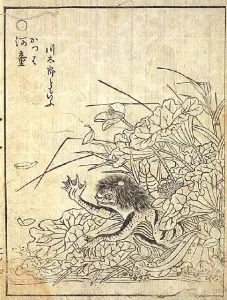
Many Yōkai Watch characters transform everyday habits, emotions, wordplay, objects, animals, and social friction into comic supernatural agents. Some draw on familiar folkloric names or motifs; others are new character designs whose humor depends on contemporary language and situations. The franchise thus participates in the long history of redefining yōkai for changing media.
This creative process should not be mistaken for direct documentation of folklore. A character’s appearance or ability in the game may have little connection to regional legends, ritual practice, or historical picture scrolls. The franchise is useful evidence for modern popular culture and for the continued flexibility of the word yōkai, not an authority that fixes what people in earlier periods believed.
Anime, manga, toys, and the media mix
Yōkai Watch was designed and promoted across several media. Television animation and manga introduced the characters through episodic comedy, while toy watches and collectible medals reproduced central objects from the fiction. Songs, films, retail campaigns, and events added further routes into the franchise. Each medium repeated recognizable names and devices while changing pacing, participation, and audience contact.
Media scholar Marc Steinberg analyzes Yōkai Watch as a particularly intensive example of media-mix mobilization. The medals were not only images from the screen: physical objects could circulate through toys, games, shops, and social exchange. Academic research using the franchise as a case study also found that the timing of media-mix activity was strongly associated with game sales during its early growth.
Breakthrough and awards
The first game’s audience expanded after release as the wider media project became visible. At the Japan Game Awards 2014, Yōkai Watch shared the Grand Award and also received an Award for Excellence. The official award citation highlighted its distinctive yōkai, touchscreen battle interactions, medals, and cross-media development.
The award matters as evidence of industry recognition, but it should not be treated as a complete measure of cultural influence. The franchise’s mid-2010s prominence also appeared through television, toys, music, retail scarcity, public promotions, and children’s everyday play. Different media generated different forms of participation, making “the success of the game” inseparable from the coordinated franchise during this period.
Series development and localization
Sequels and spin-offs expanded Yōkai Watch beyond the structure of the original game, revisiting characters and places while altering battle systems, perspectives, historical settings, and playable formats. The franchise also moved onto later consoles and mobile platforms. On 9 September 2026, the official series portal announced that YO-KAI WATCH 2: Haunted Domain was in development for Nintendo Switch 2, demonstrating continuing activity beyond the franchise’s original 3DS era.
Localization involved more than translating dialogue. Character names, jokes, food, urban details, voices, and cultural references had to be presented to new audiences, while the franchise’s English title itself separated yōkai into “Yo-kai.” These adaptations helped circulation but also changed how explicitly Japanese the setting and humor appeared in each market.
The Pokémon comparison
The comparison is clearer when Pokémon is treated as both a collect-and-trade game design and a coordinated media mix, not simply as another set of friendly monsters.
Yōkai Watch is frequently compared with Pokémon because both are Japanese game-centered franchises in which children collect named nonhuman companions and because both expanded through animation, manga, toys, and merchandise. The comparison can clarify the industrial importance of characters and portable-game play, but it becomes misleading when used as a complete description.
Pokémon began in 1996 around collecting, raising, trading, and battling creatures across a journey. Yōkai Watch instead centers on detecting supernatural causes within familiar urban life, friendship medals, episodic problems, and a battle interface built around a rotating team. Their media mixes also developed in different technological and market periods. Similarities do not establish direct equivalence.
Folklore, popular culture, and legacy
Yōkai Watch belongs to a modern sequence of media that makes yōkai newly visible to children and families. It follows earlier encyclopedias, manga, animation, films, games, mascots, and local tourism projects that repeatedly selected and redesigned supernatural figures. Its ordinary-town setting makes invisible emotion and behavior legible through comic characters, turning the category yōkai into a flexible storytelling device.
The franchise’s historical importance lies in this combination of game design and coordinated media circulation. It is both a Japanese video game series and a case study in the contemporary reinvention of folklore. Keeping those two levels distinct allows the work to be connected to older yōkai traditions without treating its fictional taxonomy as inherited belief.
Sources
- 妖怪ウォッチ — Level-5.
- 7月11日(木)発売『妖怪ウォッチ』7月3日(水)より体験版配信開始のお知らせ — Level-5.
- YO-Kai Watch: Grand Award / Award for Excellence — Japan Game Awards 2014.
- YO-KAI WATCH 2: Haunted Domain — Level-5.
- The Study about the Effect Measurement Method of Media Mix — CiNii Research.
- Media Mix Mobilization: Social Mobilization and Yo-Kai Watch — Animation.
- Yōkai Culture: Past, Present, Future — California Scholarship Online.
Last updated:


.jpg)