Karate
Oi-zuki
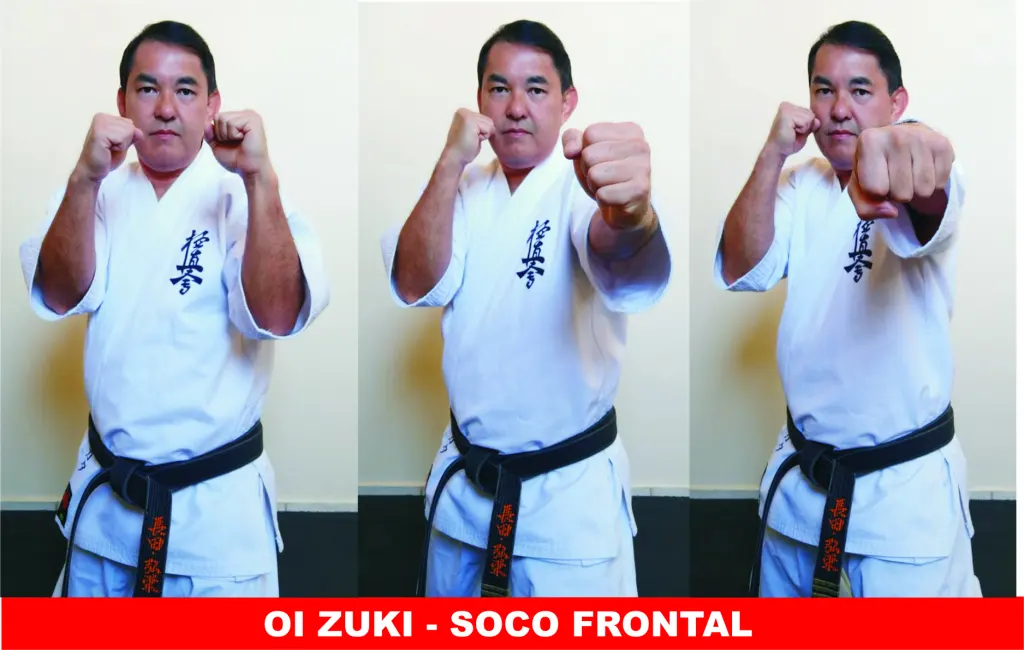
Image: Shihan Nagata / Wikimedia Commons · CC BY-SA 4.0
Overview
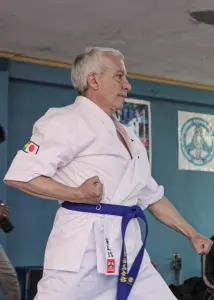
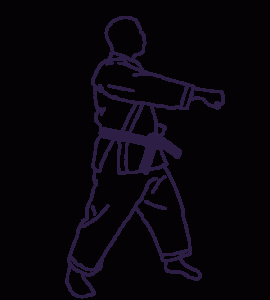
Oi-zuki coordinates an advancing leg with the hand on the same side.
Oi-zuki (追突き) is a Karate thrust performed as the practitioner advances, finishing with the punching hand on the same side as the stepping or forward leg. The All Japan Karatedo Federation presents jun-zuki and oi-zuki together for this relationship, while other traditions may prefer one term or distinguish them. The name is relational: it does not require one stance length, hip action, heel position, guard, or target. A complete action joins distance, step, trunk, thrust, stable landing, and recovery rather than treating the arm and foot as separate events.
The starting guard and stance establish distance.
Forward movement is coordinated from the hips through the fist.
The new base permits recovery or continuation.
- Japanese
- 追突き
- Reading
- おいつき
- Related term
- 順突き · jun-zuki
- Reference meaning
- Lunge or stepping punch
- Classification
- Tsuki · hand technique
- Defining relation
- Advancing leg and hand on the same side
01Name & terminology
The name connects pursuit or advance with a thrust.
English translations do not fully express the arm–leg relationship.
Common spellings include oi zuki, oizuki, and oi-tsuki. The JKF groups jun-zuki and oi-zuki; organisation and lineage should be named when a source treats those labels differently.
02The advancing relationship
The step establishes a new lead while the same-side fist completes the thrust.
The hand that begins behind can finish beside the newly forward leg.
Move from the hips
The JKF description begins the action with coordinated forward movement rather than an isolated reaching arm.
Step and thrust as one action
Instruction may separate phases for learning, but the finished movement connects them.
Land with usable posture
The base must permit guard recovery, repetition, or the next technique.
03Whole-body coordination
Forward travel, rotation, and deceleration meet at the fist.
Stance is a moving support problem rather than a pose added after the punch.
Sets direction and reach
The step reduces distance without sacrificing balance.
Carry and organise the centre
Exact hip range and heel use differ by method.
Transmit the thrusting line
Shoulder and elbow remain connected to the moving base.
Absorb and continue
Deceleration should leave posture and awareness intact.
04Distance, stance & recovery
The step solves distance only if the finish remains mobile.
A long formal stance and a shorter applied base can express the same defining relationship.
Clear beginning and end
A visible step, stance, and large action make left–right coordination easier to observe.
Compressed timing and guard
Range, speed, contact, and recovery are adapted to the exercise and rules.
Shotokan practice commonly finishes in zenkutsu-dachi, while other systems use a shorter base or different alignment. Stance length is therefore an attributed feature, not part of the universal definition.
05Compare the tsuki family
Same-side is the reliable cue; “front-hand punch” can mislead.
Oi-zuki advances into a new lead, whereas kizami-zuki normally uses the hand and foot already in front.
Names straightness rather than a fixed arm–leg relationship.
Same-side advanceOi-zuki追突きThe thrusting hand and advancing or forward leg finish on the same side.
Opposite-side relationGyaku-zuki逆突きThe thrusting hand is opposite the forward leg.
Leading-hand entryKizami-zuki刻み突きThe front hand attacks as the front foot enters and the rear leg follows.
06Kihon & partner practice
Repetition makes the relationship between travel and thrust visible.
It also reveals whether the landing can support another action.
Kihon
Studies step length, stance transition, fist path, and coordination on both sides.
Prearranged partner work
Adds a real target, agreed distance, and controlled contact.
Kumite
Compresses visible phases and changes guard, timing, and commitment.
JKA grading syllabuses list jun-zuki in moving basics and prearranged kumite. Those entries document one organisation’s teaching sequence rather than a universal Karate syllabus.
07Research, variation & safety
A measured performance remains a sample, not a prescription.
Research can describe coordination without settling historical meaning or universal technique.
Forty-nine performances by four athletes
A study of Egyptian national-team members used seventeen inertial sensors and included oi-zuki among four skills for automated evaluation.
Specialist sample and task
The dataset supports analysis of that performance context; it does not establish one ideal stance, timing, or movement for all Karate.
Sources and further reading
Last updated: