
Gardens
Shakkei
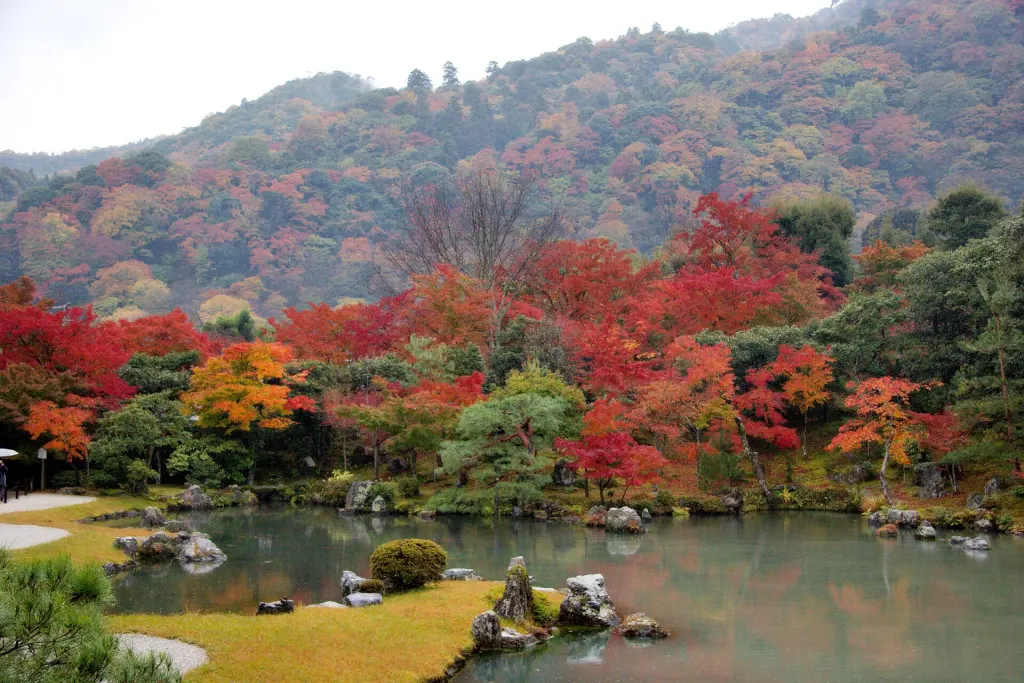
Image: KimonBerlin / Wikimedia Commons · CC BY-SA 2.0
Shakkei, usually translated as “borrowed scenery,” is a design method that incorporates a view beyond a garden's physical boundary into its composition. A distant mountain is the best-known subject, but neighboring trees, fields, water, buildings, or other landscape features can also be visually borrowed. Garden makers align viewpoints, plantings, stones, walls, and architectural openings so that foreground and external scenery read as one layered scene. The method does not transfer ownership of the landscape or simply describe any pleasant view. It depends on deliberate selection and framing. Shakkei has precedents in Chinese garden writing and a long history in Japan, yet its precise origins are uncertain. Its success also depends on continued pruning and protection of sightlines outside the garden itself.
Overview
| Japanese name | 借景 |
|---|---|
| Romanization | Shakkei |
| Common translation | Borrowed scenery |
| Classification | Landscape composition technique |
| Possible subjects | Mountains, forests, water, fields, trees, and buildings |
| Key mechanisms | Viewpoint, framing, layering, screening, and sightline control |
Name and boundary
The characters 借景 mean borrowing scenery. The borrowed feature remains physically outside the designed site but is made visually active within it. This distinguishes shakkei from constructing a miniature mountain or planting a backdrop entirely inside the garden.
Not every external view is shakkei. The term is most useful when evidence in the layout, architecture, planting, or historical record shows that a particular scene was intentionally incorporated.
Historical context
The idea has precedents in Chinese landscape and garden theory, including the seventeenth-century manual Yuanye. Earlier Japanese gardens also responded to surrounding terrain, so the practice developed before the modern term became a standard label in garden history.
Temple, residence, and strolling gardens used distant scenery in different ways. Japanese gardens at Tenryūji and Rokuonji are often cited as early examples, while early modern gardens made extensive use of mountains, rivers, and neighboring land.
Framing and layering
Foreground stones, shrubs, pond edges, and trees can lead the eye toward an external feature. Mid-ground planting hides roads or buildings that would interrupt the illusion, while gaps preserve the chosen line of sight. Color, scale, and atmospheric distance help join these layers.
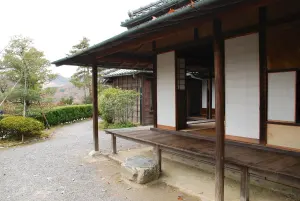
Frames may be architectural as well as botanical. Verandas, windows, gates, wall openings, and room bays establish a controlled viewpoint from which the borrowed scene becomes legible.
Distance and direction
Historical Chinese classifications distinguish distant, adjacent, upward, and downward borrowing. Japanese garden writing has used these categories to describe whether scenery lies far away, close to the boundary, above the viewer, or below a high viewpoint.
These terms help analyze spatial relationships, but a garden may combine several kinds at once. A nearby grove can screen the lower slope of a far mountain, while a raised path reveals both the garden pond and the horizon.
Architecture and viewpoint
Shakkei depends on where the viewer stands or sits. A view aligned from an engawa, reception room, or path may disappear only a few steps away. The technique therefore links landscape design with Japanese architecture.
In strolling gardens, successive viewpoints may borrow different scenes. In a viewing garden, one primary architectural position can dominate. Photographs often flatten these arrangements, so on-site movement is important for understanding them.
Well-known examples
Tenryūji's Sōgenchi garden incorporates Arashiyama and Kameyama beyond its pond and foreground rockwork. Entsūji is known for a carefully framed view of Mount Hiei, while Shugakuin Imperial Villa uses surrounding hills and agricultural land across a much larger composition.
Modern institutions also use shakkei. At the Adachi Museum of Art, designed foreground gardens visually merge with a waterfall and forested mountain beyond the grounds, demonstrating that the technique is not confined to premodern sites.
Maintenance and vulnerability
Borrowed scenery requires continuous pruning, replacement planting, and management of foreground screens. A single overgrown tree can close a sightline, while removing too much vegetation can expose unwanted roads or buildings. The technique is therefore maintained, not merely designed once.
Development outside the property creates a special conservation problem. New construction, utility infrastructure, and changing forest cover may damage the composition even when the garden itself is legally protected. Preserving shakkei can require cooperation beyond the garden boundary.
Sources
- Web Japan, Gardens Fact Sheet.
- Government of Japan, Japanese Gardens as Living Organisms.
- Japan National Tourism Organization, Japanese Gardens and Zen Gardens Around Japan.
- JAANUS, Shakkei.
- Bowdoin College, Japanese Gardens: Borrowed Scenery.
- Kyoto City Official Travel Guide, Tenryūji Temple.
- Nara National Research Institute for Cultural Properties, Heian Period Gardens.
Last updated:
.jpg)