Kendo
Nihon Kendō Kata
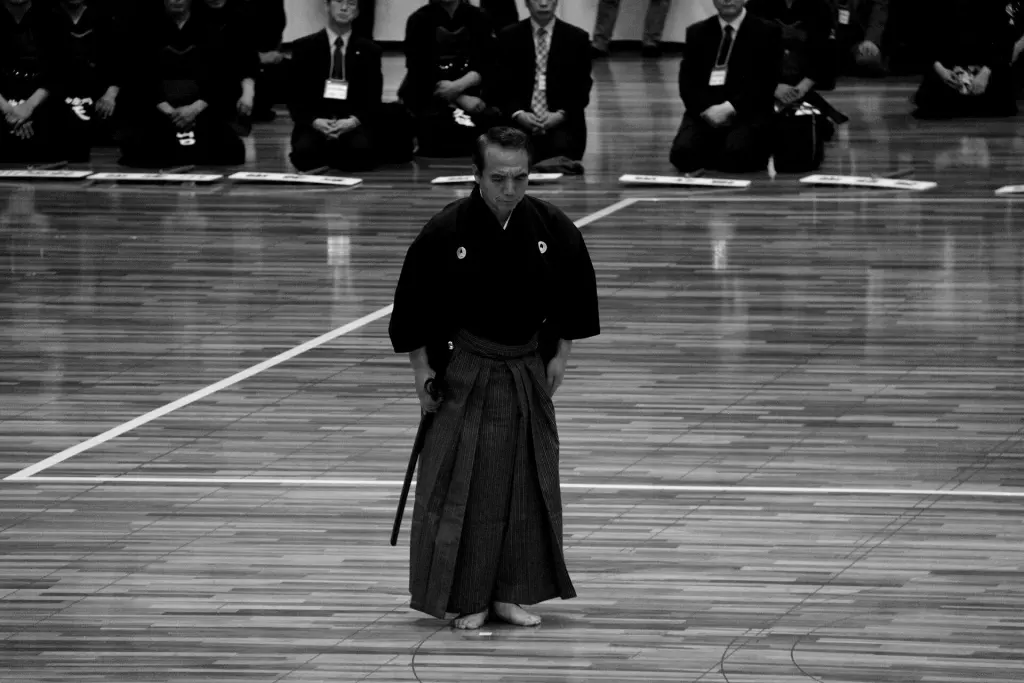
Image: peachykeen103 / Flickr via Wikimedia Commons · CC BY 2.0
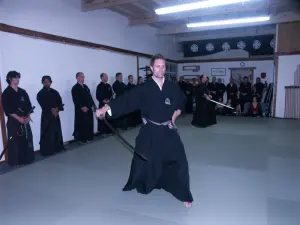
Nihon Kendō Kata (日本剣道形) is the standard paired-form system studied in Kendo. It contains ten prescribed encounters: seven tachi-no-kata using long swords and three kodachi-no-kata in which the responding practitioner uses a short sword. The system was established by the Dai Nippon Butoku Kai in 1912 as Dai Nippon Teikoku Kendō Kata and received its present name after the Second World War. It matters because modern shinai practice and competition do not by themselves preserve every principle of blade line, distance, initiative, role and formal movement that the kata isolates. Nihon Kendō Kata drew on several sword traditions, but it is a modern standardised curriculum rather than an unchanged kata set belonging to one classical school.
Overview
| Japanese | 日本剣道形 |
|---|---|
| Reading | にほんけんどうかた |
| Romanisation | Nihon Kendō Kata |
| Established | 1912 |
| Original name | Dai Nippon Teikoku Kendō Kata |
| Structure | Seven tachi forms and three kodachi forms |
| Organisation | All Japan Kendo Federation |
Name and meaning
Nihon means Japan, kendō means the way of the sword, and kata means a prescribed form. The official title writes kata as 形, emphasising formed practice rather than a tournament sequence.
The prewar title was Dai Nippon Teikoku Kendō Kata. The postwar name change did not create an entirely new ten-form system, although official wording and interpretation continued to be reviewed.
Origins and the 1912 system
The Dai Nippon Butoku Kai formed a committee in 1911 to create common forms suitable for a Kendo community still containing many lineages. The system was approved in October 1912 with seven long-sword and three short-sword forms.
Official summaries describe the forms as drawing on strong methods from different schools. Academic comparison of surviving drafts shows a process of proposal, debate and amendment, so it is safer to describe collective standardisation than to attribute every action to one founder or lineage.
Later revisions and the AJKF manual
Explanatory annotations were added in 1917 and expanded in 1933. After the war, the All Japan Kendo Federation adopted the name Nihon Kendō Kata and continued efforts to standardise explanation and teaching.
The AJKF issued its present explanatory manual in 1981. The manual is an institutional reference for sequence, terminology and teaching points; it does not erase documented historical differences in earlier texts or individual schools’ separate kata.
The ten forms
The first seven are tachi-no-kata. Both partners use long bokutō, and the forms present different guards, initiatives, lines and responses.
The final three are kodachi-no-kata. Uchidachi still uses the long sword, while shidachi uses a short bokutō. The division is by weapon and prescribed relationship, not by beginner and advanced “moves.”
Uchidachi and shidachi
Uchidachi initiates the decisive action and provides the teaching lead; shidachi responds according to the form. Their roles are relational and are practised on both sides over time.
Describing uchidachi simply as the loser and shidachi as the winner misses the instructional structure. Correct distance, timing and intention depend on both partners fulfilling their roles rather than competing to alter the outcome.
Weapons and safety
Nihon Kendō Kata is normally practised with bokutō: a long sword for both partners in the first seven forms and a short sword for shidachi in the final three. It is not performed in Bōgu.
Because wooden swords are rigid, prescribed control, spacing and supervision are essential. The kata should not be converted into unscripted contact or used as step-by-step instruction for striking a person.
What the kata studies
The forms organise kamae, maai, opportunity, blade path, posture, footwork and zanshin within a fixed relationship. AJKF examination materials emphasise smooth sliding footwork rather than the stamping step familiar from shinai competition.
The forms also retain guards that are uncommon in ordinary chūdan-centred sparring. This gives practitioners a structured way to study sword conventions that a modern match may not display.
Relationship to shinai practice
Kata and Shinai practice are complementary within institutional Kendo, but their tools and movement conditions differ. Kata is prescribed and uses rigid bokutō; shinai training permits responsive free exchange with protective equipment.
Claims that every competition technique directly reproduces one kata action are too strong. The connection lies in shared principles such as distance, opportunity, blade orientation, posture and readiness, interpreted through different training formats.
Grading and current use
Nihon Kendō Kata forms part of AJKF dan examination. Current implementation guidelines assign three tachi forms for first dan, five for second dan, seven for third dan, and all ten from fourth through eighth dan, with local representative bodies selecting the specified lower-dan forms.
Outside examinations, kata is practised in regular classes, seminars and public demonstrations. Its educational value depends on sustained paired study; memorising the order only for a grading does not exhaust the curriculum.
Relationship to classical sword schools
The 1912 committee included senior representatives associated with several sword traditions, and historians study how draft passages changed during compilation. Nihon Kendō Kata nevertheless belongs to modern institutional Kendo.
Classical kenjutsu schools preserve their own lineages, weapons, terminology and kata. Studying the standard Kendo forms does not establish transmission in those schools, and later claims of a single exclusive source should be treated cautiously.
Sources
- All Japan Kendo Federation, Nihon Kendo Kata Manual.
- All Japan Kendo Federation, What Is Nihon Kendo Kata?.
- All Japan Kendo Federation, Shogo and Dan Examination Implementation Guidelines.
- Minoru Ohya, The Origin and Interpretation of Nihon Kendo Kata, Research Journal of Budo.
- All Japan Kendo Federation, Looking Back on the Formation of Nihon Kendo Kata.
- National Diet Library Search, Study of the Learning Process through Kata in Kendo.
Last updated: