Kendo
Yūkō-datotsu
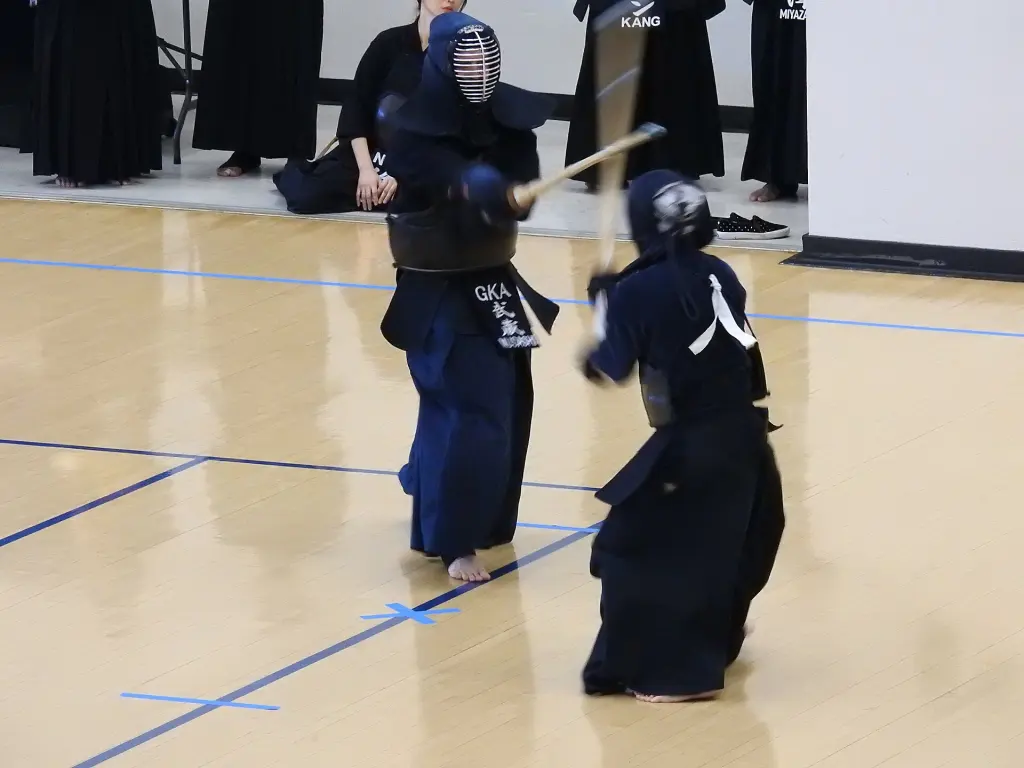
Image: Huntsmanleader / Wikimedia Commons · CC BY 4.0
Yūkō-datotsu (有効打突) is a valid scoring action in Kendo competition. The AJKF and FIK definition requires more than contact: the competitor must show full energetic commitment and proper posture, strike or thrust a recognised target with the permitted part of the Shinai in correct blade alignment, and retain zanshin, or continuing readiness. A valid action is awarded one ippon. Referees judge the action as a sequence that includes the approach, the instant of contact and the condition afterward, which distinguishes Kendo from systems based only on electronic contact or visible impact. The formal criteria are stable, but their interpretation is taught through federation guidance and applied by referees to the circumstances of each exchange.
Overview
| Japanese | 有効打突 |
|---|---|
| Reading | ゆうこうだとつ |
| Romanisation | yūkō-datotsu |
| Meaning | Valid strike or thrust |
| Martial art | Kendo |
| Competition value | One ippon |
| Official definition | AJKF and FIK Shiai and Shinpan Regulations, Article 12 |
Name and scope
Yūkō means valid or effective, while datotsu combines striking and thrusting. The term covers recognised men, kote and dō strikes as well as a valid tsuki thrust.
English “point” names the award, not the full technical judgement. An action may touch a target without becoming yūkō-datotsu, and a valid action can differ visually according to timing, technique and the exchange that produced it.
Official definition
Article 12 requires full kisei and correct posture; contact to a valid target with the permitted striking part of the shinai and correct hasuji; and zanshin after the action. These are connected requirements rather than a checklist detached from movement.
The AJKF operational guide asks referees to preserve the qualitative value of ippon while recognising that valid techniques are not mechanically identical. A light-looking action is not automatically invalid if its technical quality satisfies the criteria.
Kisei and proper posture
Kisei is energetic commitment or vigour expressed through the whole action. Vocalisation may be evidence of commitment, but volume alone does not satisfy the rule.
Proper posture concerns the competitor’s stable and effective bodily condition at the time of the action. It is assessed with footwork, balance and relation to the opponent, not as a frozen aesthetic pose.
Datotsu-bu and datotsu-bui
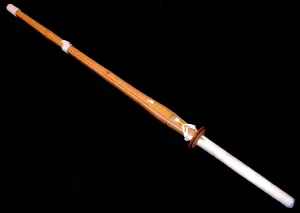
Datotsu-bu is the authorised striking portion of the shinai: the blade side opposite the cord, centred on the monouchi. Datotsu-bui is the authorised target area on the opponent’s Bōgu.
The two terms answer different questions—what part of the implement was used, and where it landed. Correct target contact with the wrong part of the shinai does not meet the definition.
Recognised targets
The rules list men-bu (front and right or left head targets), kote-bu (defined wrist or forearm targets), dō-bu (right and left torso targets) and tsuki-bu (the throat protector). Subsidiary rules define the boundaries more precisely.
Protected surfaces outside these regions are not scoring targets. Tsuki also carries particular training and age restrictions because an inaccurate thrust can create serious risk; its study belongs under qualified supervision.
Hasuji and quality of contact
Hasuji means alignment of the represented cutting edge with the direction of the strike. On a shinai, the cord indicates the back and the opposite side represents the blade.
Impact strength, te-no-uchi, body movement, opportunity and distance inform the overall judgement even where they are not separate nouns in Article 12. Neither a loud impact nor a large motion guarantees validity.
Zanshin
The AJKF operational guide explains zanshin as the mental and physical readiness remaining after a strike. Its outward form changes with the technique and the opponent’s response.
A point may be cancelled when the scorer lacks readiness for a counterattack or makes an excessive display claiming the point. The 2026 AJKF interpretation clarified the referee’s declaration sequence for such a cancellation; it did not replace the Article 12 definition.
How referees award ippon
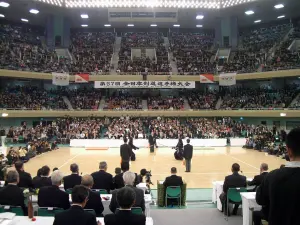
A standard referee group comprises a chief referee and two subsidiary referees. Under Article 26, a point is awarded when two or three signal yūkō-datotsu, or when one signals validity and the other two signal abstention.
Referees use red and white flags and must signal their own judgement promptly. Their task is interpretive but not unrestricted: decisions are governed by the regulations, shared training and conference procedures for doubt or error.
Training and competition
Basic drills teach the conditions of a valid action before contest tactics are added. Practitioners learn to connect posture, distance, opportunity, shinai path, body movement and continuing readiness rather than chase surface contact.
The competition definition does not define every valuable action in Kendo practice. Kata, corrective drills and ji-geiko may emphasise principles that are not scored, while Kendo Rules determine what receives ippon in a particular event.
Historical and interpretive context
Modern yūkō-datotsu emerged through the standardisation of armoured sword practice and refereeing. AJKF historical essays connect the modern idea of ippon with earlier attempts to distinguish decisive sword action from incidental contact.
Those institutional interpretations should not be rewritten as proof that a scored shinai strike equals a lethal sword cut. Yūkō-datotsu is a modern Kendo rule and teaching concept informed by sword principles.
Sources
- All Japan Kendo Federation, Safe and Effective Kendo Teaching in Junior High School, fourth edition.
- All Japan Kendo Federation, Sample Written Examination Questions and Answers for Kendo.
- International Kendo Federation, Regulations of Kendo Shiai and Shinpan, revised 26 July 2023.
- All Japan Kendo Federation, Regulations and Subsidiary Rules of Kendo Shiai and Shinpan.
- All Japan Kendo Federation, Kendo Shiai, Shinpan and Operational Guide.
- All Japan Kendo Federation, Interpretation and Application of the Shiai and Shinpan Regulations, April 2026.
- International Kendo Federation, Handbook for Kendo Shiai and Shinpan Management, 7 July 2025.
- All Japan Kendo Federation, Keywords for Considering Modern Kendo: Modern Kendo and Ippon.
- All Japan Kendo Federation, Risks of Improper Tsuki Technique, 26 February 2026.
- Characteristics of Competitors’ Gaze Behaviour in Judging Valid Strikes in Kendo, Japan Journal of Physical Education, Health and Sport Sciences.
Last updated: