Karate
Kumite
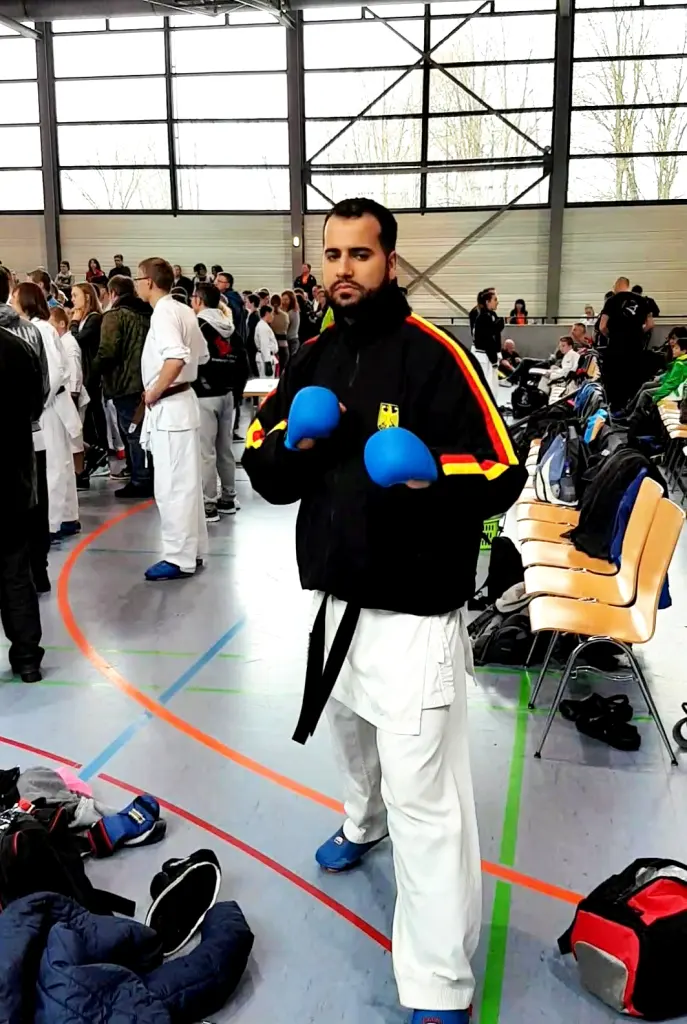
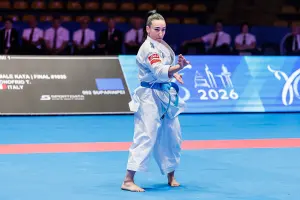
Image: Maria Schmidt84 / Wikimedia Commons · CC BY-SA 4.0
Overview
Kumite is the whole field of Karate partner practice—not a synonym for competition.
Kumite (組手) places Karate technique in relation to another person’s distance, timing, movement, initiative, and control. It ranges from agreed drills with specified attacks and responses through progressively freer exercises, open sparring, and rule-governed contests. The Japan Karate Association publishes a Shotokan progression from five- and three-step basics toward one-step and free kumite; the All Japan Karatedo Federation uses broader categories such as yakusoku-kumite, jiyū-kumite, and competition. Other traditions use different partner sets, protective equipment, targets, and contact conventions. No single progression defines all Karate.
Yakusoku-kumite
Attack, response, target, or number of steps is agreed.
One-step and semi-free forms
Fewer fixed variables increase decision-making.
Jiyū-kumite
Partners select movement and timing within dōjō limits.
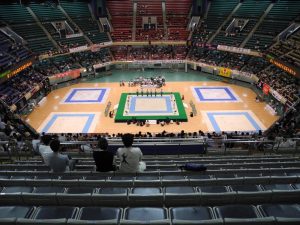
Competition
Targets, scores, contact, and stopping conditions are explicit.
- Japanese
- 組手 · engaging hands
- Scope
- Karate partner practice
- Prearranged
- Yakusoku-kumite
- Free practice
- Jiyū-kumite
- Key variables
- Maai · timing · initiative · control
- Competition
- One organisation-specific form of kumite
01Meaning & partner practice
A partner introduces information that solo repetition cannot reproduce.
The purpose is learning under relationship, not simply winning an exchange.
Join or engage
Two people enter a shared technical problem.
Hand
The compound names partner practice rather than one ruleset.
Distance · timing · response
Visual information, hesitation, pressure, and responsibility become real.
Kumite remains practice even when resistance increases. Partners share responsibility for safety, control, and a level of challenge appropriate to the exercise.
02Yakusoku-kumite
Agreement reduces uncertainty so one relationship can be studied clearly.
Prearrangement does not make the drill universal across styles.
Attack and target
A thrust, kick, level, number of steps, or role is specified in advance.
Distance and posture
Both partners can examine stepping, receiving, counter-timing, and recovery.
Less fixed response
Uncertainty grows only after roles, contact, and stopping conditions are understood.
Published basics may use oi-zuki or mae-geri as declared attacks, with responses such as jōdan age-uke, gedan-barai, or middle-level receiving actions. Exact stepping and follow-up belong to the named organisation.
03One documented progression
JKA Shotokan moves from repeated steps toward free choice.
This is an important organisational model, not the universal history of partner practice.
Gohon · sanbon
Repeated footwork, receiving, and counterattack inside a declared pattern.
Kihon-ippon
One announced action sharpens distance, posture, and response.
Jiyū-ippon
A freer approach connects announced attack to adaptive movement.
Jiyū-kumite
Partners choose action and timing within agreed training limits.
Other schools may use different step counts, continuous exchanges, formal paired kata, or kata applications as their primary prearranged practice.
04Maai, initiative & timing
Distance is physical separation plus the time and movement needed to act.
Partners learn to read and create the interval rather than measure one fixed gap.
Reach · angle · stance · footwork
The same separation changes when bodies, guards, and prepared techniques change.
Entry · hesitation · initiative · recovery
Prearranged practice reduces variables; free practice requires openings to be recognised or created.
Research on Karate learning describes this interval as an acquired skill. A technically recognisable strike still fails if distance, timing, balance, or recovery does not fit the exchange.
05Control & safety
Control is accurate placement plus responsibility for the partner.
It is more than making force look smaller.
Distance and target
Put the action where the exercise requires without exceeding the agreed boundary.
Stop or redirect
Speed and trajectory remain manageable when circumstances change.
Balance and recovery
Control includes posture before, during, and after the action.
Shared stop condition
Partners and instructors must be able to halt the exercise immediately.
Suitable space, protective equipment, targets, and contact depend on age, experience, health, school, and practice purpose.
06Competition kumite
Scoring rules create a specialised test inside the wider field.
Always identify the governing organisation and current edition.
Current JKF domestic scoring generally places hand techniques here.
Chūdan kicking techniques receive a different value.
Jōdan kicks and qualifying hand technique against a downed opponent receive the highest value.
The JKF changes effective 1 April 2026 and its July correction are dated domestic references. Age-specific facial-contact treatment differs from the corresponding WKF operation, while JKA and full-contact events maintain other criteria. See Karate Competition Rules for the current comparison.
07Different Karate traditions
One shared word contains materially different partner cultures.
These are broad tendencies; branches inside each named style also differ.
Step-to-free progression
Long-range entry and decisive timing are developed through a published sequence.
Body shifting and paired forms
Jujutsu-informed distance and formal encounters influence partner study.
Kata-linked close study
Some systems connect kumite closely to bunkai, control, and shorter distance.
Knockdown competition
Targets, contact assumptions, and winning criteria differ materially from point kumite.
Sources and further reading
- All Japan Karatedo Federation, Kumite.
- All Japan Karatedo Federation, Basic Rules of Karatedo.
- All Japan Karatedo Federation, 2026 Competition Rule Changes.
- All Japan Karatedo Federation, Summary of Rule Changes Effective 1 April 2026.
- Japan Karate Association, Instructor Technical Manual.
- Japan Karate Association, Techniques: Kihon, Kata and Kumite.
- Nishiyama and Suwa, Changes in Ma during Karate Kumite Learning, 2014.
- Research Journal of Budo, Egawa, Theoretical Consideration of Karate-dō: Basic Offensive Techniques and Kumite, 1975.
Last updated: