Karate
Tettsui-uchi

Image: Judcosta / Wikimedia Commons · CC BY-SA 3.0
Overview
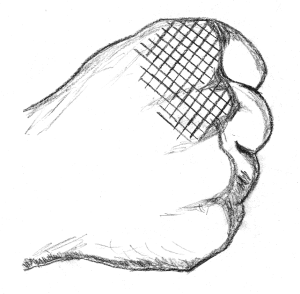
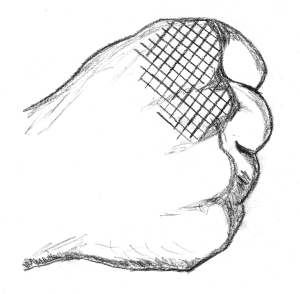
Tettsui-uchi uses the outer edge of a closed fist as a hammer-like surface.
Tettsui-uchi (鉄槌打ち) is a Karate hammer-fist strike using the little-finger-side outer edge of a closed fist rather than the first two knuckles associated with a seiken punch. The All Japan Karatedo Federation uses tettsui; English-language sources also show tetsui, while Japan Karate Association material uses kentsui and notes tetsui as another name. These spelling and naming differences do not automatically identify different mechanics. Direction, target, stance, elbow route, forearm orientation, and recovery belong to the named variation and drill. The stable reference is the hammer-fist contact region and its controlled whole-body delivery.
Organise the fingers and thumb as for a secure closed fist.
The wrist must carry a side-on impact line comfortably.
Downward, sideways, and other paths require their own context.
Do not sacrifice the hand, wrist, posture, or next action for force.
- Japanese
- 鉄槌打ち
- Reading
- てっついうち
- Reference meaning
- Hammer-fist strike
- Contact area
- Outer fist beside the little-finger ball
- Classification
- Uchi-waza · striking technique
- Source variants
- Tettsui · tetsui · kentsui
01Name & spelling
The “iron hammer” image describes the named fist surface and striking role.
Romanisation and curriculum vocabulary vary by source.
JKF uses tettsui, KUGB lists tetsui uchi, and JKA uses kentsui while recording tetsui as another name. Compare the described surface and route, not spelling alone.
02Hammer-fist contact surface
The outer fist edge—not the punching knuckles—carries the named action.
Wrist and forearm alignment change with the direction of travel.
Close the hand securely
JKF relates the fist formation to seiken while distinguishing the surface used for contact.
Use the little-finger side
The contact region lies beside the little-finger ball on the outer edge of the fist.
Support the impact line
Side-on loading requires comfortable alignment; a surface name is not a substitute for instruction.
03Path & target
Downward and sideways routes are examples, not a single universal endpoint.
Direction changes elbow route, forearm orientation, target angle, and recovery.
Establish posture and target line
Guard, chamber, stance, and the non-striking side follow the named exercise.
Bring the hammer-fist edge along the chosen path
The target must suit the surface and the direction being practised.
Keep the wrist, elbow, and balance usable
Control and continuation matter more than exaggerating a formal finish.
04Role & distinction
The surface can appear in striking or receiving relationships, so name the action being studied.
JKF examples of targets identify possible lines—not permission for uncontrolled contact.
Tettsui-uchi
The closed-fist outer edge travels to strike along a declared line.
Uraken-uchi
The fist is also closed, but contact comes from the index- and middle-knuckle region on its back side.
05Selected Uchi-waza family
Tettsui-uchi is identified by the hammer-fist edge within this four-surface map.
Contact region is the first comparison; path, target, and context come next.
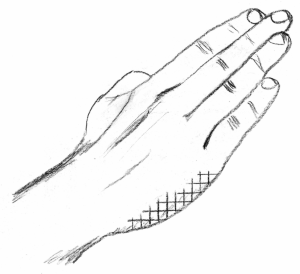
The little-finger side of an open hand supplies the named striking surface.
Closed fistUraken-uchi裏拳打ちBack-fist knucklesThe index- and middle-finger knuckle area is used from the back-fist side.
Closed fistTettsui-uchi鉄槌打ちHammer-fist edgeThe outer fist beside the little-finger ball creates the hammer-like surface.
Arm segmentEnpi-uchi猿臂打ちElbow regionThe elbow becomes the contact region, principally at close range.
06Kihon, kata & bunkai
Controlled repetition builds the surface before sequence and partner meaning are added.
Do not increase force faster than alignment and distance can support.
Stabilise fist, wrist, path, and return
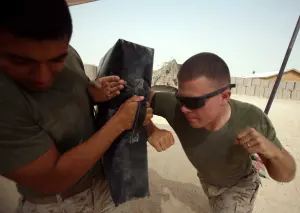
A suitable pad should match the hammer-fist surface and the intended route.
Read turns and adjacent actions
A formal hammer-like path preserves a sequence relationship but not one exclusive target.
Declare the partner task
Striking, clearing, releasing, or receiving interpretations belong to a named lineage and drill.
07Evidence, variation & competition
Research on punches cannot supply a universal hammer-fist impact value.
The available review is most useful for marking that evidence boundary.
Published studies concentrate on limited strike types
A systematic review did not establish one tettsui-uchi force, velocity, optimal mechanic, or safe threshold.
Spelling is only the first difference
Chamber, elbow route, fist tension, target, stance, and the point at which the wrist firms can also vary.
A traditional name does not guarantee a score
Legality, contact, target, and value follow the current rules of the responsible event and organisation.
Protect the hand and wrist
Use suitable targets, gradual progression, controlled partner contact, and qualified supervision around vulnerable areas.
Sources and further reading
Last updated: