Karate
Pinan Nidan
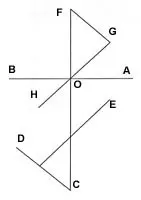
Image: ShotokanKarate / Wikimedia Commons · CC BY-SA 3.0 and GFDL 1.2 or later
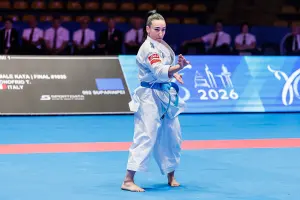
Pinan Nidan (ピンアン二段) is the second named form in the five-part Pinan family associated with Itosu Anko and later transmitted through several Karate schools. The All Japan Karatedo Federation places the five Pinan forms in its Wado-ryu Basic Kata group and publishes a Wado-ryu reference film for Nidan. That institutional placement does not make Pinan Nidan identical to Heian Nidan or to every Okinawan Pinan version. Names, numbering, sequence, stance, timing and application must remain attached to the school being discussed. This guide therefore centres the JKF Wado-ryu model, explains the wider Heian-Pinan relationship and avoids treating family resemblance as proof of one universal performance.
JKF official kata videos
Official reference
Use these federation reference films to compare named versions. Each video documents one JKF-published model for the named tradition; it does not define every dōjō or lineage.
Wadō-ryū和道流
Pinan Nidan
Karate Kihon Kata #4
JKF framework
Where this kata sits
Official competition placement and broader guide context are shown separately.Official JKF position
Basic kata
- Wadō
The JKF Basic Kata reference places the five Pinan forms in the Wadō-ryū column.
Guide context
Heian / Pinan
- Wadō
Heian and Pinan are historically related name families. Modern sequence, numbering and execution remain version-specific.
Overview
| Japanese label | ピンアン二段 |
|---|---|
| Reading | ピンアン にだん |
| Romanisation | Pinan Nidan |
| Series position | Second in the Pinan name sequence |
| Name family | Heian / Pinan |
| JKF position | Wado-ryu Basic Kata |
| Related guide | Heian Nidan |
| Version boundary | Pinan and Heian versions are not interchangeable |
Name and numbering
Nidan identifies the second form in this named Pinan sequence. The numeral is a curriculum label; it does not prove a universal order of difficulty, age or historical development.
The JKF terminology reference describes Heian and Pinan as a five-form family associated with Itosu Anko. Modern schools use related labels and sequences without sharing every technical detail.
The Itosu and Pinan context
The Pinan family is closely connected with Itosu's modern teaching work in Okinawa. The Okinawa Karate Information Center lists Pin-an Nidan among Shuri- and Tomari-lineage kata while warning that additional forms and versions also exist.
Kadekaru's research shows why modern kata should be studied through publications, group instruction and named institutions. A present performance is not a transparent copy of one untouched original.
The JKF Wado-ryu reference
The JKF Basic Kata announcement places Pinan Shodan through Godan in the Wado-ryu group. Its free-view catalogue and official film present Pinan Nidan under the Wado-ryu label.
This page uses that film as one federation teaching reference. It does not define every Wado-ryu association, dojo syllabus or historical Pinan transmission.
Relationship with Heian Nidan
Pinan and Heian are historically related names, but the same numeral does not guarantee the same order or sequence across curricula. A useful comparison starts with complete named versions rather than matching one familiar movement.
The Heian Nidan guide records separate Shotokan and Shito-ryu references. Keeping it apart from this Wado-ryu page makes the source of each technical claim visible.
How to read the structure
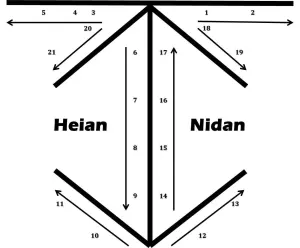
First trace direction, turns and stance changes. Then compare how the hands and feet settle together, where tempo changes and how the performer returns to a stable line.
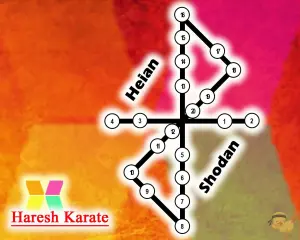
An embusen diagram can help with route memory but cannot show weight transfer, breath, contact surface or timing. Those details must be checked against the named technical model.
Bunkai and interpretation
Bunkai explores possible partner relationships within the solo pattern. Direction changes and paired hand actions may support several training interpretations when attack, range and resistance are stated.
A useful application is not automatically a documented original meaning. Name the teacher or lineage, control contact and distinguish practical exploration from a historical claim.
Curriculum and version variation
Pinan ordering can differ between organisations, and related Heian curricula may number comparable material differently. Rank placement, movement count and competition eligibility are therefore organisational facts, not part of the universal definition.
When two demonstrations differ, record the style, organisation, instructor and date before comparing stance, path or rhythm. This turns apparent contradiction into usable version information.
How to study it safely
Learn the route at a controlled pace with enough floor space for every turn. Keep the knees aligned, avoid forcing stance depth and build speed only after direction and posture are stable.
The official video is a comparison tool, not a substitute for instruction. Use short viewing passes, note the Wado-ryu label and take technical questions back to supervised practice.
Sources
- All Japan Karatedo Federation, Heian / Pinan.
- All Japan Karatedo Federation, Basic Kata textbook announcement.
- All Japan Karatedo Federation, free-view Basic and designated kata videos.
- Okinawa Karate Information Center, Kata of Okinawa karate and kobudo.
- Tooru Kadekaru, The origins of the modern kata in karate-do.
Last updated: