Manga
Mabataki yori Hayaku!!
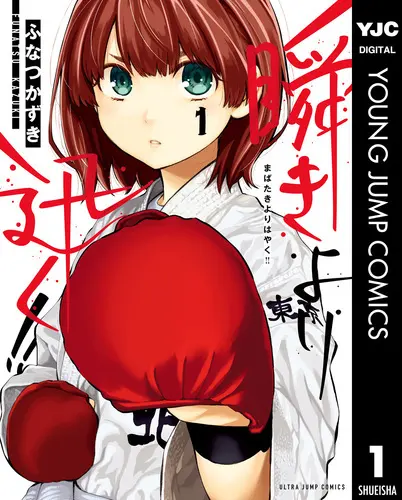
Image: Kazuki Funatsu; © Shueisha / Shueisha official book page · Copyrighted; limited low-resolution identification and critical commentary
Mabataki yori Hayaku!! (瞬きより迅く!!, “Faster than a Blink!!”) is a manga written and drawn by Kazuki Funatsu. It began in Shueisha’s Ultra Jump in 2020 and follows Himari Kohanai, a timid and accident-prone first-year high-school student whose encounter with an admired senior leads her into a girls’ traditional-karate club. The series uses both kumite and kata, team order, coaching, and Inter-High qualification to explain contemporary sport karate. Funatsu, who had practised karate, described the project as an attempt to make the rules and appeal of traditional competition understandable within a youth story. Twelve collected volumes had been published by April 2025. The work is sports fiction, not a guide to one named karate lineage.
Overview
| Japanese title | 瞬きより迅く!! |
|---|---|
| Romanization | Mabataki yori Hayaku!! |
| Creator | Kazuki Funatsu |
| Medium | Manga |
| Serialization | Ultra Jump, from 2020 |
| Collected volumes | 12 through April 2025 |
| Primary subject | Girls’ high-school traditional sport karate |
Title and publication
Shueisha published the first collected volume in June 2020 after the series began in the April 2020 issue of Ultra Jump. The official title uses the character 迅, emphasizing swiftness. Shueisha’s series catalogue lists twelve volumes through April 2025. Publication status should be checked against the publisher rather than inferred from the latest book alone.
Premise
Himari hopes to reinvent herself on entering high school but lacks confidence and coordination. Following a senior leads her to the karate club and a community whose discipline initially appears intimidating. Progress is incremental: accepting instruction, repeating basics, recognizing fear, and finding a role within the team matter before tournament success.
Traditional karate
The publisher describes the series as a traditional-karate manga. In this context, “traditional” distinguishes point-based sport forms connected with established karate practice from full-contact formats; it does not identify one specific school such as Shotokan, Gōjū-ryū, Shitō-ryū, or Wadō-ryū. Club and tournament rules provide the immediate framework.
Kumite and kata
Kumite scenes depend on distance, timing, speed, scoring technique, and the need to control contact. Kata presents a different visual problem: individual sequences must communicate rhythm, power, balance, and direction across static panels. Funatsu’s layouts use changes of scale and decisive moments to convert both forms into readable manga action.
Team structure
Although competition contains individual performances and bouts, the club is organized around shared practice and team events. Seniors, beginners, and rivals carry different technical strengths. The order of competitors makes a single bout part of a larger result, while interpersonal conflict affects whether practice knowledge can be transferred under pressure.
Inter-High narrative
The Inter-High qualifying structure gives the series a recognizable school-sport arc. Training camps and preliminary matches allow rules and techniques to be introduced through stakes rather than glossary alone. As with all sports manga, timing is compressed and dramatic emphasis is selective; real competition follows the current federation and event rules.
Author perspective
In an Ultra Jump interview, Funatsu explained that he wanted to create a youth work understandable to people who did not know kumite rules, drawing on several years of his own karate experience. He also discussed the difficulty of representing kata in comics. These comments clarify the series’ educational intention without making it an official federation account.
Place in karate manga
The series contributes a comparatively uncommon girls’ school-club view of contemporary traditional karate. It links technical explanation with a protagonist whose first challenge is social and emotional confidence. For historical lineage, organization, and terminology, it is best read beside factual pages on karate and its major styles.
Sources
Last updated: