Seasonal Customs
Kishiwada Danjiri Festival
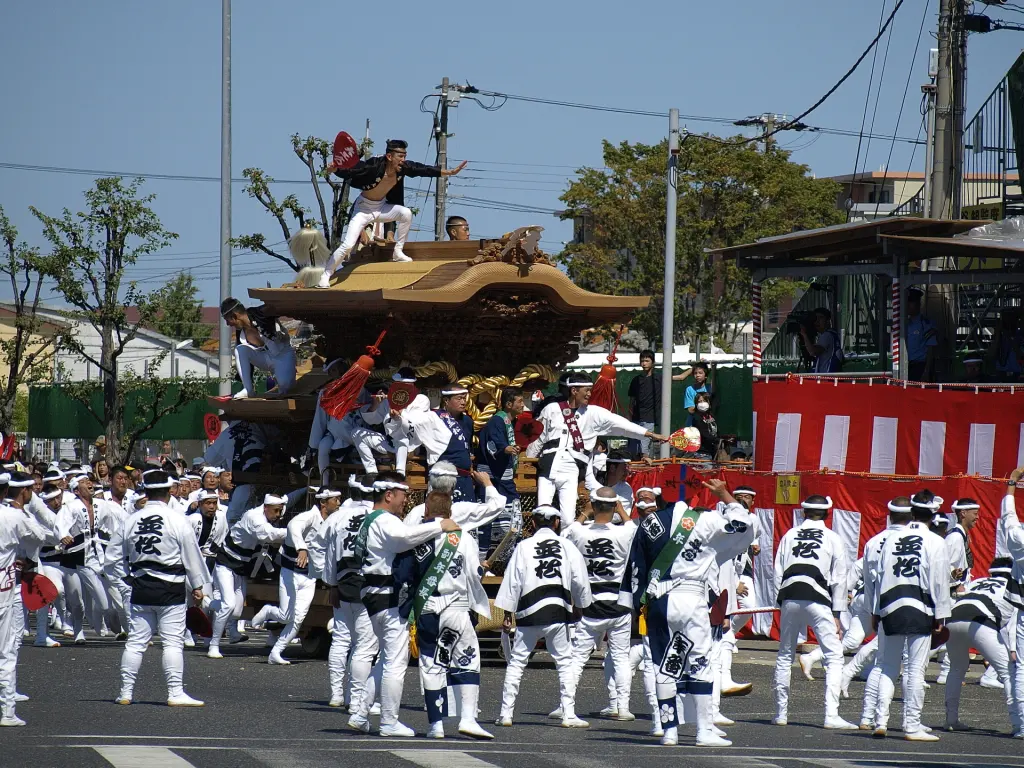
Image: Kounosu / Wikimedia Commons · CC BY-SA 3.0
The Kishiwada Danjiri Festival (岸和田だんじり祭) is a set of annual neighbourhood float processions in Kishiwada City, Osaka Prefecture. Teams pull large carved wooden danjiri through streets while musicians play inside and rooftop participants signal and perform. Its best-known action is yarimawashi, a rapid coordinated turn at a street corner. Kishiwada City traces the festival's origin to an Inari observance for an abundant harvest in 1703, but present floats, routes, organisations, and performance methods developed over later generations. The September and October festivals involve different districts and schedules; they are not one continuous citywide event. Speed is only one visible element of a larger ritual, craft, musical, neighbourhood, and safety system.
Overview
| Japanese | 岸和田だんじり祭 |
|---|---|
| Romanization | Kishiwada Danjiri Matsuri |
| Location | Kishiwada City, Osaka Prefecture |
| Classification | Urban neighbourhood float festival |
| Characteristic action | Yarimawashi, a fast coordinated cornering manoeuvre |
| Origin tradition | Kishiwada City connects the festival with an Inari harvest observance begun in 1703 |
| 2026 September festival | Trial pulls September 6 and 18; yoimiya September 19; honmiya September 20 |
| 2026 October festival | Trial pull October 4; yoimiya October 10; honmiya October 11 |
Name and scope
Danjiri is a regional name for a wheeled festival float. Danjiri festivals occur in several parts of western Japan, so the term does not identify Kishiwada alone. The Kishiwada festival is distinguished by its local float forms, routes, organisations, music, and highly visible running turns.
Kishiwada City contains several festival areas. The well-known September processions around Kishiwada and Haruki and the October processions in other districts use separate timetables and shrine relationships. A visitor should check the official district map rather than assume that every danjiri appears in one parade.
Origin tradition and historical development
The city presents 1703 as the festival's origin, when Kishiwada lord Okabe Nagayasu is said to have invited an Inari deity connected with Fushimi Inari and held a rite for abundant harvests. This tradition situates the festival within the castle town, domain authority, agriculture, and shrine worship.
An origin date should not imply that the modern spectacle appeared fully formed. Float construction, carving programmes, wheeled movement, town participation, clothing, roads, crowd control, and the organisation of pulling changed over three centuries. The festival is a living historical system rather than a fixed survival from one year.
Danjiri craft, music, and display
Kishiwada danjiri are substantial wooden vehicles covered with dense carvings. Historical and legendary scenes, animals, plants, warriors, and ornamental patterns turn the float into a moving work of architecture and craft. Maintenance requires specialist knowledge of timber, wheels, ropes, fittings, carving, repair, and storage.
Musicians inside the float play drums, flute, and metal percussion to coordinate atmosphere and movement. During evening procession, lanterns transform the appearance and pace of the danjiri. Daytime running and night display are therefore related but distinct modes of performance.
Yarimawashi
Yarimawashi is the rapid turning of a danjiri at a corner without bringing the procession to an ordinary walking stop. Pullers, front and rear controllers, rooftop signalers, and musicians must coordinate timing and force. A sociological study describes floats of roughly three to four tonnes and treats a successful turn as the product of both technique and group solidarity.
It is misleading to call the festival simply a race. Town teams do not compete on a standard track for one official fastest time. Speed and precision attract attention, but the turn belongs to a scheduled procession governed by routes, local responsibilities, shrine observance, and safety controls.
Neighbourhood organisations and roles
Participation is organised through neighbourhood groups rather than an anonymous mass of runners. Research distinguishes chōnai organisations that field and support each town's float from coordinating bodies that manage the festival across towns. Age, experience, training, and previous responsibilities influence who performs particular roles.
Children, young people, adult pullers, musicians, controllers, craftspeople, administrators, and senior advisers can all take part in different ways. This distribution of work helps transmit routes, signals, music, repair knowledge, and local relationships from year to year, while also creating debates about inclusion, burden, and change.
September and October festival cycles
Official schedules distinguish trial pulls from yoimiya, the festival eve, and honmiya, the main day. Trial pulls test movement, coordination, and route arrangements under controlled schedules. Yoimiya and honmiya include different procession periods, shrine entries, ceremonies, and evening activity according to district.
The September festival covers the best-known coastal and central areas, while October schedules apply to other Kishiwada districts. Dates can change each year. The official city page and current route notices are the appropriate sources for travel planning, closures, and viewing restrictions.
Ritual, community, and tourism
The festival joins harvest-prayer traditions and shrine relationships with neighbourhood identity. Preparation occupies much more than the public procession: organisations raise funds, maintain floats, teach music and movement, negotiate routes, and coordinate with authorities and residents.
Large audiences and media coverage also make the festival a tourism event. Tourism does not erase local religious and social meanings, but it changes crowd management, commercial activity, and the way selected scenes are presented. The spectacular corner turn should be read alongside the less visible labour that makes it possible.
Safety and responsible viewing
Heavy moving floats, taut ropes, running teams, narrow streets, and dense crowds create serious risks. Spectators must remain behind barriers, follow police and steward instructions, keep intersections and emergency routes clear, and avoid stepping into the course for photographs. Rooftops, ladders, and private property are not informal viewing platforms.
The procession schedule can produce road closures and crowded stations. Weather, heat, and last-minute operational decisions may alter access. Official city maps and notices take priority over undated travel guides, and the safest viewpoint is not necessarily the closest one.
The 2026 schedule
Kishiwada City lists September trial pulls on September 6 and 18 from 14:00 to 16:00, yoimiya on September 19, and honmiya on September 20. The October cycle lists a trial pull on October 4, yoimiya on October 10, and honmiya on October 11.
These dates were checked on September 9, 2026. District parade orders, shrine-entry orders, course maps, opening times, traffic restrictions, and cancellations are more detailed and can change, so they should be confirmed on the official festival page before attendance.
Sources
Last updated: