Judo
Judo in Manga and Anime
Image: Maplestrip / Wikimedia Commons · CC BY 3.0
Judo in manga and anime is a branch of Japanese popular culture that translates dojo practice, school-club life and competition into sequential art and screen drama. Its history extends from postwar boys’ manga and the spectacular special-move culture of Jūdō Icchokusen to the women’s Judo boom surrounding YAWARA!, the club realism of Jūdōbu Monogatari and Obi o Gyutto Ne!, and contemporary works such as JJM and Mō Ippon!. These works matter not because fiction records Judo exactly, but because it shapes how readers understand technique, discipline, gender and school sport. This article maps that history and its representational patterns; it is not a ranked “best Judo manga” guide.
Overview
| Japanese | 柔道漫画とアニメ |
|---|---|
| Reading | じゅうどうまんがとアニメ |
| Romanisation | jūdō manga to anime |
| Classification | Japanese popular culture and martial-arts media |
| Primary martial art | Judo |
| Main settings | Dojo, school clubs, domestic competition and international competition |
| Historical span | Postwar manga to the present |
How Judo entered Japanese popular culture
Popular Judo narrative predates the major manga series. Tsuneo Tomita’s 1942 novel Sugata Sanshirō and Akira Kurosawa’s 1943 film adaptation established a durable story of early modern Judo, personal formation and rivalry, though their history is dramatized rather than documentary.
Postwar children’s publishing made martial-arts heroes serial and visual. Research in the Research Journal of Budo identifies Igaguri-kun (1952–54) and later Judo narratives as important stages in the connection between budo, manga, television and commercial media.
Judo manga before YAWARA!
Jūdō Icchokusen, created by Ikki Kajiwara and Shinji Nagashima and serialized from 1967 to 1971, became a defining hot-blooded sports story. A National Diet Library record for its 1969 seventh volume documents its contemporary publication by Shōnen Gahōsha.
The series combines recognisable Judo culture with spectacular invented techniques and heightened rivalry. Its importance lies in the postwar spokon—sports perseverance—tradition and media circulation, not in serving as a technical manual.
YAWARA!
Naoki Urasawa’s YAWARA! ran from 1986 to 1993 and follows a gifted young woman whose ordinary ambitions conflict with the competitive career planned for her. Shogakukan presents the complete digital edition in 29 volumes; VAP’s anime archive documents a 124-episode television adaptation broadcast from 1989.
Scholarly discussion places the work at a turning point in women’s Judo representation. It retains training and competition structures but departs from a simple male perseverance narrative by making social expectation, media attention and the protagonist’s reluctance central.
Jūdōbu Monogatari
Makoto Kobayashi’s Jūdōbu Monogatari was serialized in Kodansha’s Young Magazine and completed in eleven volumes, with the final volume first published in August 1991. Its focus is the formation of a male high-school judoka inside a demanding club structure.
The work is often associated with detailed training, hierarchy and competitive development. Its comedy does not remove the physical and social pressure of the club; instead, those features become part of its account of how a novice is absorbed into a strong team.
Obi o Gyutto Ne!
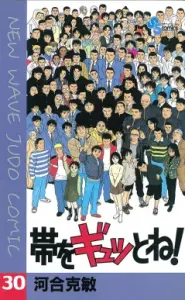
Katsutoshi Kawai’s Obi o Gyutto Ne! ran in Weekly Shōnen Sunday from the combined 1989 issue 1–2 to the 1995 issue 52 and was collected in 30 volumes. Five young black belts establish a Judo club at their high school, making team-building as important as any single protagonist.
Its early slapstick tone develops into sustained competition without abandoning ensemble school life. The series is useful for comparing individual technique, weight-class events and team orders with the institutional labour required to create and maintain a school club.
Mō Ippon!
Yū Muraoka’s Mō Ippon! is a contemporary girls’ high-school Judo series completed in 30 volumes by Akita Shoten in August 2024. A television anime began in January 2023, and the anime’s official site published collaborative material with the All Japan Judo Federation.
The work centres the continuity of club participation, friendship and ordinary tournament preparation rather than an invincible prodigy. Its contemporary setting also allows equipment, coaching and women’s school competition to appear as established parts of Judo culture.
JJM
JJM: Joshi Jūdōbu Monogatari credits Olympic champion Yūko Emoto with the original story and Makoto Kobayashi with manga structure and art. Kodansha’s fifteenth volume, published in 2023, completes its high-school phase.
The series reworks experience associated with Emoto into a women’s club narrative. It should not be treated as a literal autobiography: published fiction selects, combines and dramatizes events even when a named athlete contributes the underlying account.
Women’s Judo in manga
Women’s Judo is not represented by one continuous model. YAWARA! links elite ability to family, romance and mass-media scrutiny; JJM uses an Olympian’s perspective on a school career; Mō Ippon! follows a contemporary team and the appeal of continuing to practise.
These stories appeared across different stages of women’s competitive Judo. They can illuminate changing visibility, but a manga’s popularity should not be used alone to prove a direct change in participation or policy.
School club culture
Many Judo manga use the jūdōbu, or school Judo club, as their social unit. Recruitment, senior–junior relations, teacher advisers, shared practice, club rooms and team selection give the story a structure beyond individual matches.
Fiction compresses seasons and intensifies rivalry, yet the emphasis on collective maintenance is recognisably tied to Japanese extracurricular sport. Jūdōbu Monogatari, Obi o Gyutto Ne!, JJM and Mō Ippon! each assign different weight to hierarchy, friendship and institutional continuity.
Competition and technique
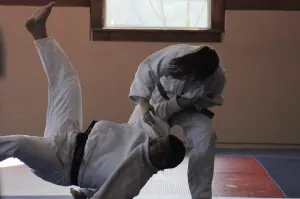
Named throws, holds, belt grades, weight categories, team order and school tournaments give Judo fiction technical specificity. Close visual framing and internal monologue can make balance changes legible to readers who would not recognise them in live action.
Competition rules vary by period. A scene written under older scoring, gripping or penalty rules should not be read as a statement of current Judo Rules, and Kodokan classification remains distinct from any one contest cycle.
Realism versus dramatization
Technical names and institutional detail can be accurate while narrative rhythm remains stylized. Internal thought is slowed, decisive contests recur, and injuries or recovery may serve dramatic pacing. Earlier special-move stories such as Jūdō Icchokusen make this stylization overt.
Later observational works often ground their action more closely in club routine and recognisable technique, but they remain authored narratives. Realism is therefore best evaluated element by element—rules, mechanics, institutions and character development—rather than assigned to an entire title.
Where to start
A historical reading can begin with Jūdō Icchokusen for postwar special-move sports culture, then YAWARA! for the interaction of women’s Judo and mass media. Jūdōbu Monogatari and Obi o Gyutto Ne! provide contrasting late-Shōwa and early-Heisei school-club perspectives.
For contemporary women’s high-school Judo, JJM and Mō Ippon! offer different relationships to athlete experience and ensemble life. These are routes through the field, not a ranking of quality.
Sources
- Shun Inoue, Budo and Popular Culture, Research Journal of Budo 50(3), 2018.
- Andreas Niehaus, Popularizing Judo through Manga, 2017.
- National Diet Library, Judo Icchokusen, Volume 7.
- Shogakukan, YAWARA! Digital Edition.
- VAP, YAWARA! Anime Official Archive.
- Kodansha, Judo-bu Monogatari, Volume 11.
- Shogakukan, Obi o Gyutto Ne! Official Series Page.
- Akita Shoten, Mo Ippon! Series Page.
- Mo Ippon! Anime Official Website.
- Kodansha, JJM: Joshi Judobu Monogatari, Volume 15.
Last updated: