Karate
Jion
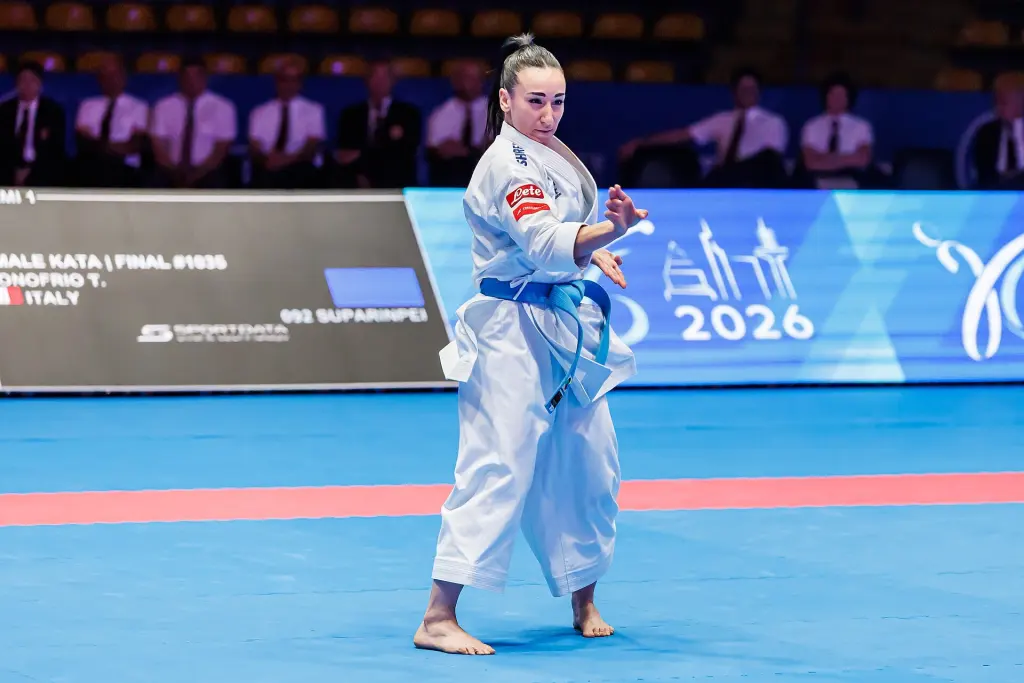
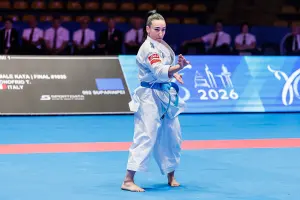
Image: Steffen Prossdorf / Wikimedia Commons · CC BY-SA 4.0
Jion (ジオン) is a Karate kata transmitted in Shuri-lineage and mainland systems, with especially clear modern documentation in Shotokan organisations. The All Japan Karatedo Federation records the written forms 慈恩 and 慈音 and describes turning, rotation and yoriashi as characteristic study points. In its dated competition framework, Jion appears in the Shotokan first designated pair with Kanku Dai. That placement is a federation reference, not proof of a single origin, translation or universal sequence. The Japan Karate Association also includes Jion in its published kata series. This guide keeps official competition placement, broader transmission and dojo-specific execution separate so that readers can compare evidence without collapsing related versions.
JKF official kata videos
Official reference
Use these federation reference films to compare named versions. Each video documents one JKF-published model for the named tradition; it does not define every dōjō or lineage.
Shōtōkan-ryū松濤館流
Jion
Dai-ichi Shitei Kata #2
JKF framework
Where this kata sits
Official competition placement and broader guide context are shown separately.Official JKF position
First designated kata
- Shōtōkan
The dated JKF amendment places Jion in the Shōtōkan-ryū first designated pair.
Guide context
Jion
- Shōtōkan
The guide centres the official Shōtōkan-ryū model while keeping broader Shuri-lineage transmission and other versions distinct.
Overview
| Japanese labels | ジオン; 慈恩 / 慈音 |
|---|---|
| Reading | ジオン |
| Romanisation | Jion |
| Classification | Karate kata |
| Lineage context | Shuri-lineage transmission |
| JKF position | Shotokan first designated kata in the dated framework |
| Paired reference | Kanku Dai |
| Name boundary | The sources do not establish one uncontested literal derivation |
Name and written forms
The JKF terminology dictionary records Jion with the written forms 慈恩 and 慈音. Those variants are evidence for modern notation, but they do not by themselves settle the kata's origin or one literal English translation.
Popular temple stories and etymologies should therefore be labelled as interpretations unless supported by a named historical source. The stable reference point is the kata name used by the organisation being discussed.
Transmission and modern documentation
The JKF places Jion among forms connected with Shuri-te transmission, and the Okinawa Karate Information Center lists Jion in its Shuri- and Tomari-lineage group. Neither list proves one unchanged route from an original creator.
Modern publication and institutional teaching helped stabilise particular kata versions. Kadekaru's research supports reading a present sequence through named teachers, texts and organisations rather than resemblance alone.
The JKF first designated position
The JKF amendment effective in 2013 places Jion and Kanku Dai in the Shotokan first designated pair. The federation's 2023 teaching project again included Jion among eight first designated kata.
This is a dated competition and instruction framework. Current eligibility and judging rules must be checked for the event concerned, and the category should not be mistaken for ownership of the kata by one lineage.
Turning, rotation and yoriashi
The JKF highlights changes of direction, body rotation and yoriashi as important features. These cues help the viewer study how posture and technique are carried through transitions rather than treating the kata as a row of final positions.
The official film also provides a named Shotokan model for rhythm and hand-foot coordination. It is a reference performance, not a substitute for an instructor's correction of timing, distance or stance.
Basic technique and rhythm
Jion is often used to expose the quality of foundational stances, receiving actions and punches because familiar techniques must remain connected through many directional changes. Visible power should not be separated from balance and recovery.
Slow and quick passages, pauses and simultaneous hand-foot arrival depend on the named technical model. Counting or tempo from another school should not be imported without evidence.
Shotokan and other versions
The JKA publishes Jion within its Shotokan kata book series, while related Jion versions also appear outside the JKA. Shared names can coexist with differences in stance, sequence, emphasis and application.
A responsible comparison labels the organisation and date of each source. It avoids calling one difference an error until the standard for that performance is known.
Bunkai and interpretation
Bunkai examines how turns, paired hand positions and repeated techniques may relate to a partner. Any exercise should state the assumed attack, range and level of resistance.
Several practical explanations may fit one visible movement. A useful drill is not automatically the kata's single historical meaning, so application and origin claims should remain separate.
How to study it safely
Map the directions first, then add stance depth, rotation and speed progressively. Keep the knees aligned through turns and use enough space to complete every line without collision.
Partner applications should be supervised and controlled. For grading or competition, use the current requirements of the named organisation rather than a count or performance borrowed from another version.
Sources
- All Japan Karatedo Federation, Jion.
- All Japan Karatedo Federation, 2013 competition-regulation amendment.
- All Japan Karatedo Federation, first designated kata tutorial list.
- Japan Karate Association, KARATE-DO KATA books.
- Okinawa Karate Information Center, Kata of Okinawa karate and kobudo.
- Tooru Kadekaru, The origins of the modern kata in karate-do.
Last updated: