Social Customs
Geta
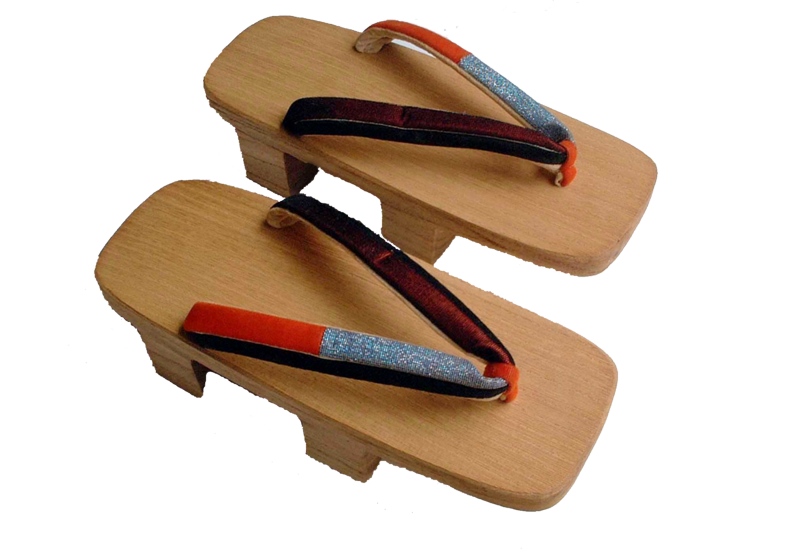
Image: Haragayato / Wikimedia Commons · Creative Commons Attribution-ShareAlike 3.0
Geta (下駄) are Japanese wooden footwear consisting of a foot platform, a thong called hanao, and a raised underside. The familiar form has two supports or “teeth” (ha), but regional, occupational, rain, festival, and fashion types differ in height and construction. Raised wooden footwear helped keep feet above mud, water, and street surfaces, and picture scrolls and archaeological finds document a long history. Mechanised production expanded availability in the modern period, while Western shoes displaced geta from most everyday use after the Second World War. Today they are especially visible with yukata, at festivals, in traditional performance, and in specialised work or fashion. Geta are not the same as flat zōri or tied straw waraji, even though all may use a thong between the first two toes.
Overview
| Japanese name | 下駄 |
|---|---|
| Classification | Raised wooden footwear |
| Upper fastening | Hanao thong |
| Common underside | Two wooden teeth, with many variations |
| Historical uses | Everyday wear, rain, work, travel, and fashion |
| Modern associations | Yukata, festivals, performance, and craft |
Basic structure
A typical geta has a wooden top board called the dai, two supports beneath it, and a fabric thong threaded through three holes. The thong passes between the big and second toes and anchors at both sides. Some forms are carved from one block; others attach the supports. Shape, toe angle, wood, finish, height, and thong padding vary.
Origins and development
Board-like foot supports were used in wet rice agriculture to prevent sinking, but agricultural ta-geta were tools rather than direct equivalents of every later clog. Raised footwear appears in ancient and medieval evidence. By the Edo period, improved woodworking and urban manufacture supported many fashionable and practical forms, from plain daily geta to lacquered and specialised designs.
Forms and uses
Two-toothed komageta represent the familiar silhouette. Rain geta may be high, lacquered, or fitted with toe covers; garden forms prioritise easy removal; single-tooth tengu geta are associated with mountain imagery and training; high pokkuri or okobo belong to particular ceremonial and entertainment contexts. These names and details vary locally and should not be collapsed into one standard pair.
Yukata, festivals, and performance
Geta are widely paired with casual yukata at summer festivals and Obon dance. Performers may choose footwear for sound, silhouette, costume, or choreography. The audible clack of wooden supports is culturally familiar, but not every event requires geta and comfort, accessibility, weather, and crowd safety are valid reasons to choose other footwear.
Walking, fit, and tabi
The foot is held by the hanao rather than enclosed like a shoe. The heel may sit near or slightly beyond the platform depending on type and fitting. Short steps reduce strain and keep the garment controlled. Geta may be worn barefoot with yukata, while tabi can accompany other ensembles. New thongs require careful adjustment to avoid rubbing.
Geta, zōri, and waraji
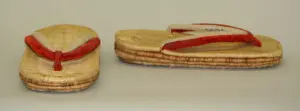
Geta are defined chiefly by a wooden raised base. Zōri have a relatively flat flexible sole made historically from plant fibres and now from many materials. Waraji are woven straw sandals secured with long cords around the foot and ankle. English “clog,” “flip-flop,” and “sandal” are useful approximations but do not reproduce these Japanese classifications.
Modern decline and revival
Mass production peaked before Western shoes became dominant in postwar daily life. Geta manufacture survives through specialist workshops, regional industries, festival demand, tourism, health products, design collaborations, and renewed interest in kimono. Modern rubber soles and padded thongs may reduce noise or improve grip without eliminating the basic wooden structure.
Care, safety, and misconceptions
Wood should be kept reasonably dry, and worn thongs or cracked supports need repair. High or single-tooth forms require experience and are not ordinary beginner footwear. Geta are neither geisha-only objects nor universal “traditional Japanese shoes.” Their history includes farmers, townspeople, workers, children, performers, and consumers using different designs for different surfaces and social settings.
Sources
Last updated: