
De-ashi-harai
出足払であしはらい
Advancing foot sweep
- Ashi-waza
- Gokyō: Dai-ikkyō
Key idea
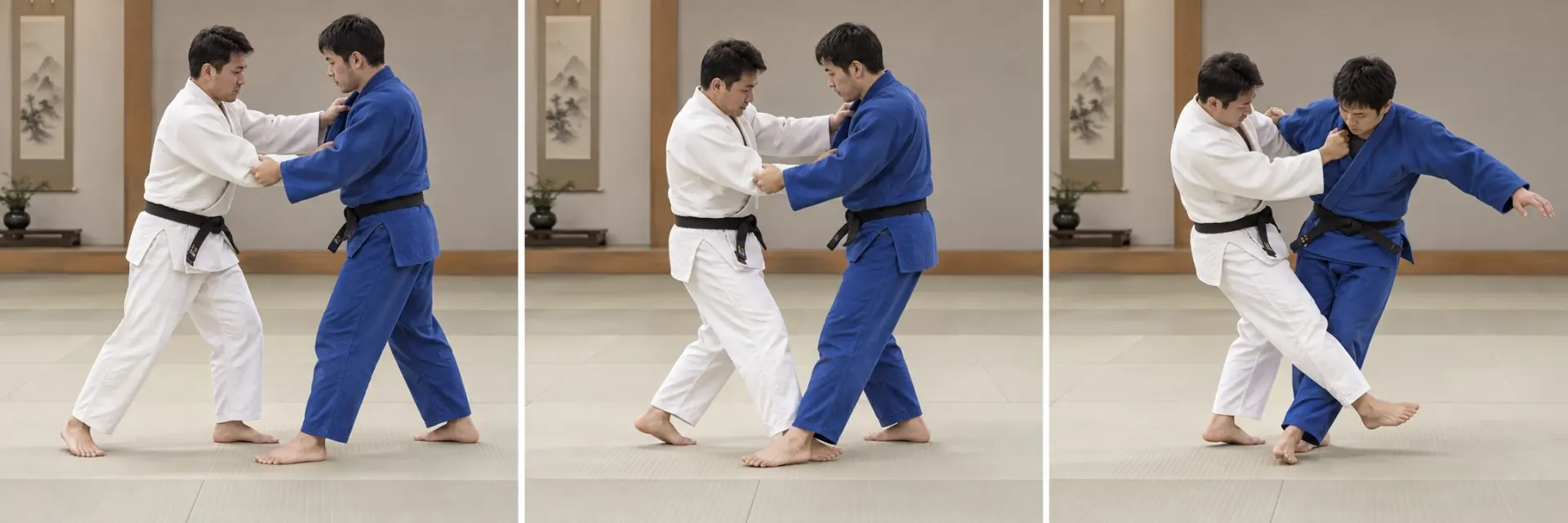
The defining action uses a short interval in the opponent’s step: the moving foot has reached or is nearing the tatami, but the opponent has not yet established a stable base.
Kodokan official demonstration
Kodokan technique list (opens in a new tab)YouTube (opens in a new tab)
VISUAL GUIDE
How to read the movement
De-ashi-harai uses a short interval in the opponent’s step: the moving foot has reached or is nearing the tatami, but the opponent has not yet established a stable base.
- Tori
- the person applying the technique
- Uke
- the person receiving the technique
- Red line
- main direction or point of contact
AT A GLANCE
Classification representative
IN SEQUENCE
Three basic phases
- 1Create the imbalance
- 2Enter with control
- 3Complete the action
Original AI-generated educational illustration for TokyoWaltz, 2026. A simplified three-stage concept; practise under qualified instruction.
PLAY WHEN NEEDED
Watch the basic movement slowly
- 1Starting pointCreate the imbalance
- 2Decisive actionEnter with control
- 3CompletionComplete the action
1 / 3Starting point— Create the imbalance
Follow the red line and phase indicator. The guide does not autoplay or loop.
How it works
De-ashi-harai uses a short interval in the opponent’s step: the moving foot has reached or is nearing the tatami, but the opponent has not yet established a stable base.
Kuzushi
Create the imbalance
Kuzushi follows the opponent’s travel and prevents the upper body from recovering over a secure base. It may be directed laterally, diagonally, or along the line of the step according to stance and movement.
Tsukuri
Enter with control
Tsukuri positions the thrower close enough to sweep without overreaching while maintaining upright, mobile posture. The supporting foot and hips travel with the opponent so the sweeping leg can remain relaxed and accurately placed.
Kake
Complete the action
Kake joins the foot sweep to the hand-and-body action. The sweeping foot travels through the opponent’s advancing foot while the hands guide the torso away from the new support.
Key points
- Kuzushi follows the opponent’s travel and prevents the upper body from recovering over a secure base. It may be directed laterally, diagonally, or along the line of the step according…
- Tsukuri positions the thrower close enough to sweep without overreaching while maintaining upright, mobile posture. The supporting foot and hips travel with the opponent so the sweeping leg can remain…
- Kake joins the foot sweep to the hand-and-body action. The sweeping foot travels through the opponent’s advancing foot while the hands guide the torso away from the new support.
Similar techniques
| Technique | Japanese name | Key difference |
|---|---|---|
| Okuri-ashi-harai | 送足払 | Okuri-ashi-harai moves uke laterally until the feet approach one another,; De-ashi-harai uses a short interval in the opponent’s step: the moving foot has reached or is nearing the tatami, but the opponent has not yet. |
| Harai-tsurikomi-ashi | 払釣込足 | Harai-tsurikomi-ashi lifts uke forward and sweeps the ankle from the front with the foot; De-ashi-harai uses a short interval in the opponent’s step: the moving foot has reached or is nearing the tatami, but the opponent has not yet. |
| Sasae-tsurikomi-ashi | 支釣込足 | Sasae-tsurikomi-ashi blocks near the ankle while the hands lift and turn uke forward around the supporting foot; De-ashi-harai uses a short interval in the opponent’s step: the moving foot has reached or is nearing the tatami, but the opponent has not yet. |
Reference
Open the detailed source material when you need definitions, technical distinctions, training context, or references.
Official definition
Official definition
In the Kodokan definition, the opponent advances a foot and begins to place weight on it. The thrower sweeps that foot and directs the upper body so the opponent is thrown. The representative form describes a right-foot advance swept by the thrower’s left foot, but the technique can be performed on either side.
The definition identifies timing and direction rather than one compulsory grip. Sleeve-and-lapel control is a standard teaching form, while other legal grips can preserve the same principal action.
Technical principle
De-ashi-harai uses a short interval in the opponent’s step: the moving foot has reached or is nearing the tatami, but the opponent has not yet established a stable base. The sweep and upper-body guidance act together across that moment.
A successful action does not rely on kicking a firmly planted leg. It redirects a moving support before weight, posture, and recovery step have settled.
Name and classification
Overview
| Japanese | 出足払 |
|---|---|
| Reading | であしはらい |
| Romanisation | de-ashi-harai; search forms: de ashi barai, deashi harai |
| Meaning | Advancing foot sweep |
| Martial art | Judo |
| Official classification | Kodokan ashi-waza |
| Gokyō no Waza | Dai-ikkyō |
Name and spelling
The name is written 出足払. De-ashi indicates a foot that is coming or stepping forward, while harai means a sweeping action. The meaning points to the movement being intercepted, not simply to the part of the body contacted.
The Kodokan uses De-ashi-harai. “De ashi barai” reflects a common English rendering with the voiced sound barai, and “deashi harai” omits the first hyphen. Both are useful search spellings, but they are not the official Kodokan romanisation used in this entry.
Kodokan classification
The Kodokan classifies de-ashi-harai as ashi-waza, one of the standing branches of nage-waza. The decisive action is the coordinated sweep of the advancing foot, supported by the hands and movement of the whole body.
It is one of the 40 throws in the Gokyō no Waza and appears in Dai-ikkyō. It is not one of the three ashi-waza selected for Nage-no-kata; that set contains okuri-ashi-harai, sasae-tsurikomi-ashi, and uchi-mata.
Detailed execution
Kuzushi
Kuzushi follows the opponent’s travel and prevents the upper body from recovering over a secure base. It may be directed laterally, diagonally, or along the line of the step according to stance and movement.
The imbalance is often continuous rather than a separate preliminary pull. The opponent’s own step contributes to the loss of stability.
Tsukuri
Tsukuri positions the thrower close enough to sweep without overreaching while maintaining upright, mobile posture. The supporting foot and hips travel with the opponent so the sweeping leg can remain relaxed and accurately placed.
Different footwork patterns are legitimate. What matters is that the thrower arrives in time with the advancing foot and retains coordinated control of the opponent’s upper body.
Kake
Kake joins the foot sweep to the hand-and-body action. The sweeping foot travels through the opponent’s advancing foot while the hands guide the torso away from the new support.
Contact is controlled and timed; the objective in training is a clean displacement and safe fall, not impact against the ankle or knee.
Timing and movement
The visible size of the step varies. De-ashi-harai can appear in forward, backward, or circling exchanges when one foot is made to advance relative to the opponent’s body. The official name follows the sweeping mechanism, not a fixed travel pattern.
Because the opportunity is brief, practice commonly develops sensitivity to weight transfer before adding speed or resistance.
Variations
Training and safety
Training
The Kodokan youth curriculum includes de-ashi-harai, but instruction remains age-, experience-, and instructor-dependent. Static Uchikomi can introduce alignment; moving drills are needed to study the defining timing.
In randori, learners can test how changes of direction and combinations create the advancing step. Safe practice requires a suitable tatami, competent ukemi, and a controlled finish.
Competition rules
Competition
De-ashi-harai is legal in IJF competition. Under the rules researched here—the IJF Sport and Organisation Rules dated 14 August 2026—the score depends on the actual landing, speed, force, back contact, and skilful control rather than on the announced technique name.
Competitive variations must also comply with current gripping, transition, and safety rules. IJF rules govern IJF contests; they do not replace the Kodokan technical classification or define every national and youth practice format.
Sources
Sources
- Kodokan Judo Institute, Judo Technique Names.
- Kodokan Judo Institute, Names of Judo Techniques.
- Kodokan Judo Institute, Definitions of Judo Techniques, 2022.
- Kodokan Judo Institute, Promotion Examination Text: Kodokan Judo, 2026.
- Kodokan Judo Institute, Youth Division Curriculum.
- Sato and Kudo, Historical Development of Judo Techniques, Research Journal of Budo.
- International Judo Federation, Sport and Organisation Rules, 14 August 2026.