Social Customs
Bowing in Japan
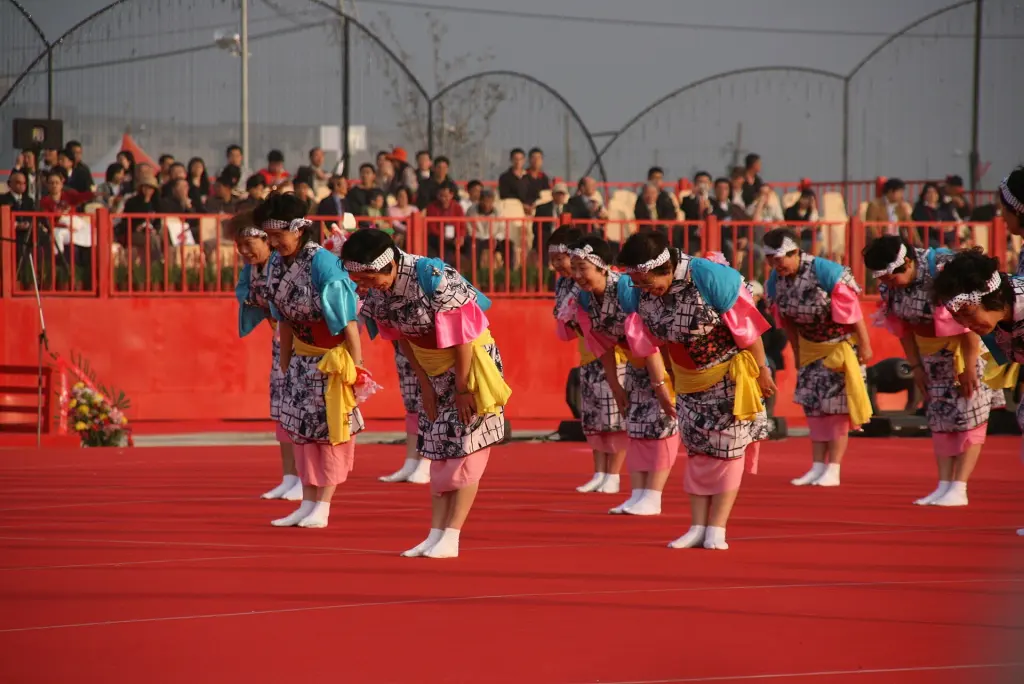
Image: Pascal Terjan / Wikimedia Commons / Flickr · Creative Commons Attribution-ShareAlike 2.0
Bowing in Japan, commonly called ojigi (お辞儀), is a family of gestures used in greetings, farewells, thanks, apologies, introductions, service encounters, ceremonies, religious practice, and the arts. A bow can range from a small inclination of the head to a formal movement from the waist or a seated bow on tatami. Meaning depends on relationship, setting, timing, posture, speech, and reciprocity rather than angle alone. Manuals often teach categories such as eshaku, keirei, and sai-keirei, but everyday practice is more fluid, and organisations may teach their own conventions. Visitors are not expected to master every distinction; a modest responsive bow is usually sufficient. Bowing is widespread without being exclusively Japanese, and handshakes or mixed greetings are also common in international and contemporary settings.
Overview
| Japanese term | お辞儀 |
|---|---|
| Romanization | Ojigi |
| Classification | Greeting and respect gesture |
| Common uses | Greeting, thanks, apology, farewell, worship, and ceremony |
| Main forms | Standing and seated bows |
| Variation | Depth, duration, repetition, posture, speech, and context |
Meanings and context
The same physical inclination can acknowledge another person, express gratitude, mark apology, open or close an encounter, or accompany ritual action. Observers interpret the whole situation. A deeper bow may signal greater formality, but it is not a universal numerical code detached from relationship and purpose.
Standing bows
Standing bows generally keep the body balanced and bend from the hips rather than dropping only the head. Hands and gaze are placed according to setting and training. Business and service manuals may distinguish shallow, standard, and deep forms, yet natural timing and attentiveness usually matter more than perfect measurement.
Seated bows
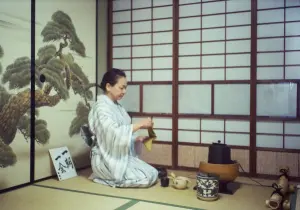
In tatami settings, participants may bow from seiza with the hands placed on the floor. Tea schools, martial arts, performing arts, and formal visits teach particular hand positions and rhythms. These should be learned within the relevant practice rather than treated as one national rule.
Work and service
Companies, schools, shops, transport operators, and hospitality businesses use bows to structure encounters. Training can standardise posture for staff, while actual interaction remains responsive. Bowing by an employee may express professional courtesy without revealing private feeling or personal rank.
Ritual and arts
Bows appear before shrine worship, in Buddhist observance, Japanese Tea Ceremony, martial arts, theatre, and performance. Their meanings differ: a bow to a partner, sacred object, audience, or altar is not interchangeable simply because the movement looks similar.
Reciprocity and mixed greetings
People often return a bow and may exchange several small acknowledgements as an encounter ends. Handshakes are familiar in international business and diplomacy, and a handshake with a slight bow may occur. Touch, distance, disability, age, and practical circumstances all shape comfortable greeting choices.
Common misconceptions
There is no need for a visitor to calculate an exact angle in every ordinary interaction. Nor does every bow prove submission, apology, or a fixed hierarchy. It is a versatile convention whose meaning comes from context. Following the other person's pace with calm courtesy is safer than exaggerating a highly formal bow.
Sources
Last updated: