Shinto
Norito
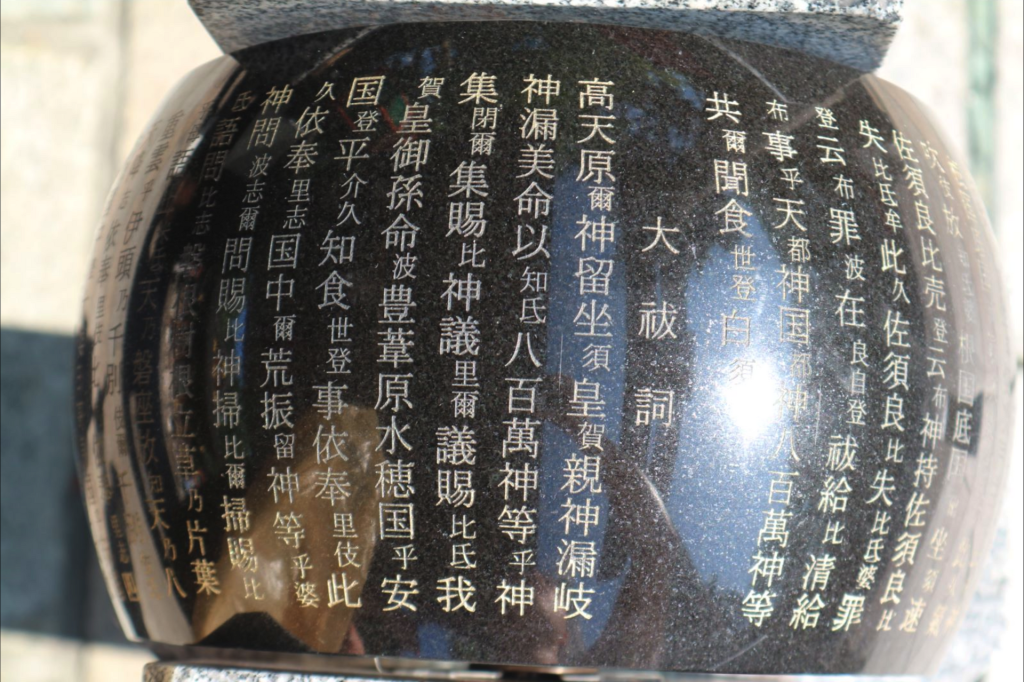
Image: 中日韩越的汉字 / Wikimedia Commons · Creative Commons Attribution-ShareAlike 4.0 International
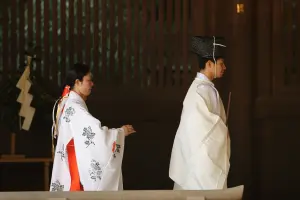
Norito (祝詞) are formal ritual words recited in Shinto ceremonies in the presence of kami. A priest normally delivers a norito after purification and offerings, announcing the occasion, identifying participants or sponsors where appropriate, praising the kami, and expressing gratitude, reports, or petitions. The term covers ancient texts preserved in the tenth-century Engishiki as well as later and contemporary compositions written for particular rites. Norito are often translated as prayers, liturgies, or ritual invocations, but they are not simply spontaneous private prayer. Their wording, elevated register, written conventions, cadence, and ritual delivery distinguish them as an officiant's formal address. Contents vary with festivals, life-cycle rites, blessings, memorial occasions, and institutional tradition.
Overview
| Japanese | 祝詞 |
|---|---|
| Romanization | Norito |
| Ritual form | Formal spoken address to kami |
| Typical performer | Shinto priest or designated ritual officiant |
| Classical corpus | Norito preserved in Book 8 of the Engishiki |
| Common functions | Praise, report, thanksgiving, petition, and purification |
Definition and function
Norito organize speech within a ritual relationship between a community and kami. Depending on the ceremony, the text can name the shrine and deity, state why people have assembled, enumerate offerings, report an event, give thanks, or request protection. Translation as prayer is convenient but can obscure the formal and declarative character of the address.
Classical texts
Twenty-seven norito appear in Book 8 of the Engishiki, a compilation completed in the early tenth century. These texts preserve important evidence for court and shrine ritual language, although surviving wording reflects compilation, transmission, and interpretation. The corpus is not a complete scripture or a catalogue of everything recited at all shrines.
Language and writing
Classical norito use an elevated register with formulaic parallelism, honorific expressions, and patterns designed for oral delivery. Manuscripts developed conventions that visually distinguish grammatical elements and support recitation. Contemporary texts may retain archaic vocabulary and cadence while adapting names, dates, places, and petitions to a specific ceremony.
Order of ritual
In a common shrine sequence, harae prepares participants and offerings, food and other gifts are presented, and the presiding priest recites norito before acts such as offering a tamagushi. Exact ordering and personnel depend on the rite, but the recitation is directed toward the kami rather than performed as a lecture to the congregation.
Ōharae no Kotoba
The Ōharae no Kotoba, also associated with the name Nakatomi no Harae, is the best-known purification norito. It describes the removal and onward carrying away of tsumi and kegare. Its history includes court recitation, medieval commentary, scholarly study, and continued modern use in varied Shinto settings.
Modern composition and translation
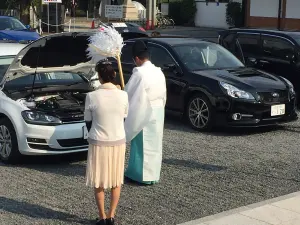
Priests compose or adapt norito for construction, vehicles, weddings, personal petitions, disasters, public commemorations, and new technologies. Good translation conveys the purpose and structure without pretending that one English religious vocabulary is exact. A printed text also records only part of the event: voice, posture, offerings, spatial arrangement, and audience complete the ritual performance.
Sources
- Association of Shinto Shrines, Matsuri and the order of shrine ritual.
- Ise Jingu, Soul of Japan glossary.
- Meiji Jingu, Kigansai private rite.
- Nanzan Institute for Religion and Culture, Rokujikyōhō in Medieval Japan.
- Kokugakuin University, Encyclopedia of Shinto: Norito.
- Kokugakuin University, Encyclopedia of Shinto: Nakatomi no Harae.
- Obihiro Ohtani Junior College, A Study of Food and Culture on Norito Prayer in the Nara Era.
Last updated: