
Seasonal Customs
Obon
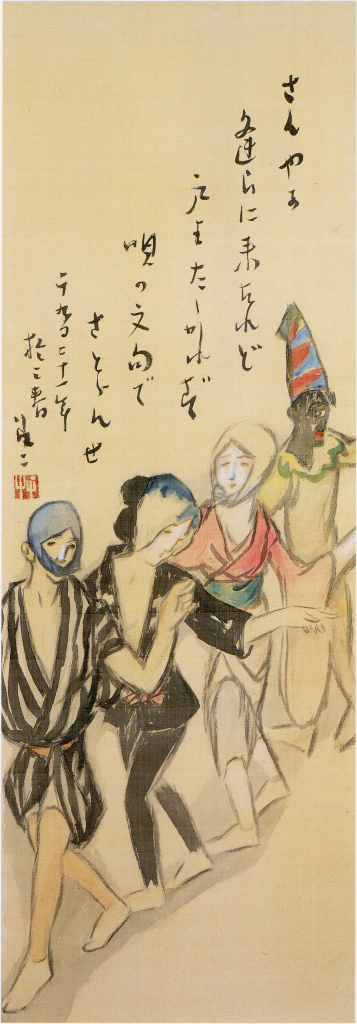
Image: Takehisa Yumeji / Wikimedia Commons; Yumeji Art Museum · Public domain
Obon (お盆), often shortened to Bon, is a Japanese summer observance for honouring the dead and renewing relationships between living families and ancestral spirits. Many communities observe it around August 13–16, while others use dates in July or follow a lunisolar schedule. Families may return to ancestral homes, visit and clean graves, make offerings at household Buddhist altars, light welcoming and send-off fires, and join bon odori dances. Obon draws strongly on Buddhist memorial traditions but also includes local household, community, and regional practices that cannot be assigned to a single institution. It is culturally one of Japan’s most important annual periods, yet it is not a national public holiday. The travel rush called the “Obon holiday” reflects customary leave and workplace closure.
Overview
| Japanese | お盆; 盆 |
|---|---|
| Usual timing | Mid-July, mid-August, or regional lunisolar dates |
| Central focus | Honouring and receiving ancestral spirits |
| Household practices | Offerings, graveside visits, lanterns, and fires |
| Community practice | Bon odori |
| Public status | Major customary holiday period, not a national holiday |
Name and timing
The name is linked to urabon, a Buddhist observance whose textual and ritual history extends across East Asia. Calendar reform produced several present schedules. Tokyo and some eastern areas often observe Bon in July, much of Japan in August, and Okinawa and some other regions on dates derived from the lunisolar calendar. No single modern date represents every community.
Buddhist and local histories
Higan is another major Japanese Buddhist memorial observance, but it centres on seven days around each equinox rather than Obon’s summer cycle of welcoming and sending off ancestral spirits.
Buddhist narratives of offerings made to aid the dead supplied a major ritual framework. In Japan these practices met older and continuing relations with household ancestors, local spirits, graves, and seasonal return. “Festival of the dead” is a convenient translation, but it can hide the combination of solemn memorial service, family hospitality, community gathering, and regional performance.
Welcoming the ancestors
The opening of Obon may be marked with mukaebi, small welcoming fires, and lanterns that guide ancestral spirits home. Families prepare food, flowers, incense, and water at a butsudan or temporary shelf. Cucumber horses and eggplant cattle are familiar offerings in some regions, imagined as conveyances for swift arrival and unhurried departure, but they are not universal.
Graves, temples, and households
Ohakamairi involves visiting and cleaning family graves, offering flowers and incense, and reporting family news. Buddhist priests may recite sutras in homes, cemeteries, or temples. The distribution of work between relatives, priests, neighbourhood groups, and cemetery institutions differs by sect, locality, and household history.
Bon odori
Casual yukata and wooden geta are visible at many contemporary Bon odori, although dress and footwear remain optional and locally variable.
Participants at contemporary Bon odori may wear a casual summer yukata, although ordinary clothing is also common and local practice varies.
Bon odori are communal dances performed to local songs and rhythms, often around a raised yagura. Their movement, music, costume, and religious emphasis vary greatly. Some retain strong memorial associations; others function primarily as inclusive summer gatherings. Awa Odori, Nishimonai Bon Odori, Gujō Odori, and Okinawan Eisa demonstrate the diversity hidden by the singular label.
Sending off
The close of Obon may be marked by okuribi, send-off fires, floating lanterns, or other acts guiding the ancestors away. Kyoto’s Gozan Okuribi is a famous public example, while many households use much smaller flames or lanterns. Environmental and safety rules have changed how fire and water rites are performed in some communities.
Family mobility and modern life
Keirō no Hi may also prompt visits, calls, gifts, and intergenerational gatherings, but it is a modern national holiday honouring older people rather than an ancestral rite or a second Obon.
Modern Obon is also a major period of domestic travel because workers and students return to family homes. Transport congestion, tourism, and workplace scheduling give it nationwide visibility despite the absence of statutory holiday status. For families separated by distance, the observance can concentrate memorial visits and intergenerational reunion into a few days.
Explore the music, movement, and regional variety of Bon Odori, including its relationship to Awa Odori.
Sources
Last updated:


.jpg?width=320)
