Folklore & Mythology
Oni
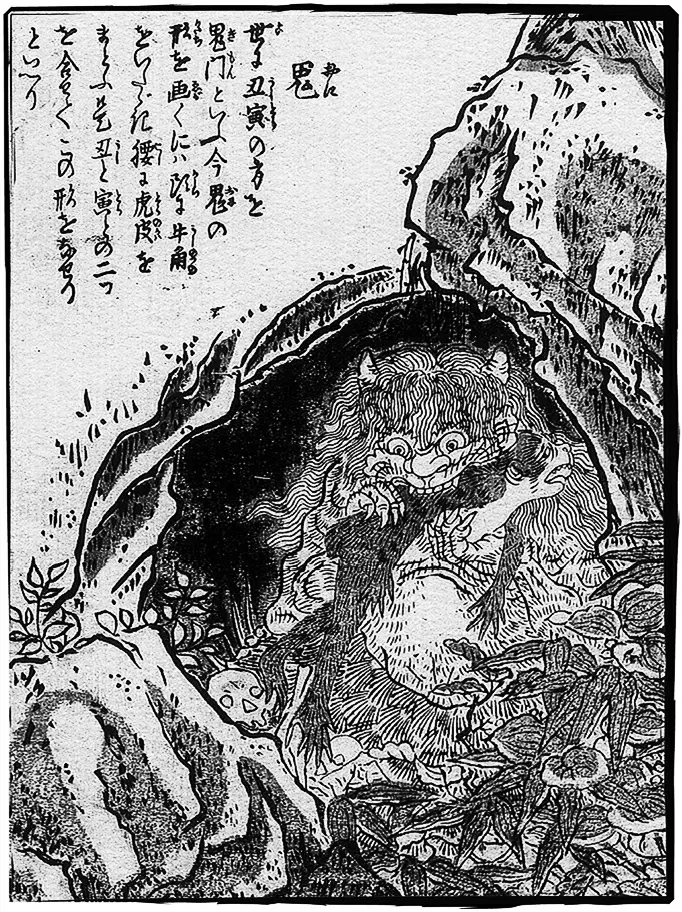
Image: Toriyama Sekien / Wikimedia Commons · Public domain
Oni (鬼) are powerful beings in Japanese religion, folklore, literature, and visual culture. They are commonly rendered in English as “demons” or “ogres” and are often shown with horns, fangs, great strength, and tiger-skin garments. That familiar image is only one historical layer. The word has also referred to invisible spirits, agents of disease, inhabitants of Buddhist hells, dangerous outsiders, and defeated or converted protectors. Oni may terrorize a community in one story and defend Buddhist teaching in another. Their variable status places them near both yōkai and kami, while ritual and performance repeatedly turn fear into controlled encounter.
Overview
| Japanese | 鬼 |
|---|---|
| Romanization | Oni |
| Common English renderings | Demon; ogre |
| Typical later features | Horns, fangs, claws, and tiger-skin garments |
| Major contexts | Buddhism, court ritual, folktale, theatre, and festivals |
| Well-known narratives | Shuten-dōji and the oni of Rashōmon |
Name and range
The graph 鬼 came to Japan through written Chinese, where it could denote spirits of the dead and other unseen beings. Japanese usage accumulated Buddhist, courtly, local, and literary meanings. “Ogre” captures the large, embodied enemy of many stories, while “demon” is broader; neither translation should imply that oni belong to a single theology or are always wholly evil.
Religious and ritual backgrounds
Buddhist texts and images place horned wardens in hell, where they punish the dead under a larger moral order. Other oni oppose Buddhist practitioners, are subdued by holy power, or become guardians after conversion. Court rites influenced by continental ritual traditions expelled harmful forces from a protected centre, helping connect oni with dangerous directions, epidemic, and the outside of ordered space.
Visual form
The now-familiar red or blue body, horns, fangs, iron club, and tiger-skin loincloth became conventional through painting, sculpture, performance, and print. Horns and tiger imagery are often explained through the northeastern direction, ushitora—ox and tiger—which was treated as an unlucky demon gate in directional thought. Actual depictions remain varied: oni may be nearly human, animal-like, grotesque, muscular, or comic.
Legends and literature
Medieval and early modern narratives made named oni into memorable antagonists. Shuten-dōji rules a mountain stronghold before being killed by warrior heroes, while the Rashōmon story centres on an encounter at a city gate. Such tales combine religious danger, political order, border spaces, and heroic violence. Versions differ across texts, Noh, picture scrolls, illustrated books, Kabuki, and later popular media.
Setsubun and expulsion
At Setsubun, the boundary before spring, beans may be thrown with the phrase “Oni out, good fortune in.” The practice dramatizes expulsion of harmful forces from the household. Local festivals do not all treat oni identically: in some traditions oni visit, test, bless, protect, or discipline rather than simply represent evil. Ritual role is therefore more informative than the creature’s appearance alone.
From enemy to protector
Oni can cross the boundary between threat and protection. A conquered being may guard a temple, and a feared local power may receive offerings. Comic art also domesticates oni by showing them drinking, hiding, losing contests, or performing human tasks. These reversals explain why oni remain useful figures for representing both uncontrolled force and the possibility of redirecting it.
Relation to yōkai, kami, and yūrei
Oni are often included within the broad modern field of yōkai, but their strong Buddhist, ritual, and heroic associations give them a distinct profile. An oni may become kami-like when worshipped, while a wrathful dead person can acquire oni imagery without becoming equivalent to every yūrei. The comparison page Kami, Yōkai, Oni and Yūrei sets out these overlapping categories.
Sources
Last updated: