Tea & Aesthetic Arts
Ikebana
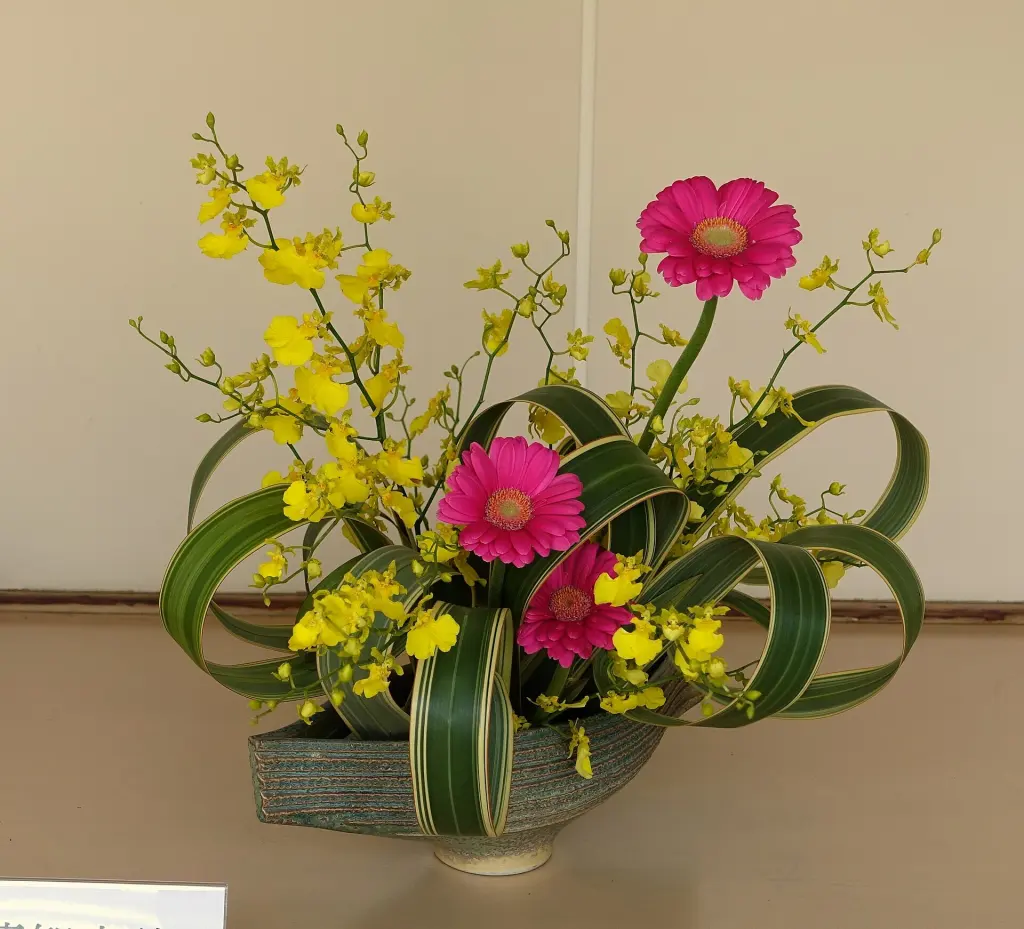
Image: Daderot / Wikimedia Commons · Creative Commons CC0 1.0 Universal Public Domain Dedication
Ikebana (いけばな, 生け花) is the Japanese art of arranging flowers, branches, leaves, grasses, and other plant materials in relation to a vessel and surrounding space. It is also called kadō (華道), the “way of flowers.” Unlike a general bouquet, an ikebana work is organised through line, direction, interval, balance, and the individual character of its materials; open space may be as important as blossom density. The tradition developed from several contexts, including Buddhist flower offerings, court and warrior display, domestic alcoves, and the work of specialist masters. It now includes codified historical styles, naturalistic arrangements, and modern sculptural forms taught by many schools in Japan and internationally.
Overview
| Japanese names | いけばな; 生け花; 華道 |
|---|---|
| Romanization | Ikebana; kadō |
| Materials | Flowers, branches, leaves, grasses, and vessels |
| Early documented master | Ikenobō Senkei, recorded in 1462 |
| Major style families | Rikka, shōka, nageire, moribana, and jiyūka |
| Mode of transmission | School-based study and direct instruction |
Name and scope
The word ikebana is commonly interpreted as “living flowers” or “making flowers live,” while kadō places the practice among cultivated arts described as a “way.” Historical texts and modern schools use several written forms and terms.
Ikebana is not defined by one visual formula. Some arrangements are highly codified and symbolic; others emphasize the observed character of seasonal plants or treat plant and non-plant materials as sculpture.
Ritual and aesthetic origins
Plants were presented as Buddhist offerings and also used as markers of sacred presence. Over time, placing flowers in interior settings became an aesthetic practice connected with elite residences, temples, and the display alcove.
These origins should not be compressed into a single founding event. Religious offering, seasonal appreciation, architecture, vessel culture, and the professional work of flower masters all contributed to the formation of ikebana.
Muromachi formalisation
The priest and flower master Ikenobō Senkei is recorded as creating an admired arrangement in Kyoto in 1462. Ikenobo sources identify late fifteenth-century manuscripts as the oldest surviving written teachings associated with the tradition.
During the Muromachi period, formal upright arrangements developed alongside new interior display conventions. Later generations transmitted compositional principles, diagrams, and named forms, helping establish flower arrangement as a specialist art.
Major styles
Rikka is the oldest major formal style and builds a complex composition from multiple directional parts. Shōka developed as a more concise structure. Nageire uses a freer, apparently natural placement, often in a tall container, although skilled construction remains essential.
Moribana commonly uses a broad, shallow vessel and a pin holder, allowing wide landscape-like compositions. Jiyūka, or free style, permits greater experimentation with materials, scale, and abstraction. Schools define and teach these categories differently.
Line, space, and season
An arrangement is read through the directions and lengths of branches and stems, the distribution of visual weight, and the empty intervals between forms. Asymmetry can create movement and prevent a composition from appearing mechanically mirrored.
Season matters through available plants, stages of growth, colour, and cultural association. Buds, damaged leaves, seed pods, and bare branches may be valued because they register time and the specific life of a material.
Materials, vessels, and technique
Containers may be ceramic, metal, bamboo, glass, or other materials. Their height, opening, surface, and visual weight affect the structure. Fixing devices include pin holders and internal supports, while cuts and bends are used to control angle and water uptake.
Technique begins before placement: the arranger studies front and back, strength, curvature, and condition. Responsible handling also requires attention to plant toxicity, conservation rules, and the source and durability of materials.
Schools and transmission
Ikenobo describes itself as the origin of ikebana and preserves a long institutional lineage. Many later schools developed their own curricula, names, preferred forms, and responses to changing architecture and artistic movements.
Students normally progress through set exercises under an instructor before working more independently. Exhibitions, manuals, demonstrations, and international branches extend access, but evaluation remains linked to the conventions of a particular school.
Modern and global practice
In the modern period, ikebana entered girls’ and women’s education, public exhibitions, cultural associations, and overseas teaching networks. New vessel forms and modern architecture encouraged wider horizontal compositions and experimental work.
Contemporary ikebana ranges from domestic study pieces to room-sized installations. The breadth of practice makes school, style, and date essential when describing an arrangement; “ikebana” alone does not identify its method.
Sources
Last updated: