Martial Arts Figures
Gozo Shioda
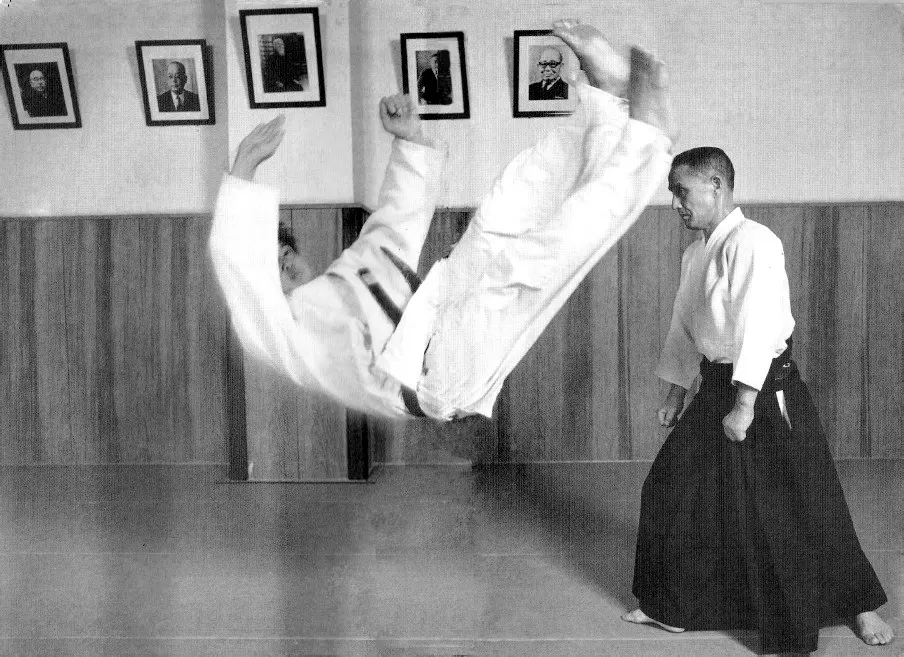
Image: Chente moreno / Wikimedia Commons · CC BY-SA 4.0
Gozo Shioda (1915–1994) was a Japanese Aikido teacher and the founder of Yoshinkan Aikido. He entered Morihei Ueshiba's Kobukan dojo in 1932 and trained during the period when Ueshiba's art was commonly called aiki-budo. After the Second World War, Shioda resumed public teaching and established the Yoshinkan organisation in Tokyo in 1955. His pedagogy organised posture, footwork, balance, and paired technique into repeatable basic movements, making instruction easier to structure for large and professionally disciplined groups. Yoshinkan's association with the Tokyo Metropolitan Police and its intensive instructor courses gave Shioda a prominent role in postwar Aikido. Descriptions of his method as merely “hard” overlook its emphasis on timing, stable body alignment, and precise control.
Overview
| Japanese name | 塩田剛三 |
|---|---|
| Born | 9 September 1915, Yotsuya, Tokyo, Japan |
| Died | 17 July 1994, Tokyo, Japan |
| Teacher | Morihei Ueshiba |
| Founded | Yoshinkan Aikido, 1955 |
| Known for | Systematic basics, instructor training, and police Aikido |
Early life and martial background
Shioda was born in Yotsuya, Tokyo, into the family of physician Seiichi Shioda. His father's Yoshinkan dojo provided an early setting for Judo and other martial training. The name Yoshinkan was later reused for the Aikido organisation founded by his son.
He began Judo as a boy and developed the compact, strongly aligned posture that later characterised his demonstrations. His early background did not make his Aikido a branch of Judo, but it influenced how he understood balance, close contact, and disciplined repetition.
Training at the Kobukan
Shioda met Morihei Ueshiba in 1932 and entered the Kobukan dojo. Prewar training there was demanding and less standardised than many later curricula. Students practised throws, controls, strikes, and weapons-related movement under Ueshiba's direct supervision.
The vocabulary of the art was still changing. Shioda's formative practice is often described as aiki-budo, although later institutional histories place it within the development of Aikido.
Wartime years and return to Tokyo
During the Asia-Pacific War, Shioda held civilian administrative assignments in territories under Japanese occupation. Later institutional biographies list postings in China, Taiwan, and Borneo, but do not provide a complete administrative record.
After returning to Japan, he worked in business and gradually resumed martial teaching. His appearance at a large postwar demonstration in 1954 helped attract support for a permanent organisation and dojo.
Founding the Yoshinkan
The first Yoshinkan dojo opened in 1955 at Tsukudo-Hachiman in Shinjuku. The organisation emerged during the broader postwar revival of Aikido, while maintaining a teaching identity distinct from the Aikikai network led by the Ueshiba family.
Shioda received ninth dan from Ueshiba in 1961. Rank alone, however, does not explain his influence: the Yoshinkan's repeatable teaching sequence allowed the organisation to train beginners, police officers, company groups, and overseas instructors on a large scale.
Kihon dosa and teaching method
Yoshinkan pedagogy isolates fundamental body actions known as kihon dosa. Students study stance, coordinated hip movement, changes of direction, entering, and the transfer of power before combining them in paired techniques.
Techniques are often taught in clearly counted stages. This does not mean that application is intended to remain mechanical; the structured form is a learning device for developing balance, timing, and the ability to control a partner without depending on muscular force alone.
Police and intensive training
Yoshinkan instruction for the Tokyo Metropolitan Police began in the late 1950s and later developed into a formal intensive course. The course became internationally known through the senshusei instructor-training model, which combines frequent practice, physical conditioning, etiquette, and supervised teaching.
The police relationship increased Yoshinkan's public visibility, but police instruction is only one part of the organisation's history. Civilian dojo, university clubs, companies, and international affiliates also transmitted Shioda's methods.
Demonstration and technical reputation
Shioda was a small practitioner noted for demonstrations in which posture, distance, and sudden changes of balance made techniques appear effortless. Films and anecdotes contributed to the image of an exceptionally powerful master.
Historical interpretation benefits from separating demonstrative skill from supernatural claims. Shioda explained technique through centred posture, timing, concentration, and the coordinated use of the whole body, even when he used traditional language such as kokyu-ryoku.
Legacy
Shioda died in Tokyo in 1994. Yoshinkan Aikido continued through the Aikido Yoshinkai Foundation and through several organisations founded by senior students. These groups share a historical source but are not all governed by a single international administration.
His durable contribution was pedagogical as much as technical: he turned experience acquired in a small prewar dojo into a curriculum that could be repeated, examined, and carried into many institutional settings.
Sources
Last updated: