
Shinto
Matsuri

Image: James..g / Wikimedia Commons · CC BY-SA 4.0
Ritual · Procession · Performance · Community
More than the procession.
Matsuri (祭 / 祭り) can mean a ritual observance and the celebration surrounding it. Communities honour kami, renew local ties or mark significant times and events. Religious meaning, public access and local forms differ from festival to festival.
Four ways to read a matsuri
Ritual, movement, performance and community can overlap within one event. These are interpretive lenses, not four compulsory stages; the most visible spectacle may not be the ritual centre.
What is being observed?
Purification, offerings and prayer can address kami or mark a religious occasion. Some events called matsuri are civic celebrations.
What moves through the place?
Omikoshi processions and festival floats give different forms to public movement. Some observances have no procession.
What is offered or enacted?
Kagura, music, dance and other arts may be offerings as well as performances for spectators.
Who sustains the event?
Priests, neighbourhood groups, musicians, craftspeople, volunteers and visitors have different responsibilities and access.
The Jinja Honcho matsuri guide and Yasaka Shrine’s Gion Matsuri account show how religious rites and public celebration belong to a wider calendar. Check the organiser’s programme to distinguish public events from restricted ritual spaces.
At a glance
- Term
- 祭 / 祭り · Matsuri
- Contexts
- Shinto, Buddhist, civic and seasonal traditions
- Read through
- Ritual, movement, performance and community
- Local variation
- No universal programme, route or set of features
Meaning and scope
The verb matsuru refers to enshrining, venerating, or performing rites for a sacred being. In Shinto, matsuri commonly denotes a rite directed toward kami. In everyday Japanese, the term can also be used more broadly for civic celebrations and special events.
This range explains why a matsuri may appear solemn in one setting and festive in another. Ritual and entertainment are not necessarily opposites: performances, music, and communal enjoyment may be understood as offerings to the kami as well as experiences for human participants.
Ritual structure
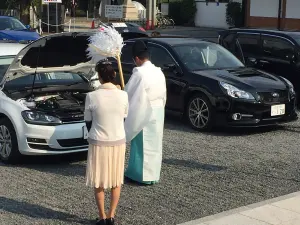
A formal shrine festival may include purification, the presentation of offerings, recitation of ritual prayers, and sacred music or dance. These rites are usually conducted in controlled areas by priests and authorized participants. Public elements may follow or surround them.
Some matsuri include a procession in which a kami is invited to travel in an omikoshi, or portable shrine. Others are organized around decorated floats, horses, boats, fires, or dances. Kagura may be offered as entertainment for the kami. No single feature is required in every matsuri.
Processions, floats and local examples
| Element | How to understand it | Explore |
|---|---|---|
| Omikoshi | A portable shrine associated with the movement of kami during an observance; this is not simply another name for every festival float. | Omikoshi |
| Festival floats | Locally named and designed vehicles or structures used in processions, display and performance. Sacred meanings and relationships to kami depend on the tradition. | Festival floats in Japan · Dashi |
| Kagura | Performance associated with kami worship, with diverse regional forms. Not every matsuri includes kagura. | Kagura |
Gion Matsuri
Yasaka Shrine’s official account places public festivities within a wider series of observances. A float procession and a shrine rite have different roles.
Kishiwada Danjiri Festival
Carved floats, music, shrine observance and local responsibilities show how a festival links streets, communities and generations.
Hanabi & Hina Matsuri
Fireworks events and seasonal celebrations broaden the field. Their names alone do not establish a shared ritual structure.
Seasonal and local cycles
Many matsuri follow the agricultural year. Spring rites may ask for fertile fields and protection, while autumn rites give thanks for the harvest. New Year observances, summer purification, epidemic-protection rites, and a shrine’s annual grand festival form other common patterns. Dates and meanings are specific to each tradition.
A local shrine often serves as the religious center for residents known as ujiko, traditionally linked to its tutelary kami. Preparing a matsuri distributes responsibilities among priests, neighborhood associations, musicians, craftspeople, and volunteers. The event can preserve local knowledge through repeated participation.
Hanabi, or Japanese fireworks, may form part of shrine offerings, neighborhood festivals, civic events, competitions, or independent public displays; the organizer and local purpose determine the relationship to matsuri.
Historical development
Matsuri have changed with political authority, urban growth, transport, tourism, and local demographics. Some major urban festivals developed elaborate processions supported by merchant neighborhoods. Rural festivals may retain forms tied to farming, fishing, or mountain worship. Epidemics and natural disasters also shaped rites of pacification and protection.
Modern festivals may use trucks, electric lighting, public-address systems, or crowd controls while continuing older ritual sequences. Claims that every detail has remained unchanged should therefore be treated cautiously.
Participation and etiquette
Visitors can usually watch public processions and performances, but participation in carrying an omikoshi or entering ritual space may require local affiliation, registration, or prescribed clothing. Photography rules differ. Following staff directions and avoiding obstruction of processions respects both safety and the religious purpose of the event.
Contemporary significance
Matsuri remain sites of worship, recreation, cultural transmission, and local identity. They can also face pressures from population decline, extreme weather, crowding, and commercialization. Communities respond by changing schedules, recruiting outside participants, documenting performance traditions, or limiting access. Such adaptations are part of the continuing history of matsuri rather than evidence that they have ceased to be traditions.
Follow the context
Shinto & Kami
Read about the relationships underlying many shrine observances.
Buddhism in Japan & Obon
Explore other religious contexts for communal and seasonal observance.
Shinto rituals
Distinguish preparation, offerings and prayer within shrine practice.
Sources
Institutional sources describe their own traditions; historical and cultural sources provide context.
Last updated:




.jpg?width=320)
