Seasonal Customs
Hina Matsuri
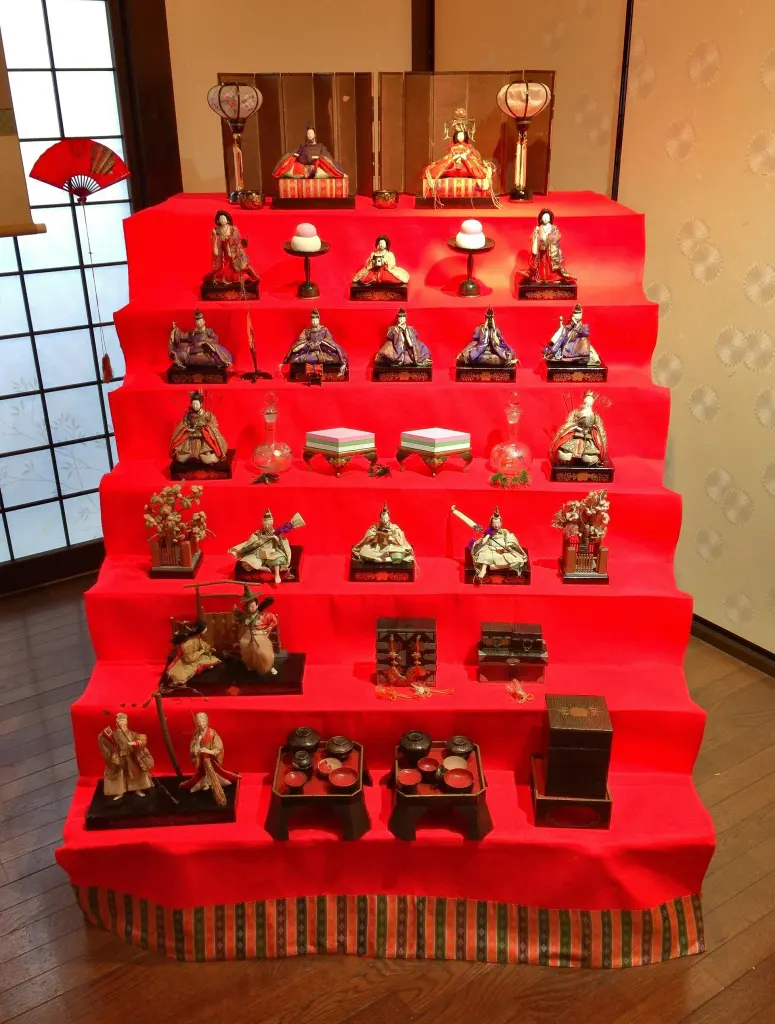
Image: Asanagi / Wikimedia Commons · CC0 1.0
Hina Matsuri (雛祭り), observed on March 3, is a Japanese seasonal custom centred on ornamental hina dolls and wishes for children’s health and wellbeing. It is also called the Doll Festival or Momo no Sekku, the Peach Festival. The familiar display places a courtly pair at the top of a platform and may add attendants, musicians, furnishings, and miniature implements on lower tiers. The arrangement developed mainly during the Edo period rather than surviving unchanged from the Heian court it evokes. Hina Matsuri combines earlier purification practices, doll play, household display, craft, food, and family commemoration. Although it has long been particularly associated with girls, contemporary descriptions vary, and it is not a Japanese national public holiday.
Overview
| Japanese | 雛祭り |
|---|---|
| Common English names | Doll Festival; Girls' Day |
| Date | March 3 |
| Alternative name | Momo no Sekku, or Peach Festival |
| Central objects | Hina dolls arranged on a platform or tiered stand |
| Purpose | Wishes for children's health, growth, and wellbeing |
Name and date
Chōyō no Sekku, the ninth-day Chrysanthemum Festival, stands with Jōshi—the historical seasonal observance underlying Hina Matsuri—among Japan’s five traditional gosekku.
The festival is held on the third day of the third month in the modern calendar. Hina refers to the dolls, while matsuri here names the observance rather than necessarily a large public procession. The name Momo no Sekku links the date with peach blossoms and one of the traditional five seasonal festivals.
Purification and doll play
One strand of the festival’s history lies in Jōshi no Sekku, when human-shaped substitutes could receive impurity and be set afloat or otherwise removed. Another lies in elite children’s doll play, known from court literature. Museums describe the later festival as a convergence of purification figures and dolls used for play, not as a simple survival of one prehistoric rite.
Edo-period development
Kyoto National Museum notes that records of displaying dolls specifically for the third day of the third month emerge in the early Edo period. Seated doll types, increasingly elaborate costumes, and larger sets developed over the seventeenth through nineteenth centuries. Court dress gave the display an image of refined antiquity even as the format itself continued to change.
The hina display
At the top are a male and female courtly pair often called dairi bina. Larger arrangements may include three court ladies, five musicians, ministers, guards, lacquer furnishings, vehicles, and household tools. The number and order of tiers are not universal. Kyoto and Edo developed different emphases, including palace structures, kitchens, tall platforms, and numerous furnishings.
Food, flowers, and seasonal symbols
Peach blossoms, diamond-shaped hishimochi, coloured hina-arare, clam soup, and festive sushi are widely associated with the day. Their use varies by household and region. These elements make the display a multisensory marker of early spring rather than an art object isolated from food, plants, and domestic hospitality.
Regional forms and nagashibina
Some communities practise nagashibina, sending simple figures downstream in a ritual that recalls purification by transfer and removal. Doll styles, the placement of the courtly pair, foods, and festival dates can also differ regionally. A commercial seven-tier set is therefore only one prominent form within a wider field of local observance.
Craft, memory, and modern households
Hina sets may be inherited, purchased for a child, displayed in museums, or adapted to smaller homes. Contemporary families often use compact displays while towns organize large collective exhibitions. The festival preserves specialist doll-making and textile skills, but its meaning is also personal: the repeated display records children’s growth and family memory across years.
Sources
Last updated: