
Seasonal Customs
Setsubun
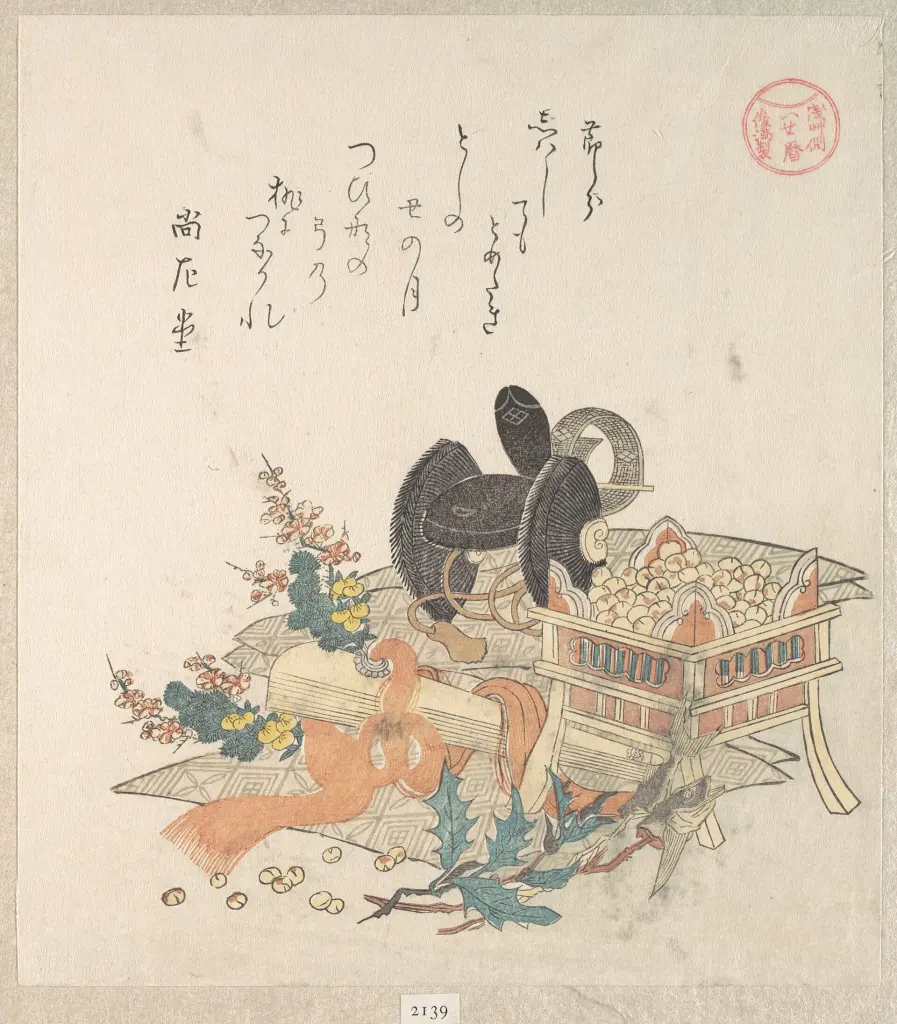
Image: Kubo Shunman / Wikimedia Commons; Metropolitan Museum of Art · Public domain; digital reproduction CC0
Setsubun (節分) means the division between seasons. In present-day Japan the name usually refers to the day before risshun, the calendrical beginning of spring, which falls in early February. Its best-known practice is mamemaki: roasted soybeans are scattered while people call for harmful forces to leave and good fortune to enter. An oni mask may give misfortune a visible role, but local customs do not all treat oni in the same way. Temples, Shinto shrines, schools, shops, and households have developed distinct forms of the observance. Setsubun is therefore both an inherited seasonal rite and a flexible modern custom shaped by region, family, commerce, and public performance.
Overview
| Japanese | 節分 |
|---|---|
| Literal meaning | Seasonal division |
| Usual timing | The day before risshun in early February |
| Best-known practice | Mamemaki, or scattering roasted soybeans |
| Common words | Oni wa soto; fuku wa uchi |
| Main settings | Homes, temples, shrines, schools, and community events |
Name and calendar
In a calendrical sense, setsubun can describe the eve of any of the four seasonal beginnings. Over time, the boundary before spring became the dominant observance and eventually took the name without qualification. The date is calculated from risshun, so it is commonly February 3 but can shift by a day. Calling it a fixed February 3 holiday obscures this calendrical relationship.
From seasonal boundary to annual rite
The change of season was treated as a vulnerable threshold at which disorder and illness could enter. Courtly rites of expulsion, including tsuina, and later religious and household practices contributed to the history of Setsubun. The present observance should not be reduced to one unchanged ancient ceremony: its elements were combined, renamed, and popularized in different periods.
Mamemaki
During mamemaki, roasted soybeans called fukumame are thrown or scattered. A widely known call is Oni wa soto, fuku wa uchi—“Oni out, fortune in.” In homes, one person may wear an oni mask while others throw beans; public ceremonies may distribute small packets to a crowd. Eating a number of beans linked to one’s age is another familiar practice, although details vary.
Oni, expulsion, and local difference
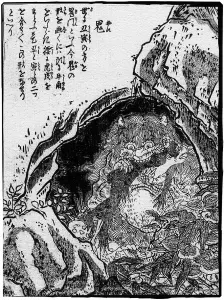
The oni gives misfortune a dramatic target, especially in family and school performances. Yet some temples and communities omit “oni out,” welcome oni-like visitors, or treat them as protective figures. The observance therefore demonstrates the wider ambiguity of oni: a threatening appearance does not determine one permanent ritual role.
Food and household customs
Regional Setsubun customs include displaying holly and roasted sardine heads near an entrance, using peanuts instead of soybeans, or eating foods associated with good fortune. Ehōmaki—an uncut rolled sushi eaten while facing the year’s auspicious direction—was strongly associated with parts of Kansai before nationwide retail promotion expanded its reach. It should be presented as a modern nationalized custom with regional roots, not a universal ancient rule.
Temples, shrines, and public events
Large ceremonies at Buddhist temples and Shinto shrines may include clergy, invited public figures, ritual performance, and the distribution of beans or gifts. Their liturgies and local explanations differ even when the public action looks similar. Setsubun can consequently cross institutional boundaries without becoming exclusively Buddhist or exclusively Shinto.
Setsubun today
Today the custom links a technical calendrical boundary with accessible acts of play, food, prayer, and family participation. Commercial masks and bean packets make the observance easy to reproduce, while local institutions preserve distinctive ceremonies. Its continuity lies less in a single fixed script than in the recurring work of driving out harm and opening the household or community to a new season.
Sources
Last updated:


_MET_DP138337.jpg)