Cultural Geography
Ryukyu Kingdom

Image: 663highland / Wikimedia Commons · CC BY 2.5
Ryukyu Kingdom
An island court within a connected East Asia.
The Ryukyu Kingdom was an island monarchy centred on Shuri in present-day Okinawa. Its conventional chronology begins with the unification of Okinawa’s three rival polities in 1429 and ends with the abolition of the kingdom in 1879. Maritime exchange connected the court to China, Japan, Korea and Southeast Asia, contributing to distinctive forms of government, ritual, art and architecture. Its political position changed significantly after the Satsuma invasion of 1609, while relations with China continued. Ryukyuan history therefore cannot be reduced to either complete isolation or an unchanged relationship with a single neighbour. Modern Okinawa preserves and interprets this heritage, but its institutions are not identical to those of the kingdom.
Polity
Royal institutions developed around Shuri.
Exchange
Maritime relationships connected several regions.
Heritage
Sites and museums interpret a vanished monarchy.
At a glance
- Japanese form
- 琉球王国 — Ryūkyū Ōkoku
- Royal centre
- Shuri, on Okinawa Island
- Conventional unification date
- 1429
- Major political change
- Satsuma invasion, 1609
- Abolition of the kingdom
- 1879
01
A unified kingdom emerged from competing centres
The Shurijo Castle Park account describes a period of regional powers before the unification achieved by Shō Hashi in 1429. This milestone concerns political consolidation on Okinawa Island. It should not be treated as the beginning of settlement, culture or overseas contact throughout the Ryukyu Islands, whose histories reach much further back.
02
Maritime connections shaped court society
UNESCO identifies exchange with China, Korea, Japan and Southeast Asia as fundamental to Ryukyuan cultural development. The prefectural museum presents the kingdom as an important trading state within East Asia. Diplomacy, goods and cultural practices moved through these relationships, while the court adapted them within its own institutions and island setting.
03
Political relationships changed over time
The kingdom’s history contains changes in the conditions under which its rulers exercised power. The 1609 invasion did not immediately end the royal institution or its Chinese relations. The nineteenth-century abolition was a different transformation and belongs to the creation of modern Okinawa Prefecture.
- 1429
- Shō Hashi’s unification established the kingdom centred on Shuri.
- 1609
- Satsuma’s invasion changed the kingdom’s political position.
- 1879
- The Japanese state abolished the kingdom and established Okinawa Prefecture.
04
Royal power occupied a wider cultural landscape
Shuri Castle was the principal court centre, but the UNESCO property also includes other castle sites, monuments and landscapes. Shikinaen, pictured here in 2011, is associated with the royal garden tradition. A network of places gives a fuller account of court society than one palace building alone.
05
Sacred places preserve a different kind of evidence
UNESCO recognises the significance of Ryukyuan sacred sites and traditions of nature and ancestor worship. These places show that political history and religious practice were intertwined without becoming the same subject. Their continued importance should not be mistaken for proof that every ritual has remained unchanged or that all island communities followed identical arrangements.
06
Modern preservation interprets the kingdom’s remains
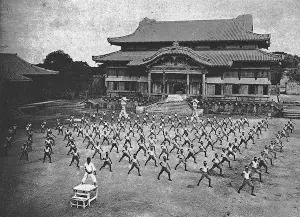
The nine-part World Heritage property was inscribed in 2000, long after the monarchy ended. Museums, archaeology and architectural restoration now organise public understanding of the kingdom. Eisa and Karate Day offer further perspectives on Okinawan culture, with their own histories of transmission and modern presentation rather than a single unbroken royal origin.
Sources
Last updated: