Performing Arts
Shūmei

Image: Unknown photographer; reproduced in Louise Jordan Miln’s 1894 publication / Wikimedia Commons · Public domain
Shūmei
One name. Successive performers. A living tradition.
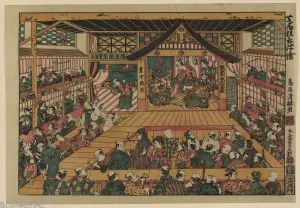
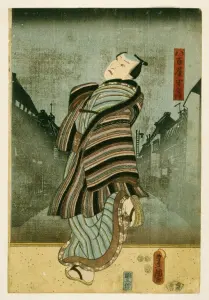
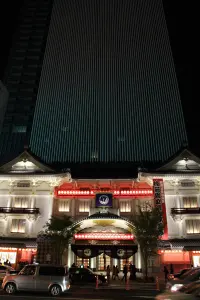
Shūmei (襲名) is the assumption of an established name by a new holder. In Japanese performing arts, it connects an individual career with a recognised artistic lineage. The practice is particularly visible in kabuki, where a celebrated name may pass through successive performers and be announced in special theatre programmes. A succession can express family continuity or a relationship with a teacher or predecessor. It also places the new holder before an audience familiar with the name’s earlier achievements. Understanding shūmei means separating the inherited stage name, the performer who currently bears it, the household identity associated with it, and the performances through which the succession becomes public.
Name
A recognised identity with an artistic history.
Holder
A distinct performer in that history.
Announcement
The theatre presents the succession publicly.
At a glance
- Japanese
- 襲名 — shūmei
- Core meaning
- Assuming an established name
- Principal context here
- Kabuki and its performance lineages
- Related terms
- Myōseki, yagō and shūmei hirō
- Interpretive point
- A numbered name identifies successive holders, not biological generations
01
A name can outlast one career
A myōseki is an established name that can be inherited. In kabuki, taking such a name brings an actor into a history of roles, performance styles and audience expectations. The name is a form of public continuity, while the actor remains a distinct performer. One person may use several stage names over a career.
02
Three terms that describe different things
Names in programmes and calls from the audience do not all perform the same function. Keeping these terms separate makes cast lists and theatre histories easier to read.
- Myōseki
- An established professional name passed to a successor.
- Yagō
- A house name associated with an actor’s theatrical household, such as Naritaya.
- Shūmei hirō
- The public presentation and celebration of a name succession.
03
Succession follows artistic relationships
The Japan Arts Council describes names passing from fathers, elder brothers, teachers and earlier performers. Succession therefore concerns an artistic relationship as well as family history. It should not be read as proof that every holder is a direct descendant of the preceding one. The wider training of kabuki actors also includes apprenticeship and institutional training.
04
The theatre makes the succession public
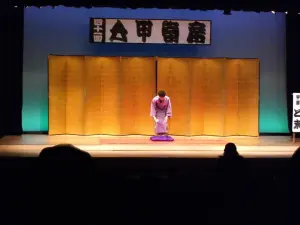
A shūmei hirō programme places the new name in front of an audience. A kōjō is a formal stage announcement, often involving senior actors, while the associated performances allow the successor to appear under the name. The announcement and the acting have complementary roles: one declares the change, and the other gives it an artistic presence.
05
Programmes preserve the identity of each holder
Ordinals such as IX or VIII help distinguish performers who used the same name at different times. Shochiku’s Ōtani Library documented the 2025 successions of Onoe Kikugorō VIII and Onoe Kikunosuke VI alongside material connected with earlier Kikugorō generations. Programmes and other theatre records allow a familiar name to be connected to a particular person, date and production.
06
An inherited name carries expectations
Professional sumo provides another institutional setting: Kimura Shōnosuke and Shikimori Inosuke are inherited senior referees’ names, with their own succession arrangements.
Shochiku presents succession as a responsibility to predecessors and an opportunity for artistic development. Continuity does not require every interpretation to be identical. For a reader or spectator, the useful questions are which performer held the name, when it was assumed, and which roles or household traditions are relevant. Shūmei also occurs beyond kabuki, including other traditional performance genres.
Sources
Last updated: