Calligraphy
Shodo (Calligraphy)
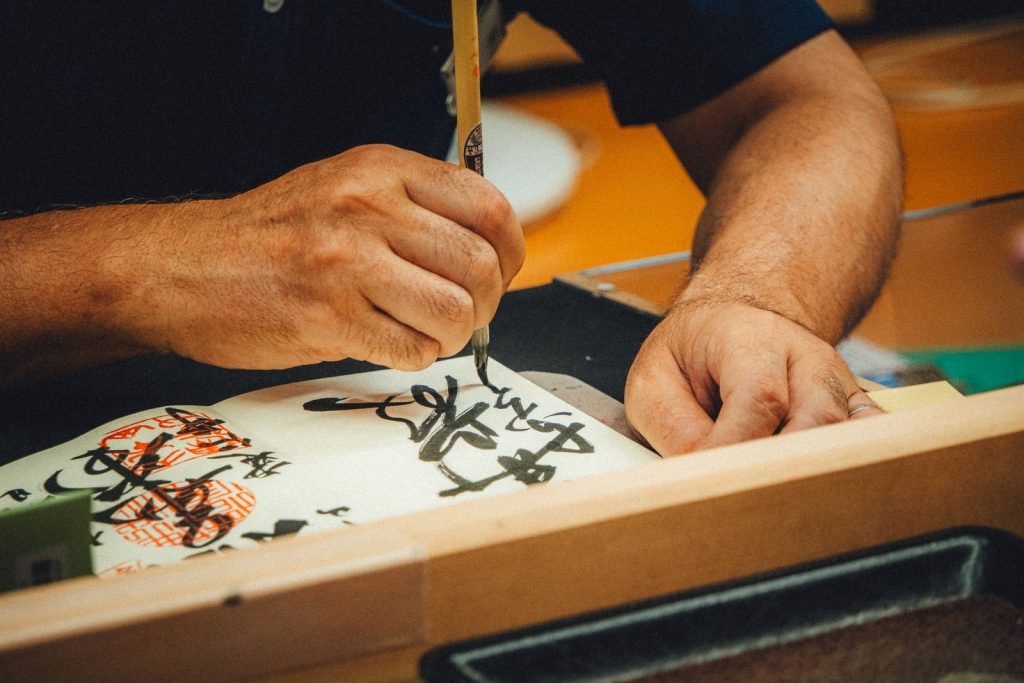
Image: Liuuu _61 / Pexels · Pexels License
Overview
| Japanese name | 書道 |
|---|---|
| Meaning | Way of writing |
| Type | Japanese calligraphy |
| Core tools | Brush, ink, paper, and inkstone |
| Major scripts | Kaisho, gyōsho, and sōsho |
Shodō (書道), literally “the way of writing,” is the Japanese art of shaping characters with brush, ink, and paper. A finished work communicates language, but it also records speed, pressure, rhythm, hesitation, and breath. Because a brushstroke cannot be erased and redrawn without changing its character, each line becomes evidence of a particular movement made at a particular moment.
Writing and visual art
Shodo treats writing as disciplined visual practice, while the Japanese writing system describes how kanji and kana represent language. The two overlap historically without being synonymous.
Shodō is more than neat handwriting. Viewers look at the structure of the characters, the weight and direction of each stroke, variations between wet and dry ink, and the balance between marks and empty paper. A bold character may feel architectural; a flowing kana poem may seem closer to music. Meaning and form remain connected, even when the viewer cannot read every word.
The related word shosha usually refers to penmanship and learning to write characters correctly. Shodō builds on that discipline but treats writing as an expressive art. Accuracy matters, yet mature work may deliberately stretch, compress, connect, or simplify forms to create energy and harmony.
The four treasures of the study
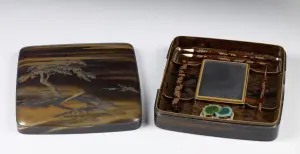
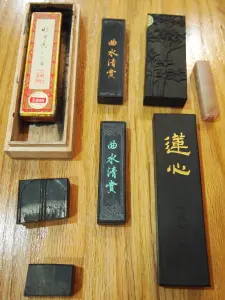
Traditional calligraphy centers on four tools, sometimes called the Four Treasures:
- Fude: a flexible brush whose tip can produce a hairline, a broad stroke, or a textured edge.
- Sumi: solid ink made into a usable liquid by grinding it with water, or prepared liquid ink for everyday practice.
- Suzuri: the inkstone on which an ink stick is ground and the liquid ink is held.
- Kami: paper. Absorbency and texture strongly affect how the ink spreads.
A felt mat protects the table and gives the paper a stable surface. A paperweight, or bunchin, keeps the sheet from moving. The preparation of the tools slows the practitioner down before the first stroke is made.
From Chinese models to a Japanese voice
Writing, brush technology, ink, and papermaking reached Japan from the Asian continent, and Chinese calligraphic models deeply shaped early practice. Buddhist scriptures, official records, and the education of the court all depended on skilled writing. Copying respected works—rinsho—became a central method of learning.
During the Heian period (794–1185), the development of kana made it possible to write Japanese more flexibly. Calligraphers created a softer and more flowing Japanese style known as wayō. Poetry, decorated paper, and the movement of kana across a page produced forms that differed from Chinese prototypes while remaining in conversation with them. The Tokyo National Museum identifies Ono no Tōfū, Fujiwara no Sari, and Fujiwara no Kōzei as key figures in the establishment of Japanese-style calligraphy.
Three fundamental script styles
- Kaisho: regular or block script. Strokes are clearly separated, making it a foundation for beginners.
- Gyōsho: semi-cursive script. Movements connect more freely while the characters remain comparatively easy to recognize.
- Sōsho: cursive script. Forms may be highly abbreviated, requiring knowledge and practice to read.
These are not simply “easy, medium, and hard” fonts. Each has its own rhythm, conventions, and expressive possibilities. Calligraphers may also work with kanji, kana, classical Chinese texts, modern poetry, or a single large character.
Production process
Practice often begins with posture and the way the brush is held. The whole arm can guide a stroke; the fingers alone do not do all the work. The brush touches down, changes pressure, travels, turns, and lifts. Entry and exit are part of the line. The ink may begin deep black and gradually become pale or dry as the brush moves across the sheet.
Composition is planned through character size, spacing, line length, and the surrounding blank space, or yohaku. A personal seal in red ink, called an inkan or rakkan-in, may complete the work. Mounting the paper as a hanging scroll or framed piece changes how the composition is encountered.
Learning through repetition
Students commonly copy a model written by a teacher or a historical master. This is not treated as a lack of originality. Repetition trains the eye and body to recognize structure before personal expression is introduced. A teacher may correct the angle of one stroke, the center of gravity of a character, or the relationship between two lines rather than simply judging whether the whole piece looks attractive.
Brush writing remains familiar in Japanese education. Children learn its basics in school, and many attend private calligraphy classes. The New Year custom of kakizome—the first calligraphy of the year—turns wishes or resolutions into a seasonal act of writing.
Calligraphy in everyday Japan
Shodō appears beyond galleries. Temple inscriptions, shop signs, labels, festival banners, New Year cards, and the handwritten titles used in film and design all draw on calligraphic sensibility. Contemporary artists may write on very large paper, perform with music, introduce color, or combine traditional brushwork with digital media.
Aesthetic interpretation
Begin with the whole page before trying to read it. Notice where the darkest ink gathers, where the brush accelerates, and how much room the characters are given. Then move closer: a single stroke may contain a smooth center, a rough dry edge, and a pool of ink. Reading the text adds another layer, but visual attention is already a valid way into the work.
For a first lesson, choose a short word and expect to repeat it many times. Grinding ink, arranging the tools, and cleaning the brush are part of the practice. Wear clothing that can survive permanent ink stains.
Terminology
- Rinsho: studying by copying a model.
- Hanshi: a standard practice sheet used widely in schools.
- Kakizome: the first calligraphy written at New Year.
- Yohaku: the expressive blank space around and within the writing.
- Rakkan: an artist’s signature and seal placed on a completed work.
Shodō keeps writing connected to the body. It turns language into movement and asks the practitioner to balance discipline with presence. In an age of identical digital characters, the brush preserves the unrepeatable qualities of pressure, time, and touch.
How to look at a work of shodo
Begin by identifying the text, script style, format, and reading direction. Then look at stroke order, changes in pressure and speed, the beginnings and endings of lines, ink density, spacing within and between characters, surrounding blank paper, and the balance of the whole composition. A copied model can still reveal individual execution because brush movement cannot be reduced to the character’s dictionary form.
Legibility is only one criterion and should not become a simple quality ranking. Compare how the same character changes across kaisho, gyosho, and sosho, and distinguish controlled abbreviation from an accidental or unreadable mark. The Tokyo National Museum’s guide to Japanese-style calligraphy is a starting point for relating writing, historical models, and visual expression.
Related entries
For the principal standard, semi-cursive, and cursive writing styles, see Kaisho, Gyosho and Sosho.
Sources and further reading
Last updated: