Calligraphy
Kaisho, Gyosho and Sosho
Image: Nishikawa Shundō; National Diet Library scan / Wikimedia Commons · Public domain
Overview
| Japanese | 楷書・行書・草書 |
|---|---|
| Type | Calligraphic script styles |
| Sequence | Block, semi-cursive, and cursive |
| Origin | Chinese writing traditions adapted in Japan |
| Difference | Readability versus speed and expressive flow |
Kaisho, gyosho, and sosho (Japanese: 楷書・行書・草書) are three major writing styles used in Japanese calligraphy. They are usually rendered in English as standard, semi-cursive, and cursive. The styles differ in the degree to which strokes are separated, connected, abbreviated, or transformed. They are related historically and can be used for artistic, religious, literary, and practical writing. They should not be understood only as neat, medium, and messy versions of the same handwriting.
Kaisho
Kaisho (楷書), the standard style, forms characters with clearly articulated strokes and comparatively stable proportions. The brush normally pauses or changes direction at recognizable points, making the structure easier to analyze. Kaisho is commonly used in beginning shodo instruction because it reveals stroke order, balance, and the relationship among a character’s parts.
“Standard” does not mean mechanically uniform. Calligraphers vary pressure, rhythm, line quality, and spacing while maintaining legibility and structural clarity.
Gyosho
Gyosho (行書), the semi-cursive or “running” style, allows strokes to flow into one another and permits selected abbreviations. The brush moves more continuously than in kaisho, but character forms often remain accessible to readers familiar with Japanese writing.
Gyosho has long served both everyday writing and artistic calligraphy. Its balance between clarity and movement makes it suitable for letters, poems, signs, and works intended to show an individual hand without abandoning legibility.
Sosho
Sosho (草書), the cursive or “grass” style, uses extensive abbreviation and continuous brush movement. Strokes may merge, disappear, or take shapes quite different from modern printed characters. Reading sosho requires specialized knowledge because visual economy and historical convention are more important than ordinary legibility.
The name does not mean that the form is casual or uncontrolled. Accomplished sosho depends on memorized forms, disciplined movement, rhythm, and awareness of the space between inked lines.
Historical background
These styles developed from Chinese calligraphic traditions and were transmitted to Japan with written Chinese culture. Japanese calligraphers studied continental models and adapted them within local practices, including writing that combined kanji and kana. The styles continued to change through court, temple, scholarly, and artistic lineages.
They coexist with other forms, including seal style and clerical style. A single work may also combine tendencies, so classification is a guide rather than an inflexible boundary.
Brushwork and composition
The distinction among kaisho, gyosho, and sosho concerns more than the outline of individual characters. Brush speed, pressure, ink, stroke connection, spacing, and the relation of dark and empty areas all contribute. Moving toward cursive form often increases continuity, but the calligrapher must still control structure and timing.
Learners often study kaisho before gyosho and sosho, yet historical calligraphy is not a single ladder in which cursive work is automatically more advanced or more valuable. Each style has its own conventions and demands.
Contemporary use
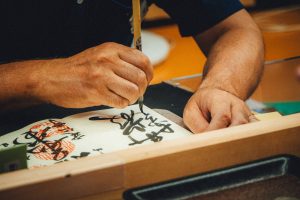
The three styles remain part of school and studio calligraphy, exhibitions, temple and shrine writing, certificates, design, and personal correspondence. Digital typefaces imitate their surfaces, but brush-written works retain variations produced by the tool, material, and movement of the writer.
How to compare the three scripts without ranking them
Compare the same character or phrase in all three scripts. Note whether strokes remain discrete or connect, which elements are abbreviated, how brush rhythm changes, how the character occupies space, and what knowledge a reader needs to recognise it. This controlled comparison is more informative than comparing unrelated works with different texts, sizes, tools, and purposes.
Kaisho, gyosho, and sosho should not be presented as a simple beginner–intermediate–advanced ladder. Masterful kaisho demands control, while fluent gyosho and sosho depend on learned conventions rather than arbitrary speed. The Metropolitan Museum of Art’s overview of Japanese brush writing and the Japan Foundation’s calligraphy guide help place the styles within artistic practice. See Shodo for materials and viewing methods, and Japanese Writing System for the wider script context.
Related entries
Sources and further reading
Last updated: