Gardens
Tsukiyama
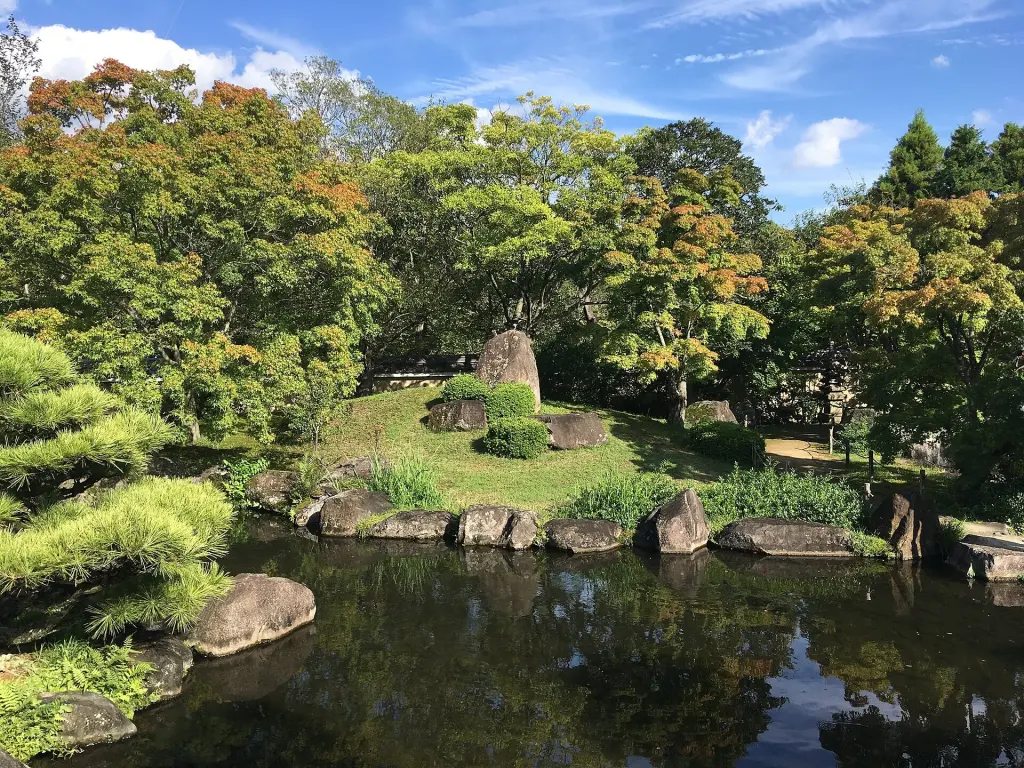
Image: Christophe95 / Wikimedia Commons · CC BY-SA 4.0
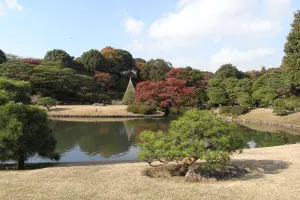
Tsukiyama are artificial hills constructed within Japanese gardens. The word can identify a single earthen landform or, in expressions such as tsukiyama niwa and tsukiyama chisen, a hill or hill-and-pond garden organized around modeled terrain. Builders use earth, stones, planting, and water to create slopes, promontories, islands, valleys, and elevated viewpoints. A tsukiyama may suggest a distant mountain or famous landscape, conceal part of a site, screen surrounding buildings, or provide a place from which to view a pond. The category is not the opposite of naturalism: these hills are deliberate constructions that make designed space feel topographically varied. Their scale ranges from modest garden mounds to prominent features in large strolling gardens.
Overview
| Japanese name | 築山 |
|---|---|
| Romanization | Tsukiyama |
| Literal meaning | Constructed mountain |
| Classification | Artificial hill or hill-garden element |
| Frequent combination | Pond, streams, stones, paths, and planting |
| Prominent use | Court, temple, residence, and strolling gardens |
Term and boundaries
Tsukiyama literally means constructed mountain. As a garden term it first describes an artificial earthen hill. The related term tsukiyama niwa refers to a garden for which such a hill is a crucial feature, and tsukiyama chisen emphasizes the common combination of hills and ponds.
Not every mound is a symbolic mountain, and not every pond garden is classified primarily as tsukiyama. The term may name a physical element, a compositional approach, or a broad garden type depending on the source and period.
Early precedents
Artificial hills appeared in early palace and residential garden traditions influenced by continental models. Excavations at the Eastern Palace Garden of the Nara palace site revealed an eighth-century hill with stone arrangements beside a carefully shaped pond, providing material evidence beyond later manuals and paintings.
Heian-period gardens continued to model shorelines, islands, hills, and watercourses around elite residences and temples. These features supported ceremony, boating, seasonal viewing, and religious representation as well as visual pleasure.
Hill-and-pond composition
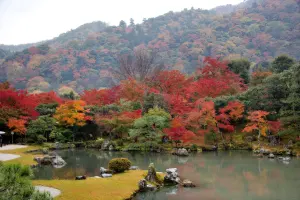
In a hill-and-pond garden, excavated soil can help form raised ground around a water body. Slopes, peninsulas, islands, and stonework create varied shorelines and apparent distance. The hill may form a backdrop, divide scenes, or lead the eye toward a waterfall or borrowed view.
Water and earthworks are technically connected. Drainage, soil stability, pond lining, erosion, and plant roots all affect how the intended topography survives. A visually natural slope depends on careful engineering and maintenance.
Miniature landscape and reference
Tsukiyama can condense a larger landscape within a garden. Hills and stones may evoke mountain ranges, islands of immortals, famous places, or scenes from poetry. The practice of mitate allows one feature to be seen as another without requiring literal imitation.
Documented names and historical descriptions are important because modern viewers can easily assign symbolic meanings that were not recorded. Some hills mainly solve spatial or practical problems while still contributing to a landscape image.
Paths and changing views
Large early modern strolling gardens use constructed hills to create ascent, descent, concealment, and changing views. A path can lead to a lookout over a pond, turn behind a planted slope, or reveal a bridge and tea house from a new angle. Even modest height can transform the perceived scale of a flat site.
The experience is closely related to shakkei. A raised viewpoint may reveal distant scenery, while a hill or its planting can hide unwanted surroundings and frame the desired view.
Manuals and early modern spread
The word tsukiyama became especially common in the Edo period. Garden manuals such as the eighteenth-century Tsukiyama Teizōden circulated terminology, models, and instructions among designers, craftsmen, and patrons. In some usage, tsukiyama became nearly synonymous with garden making more broadly.
Manuals are evidence of transmission, not proof that every built garden followed a single book. Regional practice, available land, patronage, and existing topography continued to produce substantial variation.
Preservation and reconstruction
Artificial hills are vulnerable to erosion, compaction, root damage, landslides, path wear, and changes in water level. Trees that mature over centuries can alter both the silhouette and structural stability of a slope. Conservation therefore combines archaeology, arboriculture, hydrology, and garden history.
Reconstruction requires restraint. Excavated soil layers, stone positions, historic plans, paintings, and photographs can guide work, but incomplete evidence should be acknowledged rather than filled with a generic image of a Japanese hill garden.
Sources
- Web Japan, Gardens Fact Sheet.
- Government of Japan, Japanese Gardens as Living Organisms.
- Japan National Tourism Organization, Japanese Gardens and Zen Gardens Around Japan.
- Nara National Research Institute for Cultural Properties, Japanese Garden Dictionary: Artificial Hill.
- Nara National Research Institute for Cultural Properties, Japanese Garden Dictionary: Hill Garden.
- Nara National Research Institute for Cultural Properties, East Palace Garden.
- JAANUS, Tsukiyama.
Last updated: