Gardens
Karesansui
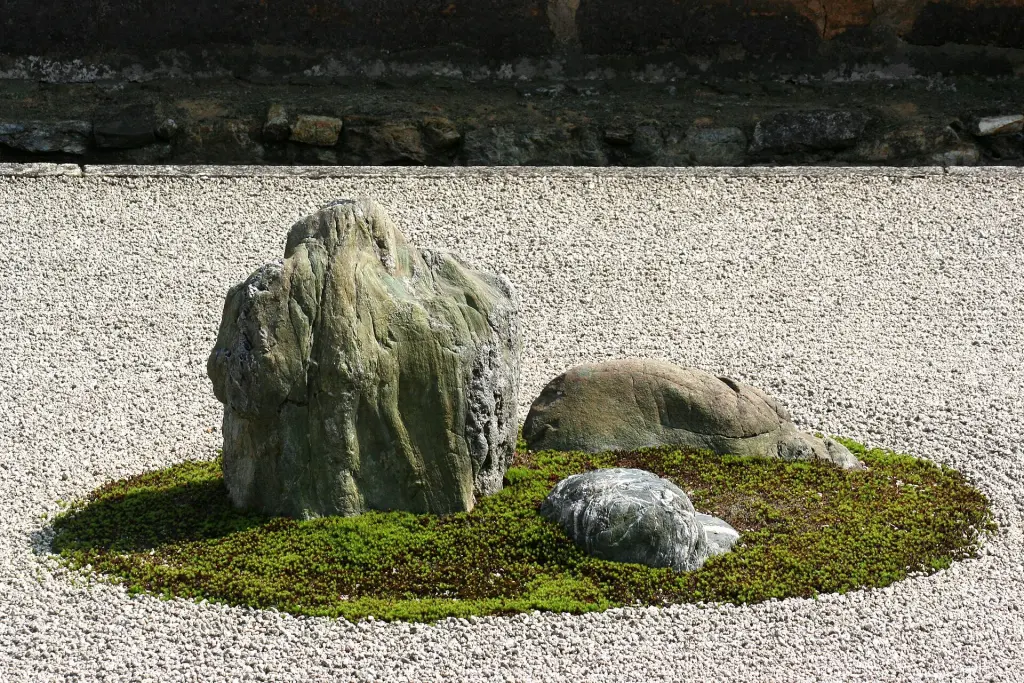
Image: Tedmoseby / Wikimedia Commons · CC BY-SA 3.0
Karesansui are Japanese dry landscape gardens in which stones, gravel, sand, and sometimes moss or other planting evoke mountains, islands, waterfalls, streams, or open water without relying on a visible pond. The term appears in the eleventh-century garden manual Sakuteiki, but the compositions most commonly associated with it developed in medieval and early modern settings. Many were made beside Zen temple abbot's quarters and viewed from a veranda or room. Calling every karesansui a “Zen garden,” however, can obscure differences in date, patronage, imagery, and use. The form is defined by its landscape representation and handling of dry materials, not by an automatic guarantee of meditation, emptiness, or one fixed philosophical meaning.
Overview
| Japanese name | 枯山水 |
|---|---|
| Romanization | Karesansui |
| Common translation | Dry landscape |
| Primary materials | Stone, gravel, sand, moss, and limited planting |
| Prominent development | Medieval and early modern periods |
| Frequent setting | Temple residences and viewing gardens |
Name and boundaries
Karesansui literally combines characters for dry, mountain, and water. In garden history it identifies landscapes that represent water and terrain through dry materials. A composition may include moss or shrubs, so dry does not necessarily mean entirely plantless. Nor is every garden containing gravel and rocks a karesansui.
The English label rock garden is convenient but incomplete because gravel fields, raked patterns, planted margins, walls, and architectural viewpoints can be as important as the stones. Zen garden is even narrower and should be used cautiously.
Early term and later development
The Sakuteiki, compiled in the late Heian period, uses karesansui for dry stone arrangements made where there was no pond or stream. Garden historians distinguish these early usages from the later, more fully developed dry landscapes familiar at medieval temples.
During the Muromachi period, specialist garden makers and temple patrons created increasingly concentrated compositions. Their visual language interacted with older garden practice, Buddhist imagery, and Chinese landscape painting. The history is cumulative rather than a sudden invention by one person or institution.
Stone, gravel, and representation
Upright, reclining, and grouped stones can suggest peaks, islands, boats, animals, or sacred formations. Raked gravel or sand may evoke water, currents, or spatial distance, while a dry waterfall uses rockwork to imply falling water without a flowing source. Meanings depend on the specific site and evidence.
Representation is not always a one-to-one code. The same arrangement can support several readings, and some modern interpretations go beyond what historical records establish. Formal analysis should be separated from later legend.
Composition and viewing
Many celebrated karesansui were composed for viewing from a nearby building. Walls, veranda posts, thresholds, and the viewer's seated position frame the scene. Overlapping stones, empty intervals, texture, and asymmetrical groupings create depth within a shallow site.
A garden can change with rain, shadows, moss growth, fallen leaves, and the angle of light. Regular raking is maintenance and performance: it renews the gravel surface while making the labor behind the apparently stable composition visible.
Zen and temple context
Karesansui are strongly associated with Zen because major examples survive at Rinzai temples and because medieval Zen culture engaged with Chinese painting, poetry, and landscape imagery. Temple residence gardens could support contemplation, reception, ritual life, and the status of the institution.
The association should not be turned into a claim that one universal Zen doctrine determines every stone. Attribution, date, and intended symbolism are disputed at some famous sites, and later tourism has amplified simplified meditative explanations.
Historical and modern examples
Ryōanji, Daisen-in, Saihōji, and several subtemples of Daitokuji are central to histories of dry landscape design, though their gardens differ greatly. Saihōji includes a dry rock composition on a slope, while Ryōanji's rectangular gravel court presents fifteen stones in groups.
Twentieth-century designers such as Shigemori Mirei reworked karesansui through new geometry, materials, and historical references. Dry landscapes have also been created internationally, where climate, plant selection, and institutional purpose reshape the tradition.
Preservation and interpretation
Preserving karesansui involves walls, drainage, gravel, moss, trees, stone stability, and surrounding views. Repeated maintenance alters surfaces while keeping the composition legible. Historical photographs, excavation, repair records, and garden manuals help distinguish earlier fabric from later restoration.
Visitors should treat fixed explanations of every rock with care. Site interpretation is strongest when it identifies documented history, acknowledges uncertainty, and explains how the garden's architecture and viewing conditions shape experience.
Sources
- Web Japan, Gardens Fact Sheet.
- Government of Japan, Japanese Gardens as Living Organisms.
- Japan National Tourism Organization, Japanese Gardens and Zen Gardens Around Japan.
- JAANUS, Karesansui.
- Journal of the Japanese Institute of Landscape Architecture, The Origin of the Karesansui in Sakuteiki Style.
- Japan Tourism Agency, Rock Garden at Saihōji.
Last updated: