
Kendo
Kendo Rules
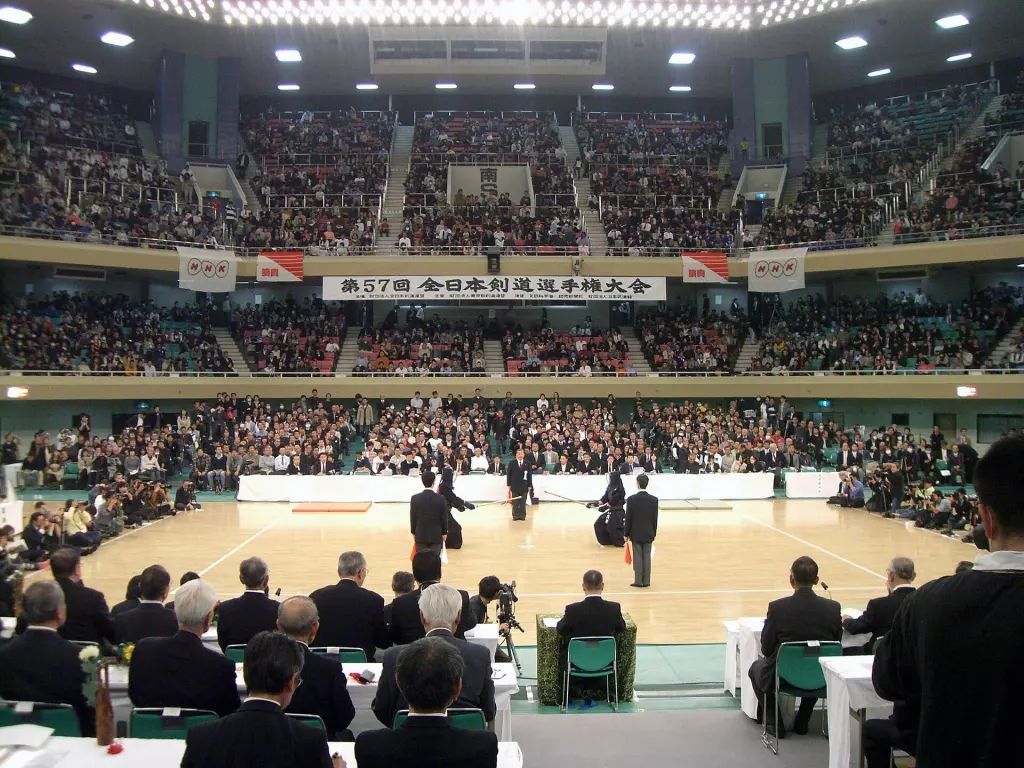
Image: Tasogare / Wikimedia Commons · CC BY-SA 3.0
Kendo rules govern shiai, or competition, by defining the contest area, permitted equipment, match duration, victory, Yūkō-datotsu, prohibited conduct and refereeing procedure. This article primarily covers the All Japan Kendo Federation regulations and their current Japanese application, while identifying the International Kendo Federation documents used internationally. Current materials researched: 2 September 2026. The core AJKF rules remain supplemented by the operational guide implemented on 1 September 2024 and an interpretation notice published in April 2026; FIK’s English regulations were revised on 26 July 2023 and its current management handbook is dated 7 July 2025. Tournament provisions, school and youth rules, and national federation adaptations can change match length or decision methods, so one event’s format should not be treated as universal Kendo practice.
Overview
| Japanese | 剣道試合・審判規則 |
|---|---|
| Reading | けんどうしあい・しんぱんきそく |
| Romanisation | kendō shiai・shinpan kisoku |
| Japanese governing body | All Japan Kendo Federation |
| International governing body | International Kendo Federation |
| Current materials researched | 2 September 2026 |
| Standard scoring format | Sanbon-shōbu |
What rules this article covers
The AJKF rulebook governs its competitions in Japan. The 2024 operational guide explains refereeing practice and made selected provisional pandemic-era procedures permanent without rewriting the core regulations. The April 2026 notice clarified cancellation procedure, a stoppage request and a team-line-up diagram.
FIK maintains its own regulations for international events. The 2023 revision states that its alterations were mainly linguistic and made no major rule change; the 2025 handbook develops management and referee guidance. Event regulations can add further provisions.
Contest area and equipment
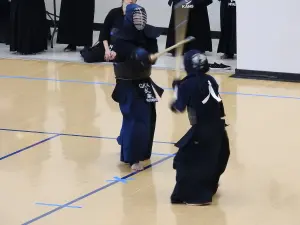
The standard contest area is a square or rectangle measuring nine to eleven metres on each side, including the boundary. A safety space of at least 1.5 metres is specified outside it, and starting lines are marked around the centre.
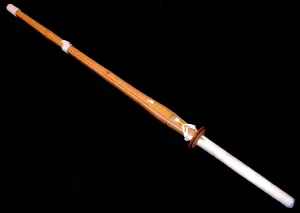
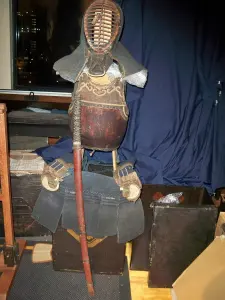
Competitors use a regulation Shinai, Bōgu, kendōgi and hakama, with red or white identification. Shinai specifications and equipment details are set by subsidiary rules and tournament inspection.
Match duration
Under the FIK regulations, the standard match duration is five minutes and a period of en-chō is three minutes. Time between a referee’s declaration of a point or stoppage and the restart is excluded.
These are standards, not a promise that every bout lasts five minutes. Youth, school, preliminary, team and event regulations may prescribe shorter matches, different extension blocks or time limits for organisational reasons.
How victory is decided
The ordinary format is sanbon-shōbu. The first competitor to score two points wins; if only one point is scored before time expires, that competitor wins. An event may instead use ippon-shōbu.
If regulation time does not decide the match, permitted options include extension until the next point, referee decision (hantei), drawing lots (chūsen) or a draw (hikiwake), according to the tournament. The rules therefore separate available decision methods from the chosen event format.
Yūkō-datotsu and ippon
A point requires full energetic commitment, proper posture, contact on a recognised target with the authorised part of the shinai and correct blade alignment, followed by zanshin. Audible impact or target contact alone is insufficient.
Article 26 awards ippon when two or three referees signal validity, or when one signals validity and the other two abstain. A point may be cancelled after conference for improper conduct or deficient readiness after the action.
Legal target areas
The recognised areas are men, kote, dō and tsuki. Subsidiary rules specify the front and side head regions, the wrist or forearm conditions, right and left torso targets, and the throat protector.
Not every protected surface is a target, and the legal kote region changes with guard. Age or event restrictions may limit tsuki even though it appears in the senior rulebook.
Referees and signals
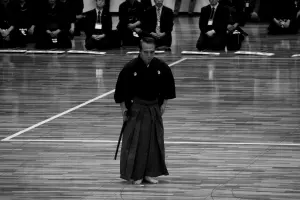
A standard referee group uses a chief referee (shushin) and two subsidiary referees (fukushin), with red and white flags. Each must judge and signal independently while sharing the rule standard.
The chief referee announces points, stoppages, infringements and outcomes. Gōgi allows the referees to confer over uncertain facts or an error; it is a regulated procedure rather than an appeal by spectators.
Prohibited acts and penalties
Prohibited acts include non-regulation equipment, tripping or sweeping, unfairly pushing an opponent out, leaving the area, releasing the shinai, unjustified stoppage requests, time-wasting, improper close engagement and other rule violations. Serious categories include prohibited substances and offensive conduct.
For ordinary infringements, two hansoku by one competitor award one point to the opponent; infringements accumulate within the match as the rules specify. Illegal equipment and serious misconduct have distinct consequences and should not be described as merely another two-warning sequence.
Tsubazeriai and separation
Tsubazeriai is the close relationship in which the guards compete. Under the AJKF operational approach implemented in 2024, competitors should attack actively or separate actively rather than use prolonged close contact to waste time.
The guide evaluates correct guard relationship, intention to strike and intention to separate. Conduct during separation can itself be penalised. FIK and local event guidance must be checked because the operational language and enforcement setting are not identical everywhere.
Team competition
In the common head-to-head team method, the team with more individual winners prevails; if equal, points are compared, and a representative match can decide a continuing tie. The rules also recognise kachinuki, in which a winner continues.
Team size, order, tie-break procedure and substitutions are set in event regulations. “Team Kendo” therefore names several recognised competition formats rather than one invariant global bracket.
Youth, school and national differences
School federations and organisers may shorten time, modify extension, restrict techniques such as tsuki, or adapt equipment and contact expectations for age and experience. National members of FIK also publish local guidance.
A rule summary should identify its authority and date. It should not instruct a child or beginner to follow unrestricted senior international rules when the responsible school, dōjō or federation applies a safer standard.
How the rules have changed
Kendo competition developed through the modern standardisation of target areas, equipment and referee judgement. The 2019 AJKF revision changed safety-related shinai and kendōgu provisions, while the pandemic period produced temporary close-contact procedures.
From 1 September 2024, the AJKF retained selected operational principles—especially active action or separation in tsubazeriai—through its revised guide rather than by altering the core articles. The April 2026 interpretation added procedural clarification. This page should therefore be maintained as an update-tracked article.
Competition rules and wider Kendo
Competition is one part of Kendo. Kata, basic drills, ji-geiko, grading, etiquette and educational practice have purposes that cannot be reduced to points and penalties.
Conversely, historical sword traditions do not determine current tournament legality. A method may be historically documented yet prohibited, restricted or irrelevant in modern shiai; Kendo Terminology helps keep those contexts distinct.
Sources
- All Japan Kendo Federation, Regulations and Subsidiary Rules of Kendo Shiai and Shinpan.
- All Japan Kendo Federation, Kendo Shiai, Shinpan and Operational Guide.
- All Japan Kendo Federation, Interpretation and Application of the Shiai and Shinpan Regulations, April 2026.
- International Kendo Federation, Regulations of Kendo Shiai and Shinpan, revised 26 July 2023.
- International Kendo Federation, Handbook for Kendo Shiai and Shinpan Management, 7 July 2025.
- All Japan Kendo Federation, Operational Guide Revision Implemented 1 September 2024.
- All Japan Kendo Federation, Library of Official Documents.
- All Japan Kendo Federation, 2019 Revision of the Kendo Shiai and Shinpan Regulations.
Last updated:
_2.jpg)