
Tomoe-nage
巴投ともえなげ
Tomoe or circular-crested throw
- Ma-sutemi-waza
- Gokyō: Dai-sankyō
- Nage-no-kata
Key idea
The defining action joins forward imbalance to a controlled rearward sacrifice.
Kodokan official demonstration
Kodokan technique list (opens in a new tab)YouTube (opens in a new tab)
VISUAL GUIDE
How to read the movement
Look for tori dropping backwards and using the foot as a pivot to guide uke through a forward arc.
- Tori
- the person applying the technique
- Uke
- the person receiving the technique
- Red line
- main direction or point of contact
AT A GLANCE
Technique shape
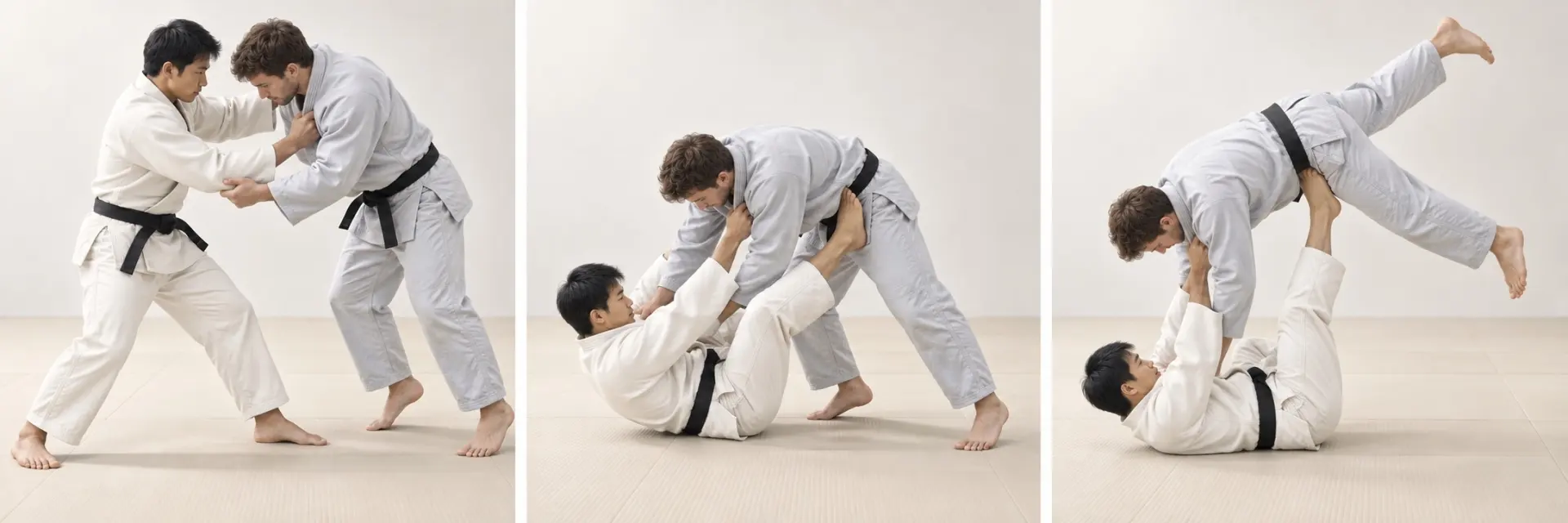
IN SEQUENCE
Three-frame concept
- 1Draw uke forward
- 2Drop backwards
- 3Guide in an arc over the foot
Original AI-generated educational illustration for TokyoWaltz, 2026. A simplified three-stage concept; practise under qualified instruction.
PLAY WHEN NEEDED
Watch the movement slowly
- 1Starting pointDraw uke forward
- 2Decisive actionDrop backwards
- 3CompletionGuide in an arc over the foot
1 / 3Starting point— Draw uke forward
Follow the red line and phase indicator. The guide does not autoplay or loop.
How it works
Tomoe-nage joins forward imbalance to a controlled rearward sacrifice.
Kuzushi
Create the imbalance
Kuzushi is directed forward so the opponent cannot settle back over the heels. Tsukuri places the thrower beneath the opponent’s line while maintaining space and control for a safe projection.
Tsukuri
Enter with control
Kuzushi is directed forward so the opponent cannot settle back over the heels. Tsukuri places the thrower beneath the opponent’s line while maintaining space and control for a safe projection.
Kake
Complete the action
Kuzushi is directed forward so the opponent cannot settle back over the heels. Tsukuri places the thrower beneath the opponent’s line while maintaining space and control for a safe projection.
Key points
- Kuzushi is directed forward so the opponent cannot settle back over the heels. Tsukuri places the thrower beneath the opponent’s line while maintaining space and control for a safe projection.
- Kuzushi is directed forward so the opponent cannot settle back over the heels. Tsukuri places the thrower beneath the opponent’s line while maintaining space and control for a safe projection.
- Kuzushi is directed forward so the opponent cannot settle back over the heels. Tsukuri places the thrower beneath the opponent’s line while maintaining space and control for a safe projection.
Similar techniques
| Technique | Japanese name | Key difference |
|---|---|---|
| Ura-nage | 裏投 | Ura-nage counters a forward attack with a close body lift and a backward sacrifice that carries uke over the shoulder; Tomoe-nage joins forward imbalance to a controlled rearward sacrifice. |
| Sumi-gaeshi | 隅返 | Sumi-gaeshi sacrifices backward while a lower leg lifts the inside of uke’s thigh and close upper-body control sends uke overhead; Tomoe-nage joins forward imbalance to a controlled rearward sacrifice. |
| Hikikomi-gaeshi | 引込返 | Hikikomi-gaeshi uses a belt grip over the back, a backward sacrifice, and an inner-thigh lift to take uke overhead; Tomoe-nage joins forward imbalance to a controlled rearward sacrifice. |
Reference
Open the detailed source material when you need definitions, technical distinctions, training context, or references.
Official definition
Official definition
The Kodokan definition describes breaking the opponent forward, falling backward, placing a foot against the lower front of the opponent’s torso, and lifting and directing the opponent over the thrower. The representative form establishes the central relationship without prescribing one compulsory grip or entry.
Recognised variations may change foot placement, body angle, or whether one or both feet contribute, provided that the principal tomoe-nage mechanism remains identifiable.
Technical principle
Tomoe-nage joins forward imbalance to a controlled rearward sacrifice. The hands keep the opponent connected while the supporting relationship between the foot and lower torso converts the thrower’s descent into an upward and forward path.
The foot is not used as an uncontrolled kick. In training, its role is to support and direct the opponent while the hands, trunk, and falling path remain coordinated.
Name and classification
Overview
| Japanese | 巴投 |
|---|---|
| Reading | ともえなげ |
| Romanisation | tomoe-nage; common search form: tomoe nage |
| Meaning | Tomoe or circular-crested throw |
| Martial art | Judo |
| Official classification | Kodokan ma-sutemi-waza |
| Gokyō no Waza | Dai-sankyō |
| Kata | Nage-no-kata, ma-sutemi-waza set |
Name and meaning
The name is written 巴投. Tomoe is the comma-like, curved motif seen in Japanese crests and decorative design; nage means throw. The name is commonly understood as referring to the circular visual relationship or path of the movement.
That interpretation describes the form of the action. It should not be expanded into claims about ancient symbolism or warrior spirituality without documentary evidence.
Classification as ma-sutemi-waza
The Kodokan classifies tomoe-nage as ma-sutemi-waza, the rear-sacrifice branch of Sutemi-waza. Ma indicates a direct or rearward sacrifice line, distinguishing it from yoko-sutemi-waza, in which the thrower falls more clearly onto a side.
The category identifies how the thrower’s fall contributes to the throw. It does not mean that every backward fall with a foot on the opponent is tomoe-nage.
Detailed execution
Kuzushi, tsukuri and kake
Kuzushi is directed forward so the opponent cannot settle back over the heels. Tsukuri places the thrower beneath the opponent’s line while maintaining space and control for a safe projection. Kake completes the curving lift and direction as the thrower falls onto the back.
These phases overlap. If connection is lost during the descent, the action may become a failed pull to the ground rather than a completed throw.
Sacrifice throws in Judo
In Judo, a sacrifice throw uses the thrower’s deliberate fall as part of the throwing power and direction. The term does not imply self-injury or recklessness. A controlled sutemi-waza retains technical connection and responsibility for the receiving partner’s landing.
This is a Kodokan technical category. Competition rules separately decide whether a particular action scores, continues into ne-waza, or breaks a safety rule.
Common variations
Tomoe-nage can be performed with different grips, a more central or slightly angled foot placement, and one- or two-foot support. Yoko-tomoe-nage is a widely used descriptive label for a more oblique entry and projection, but it is not a separate name in the current Kodokan list of 68 nage-waza.
Variation labels should therefore describe the observed form without obscuring the official classification.
Tomoe-nage in Nage-no-kata
Tomoe-nage is the first technique in the ma-sutemi-waza set of Kata in Judo's Nage-no-kata, followed by ura-nage and sumi-gaeshi. The formal presentation studies attack, response, balance, sacrifice, and a controlled receiving fall.
The kata form is not a complete catalogue of every tomoe-nage variation. It is a structured study of the throw’s principle.
Variations
Relationship with Sumi-gaeshi
Tomoe-nage and sumi-gaeshi are both ma-sutemi-waza and both use a rearward fall to project the opponent. In the Kodokan representative tomoe-nage, the foot supports the lower front of the torso and the projection travels forward over the thrower. In sumi-gaeshi, the instep or lower leg acts against the opponent’s inner thigh or leg line and the opponent is directed toward a rear corner.
Competitive entries can blur the appearance, especially from bent or asymmetric postures. The principal point of support and throwing direction are more useful distinctions than a single photograph or grip.
Training and safety
Training
Training usually progresses from ukemi and controlled placement to complete throws, combinations, and randori. Because both judoka leave or approach the standing base, instruction must manage distance, head position, and the receiver’s landing.
Tomoe-nage should be practised on suitable tatami under qualified supervision. Learners should not imitate high-amplitude or rolling competition variations without the required falling skill.
Competition rules
Competition
Tomoe-nage is legal in IJF competition. Under the rules researched here—the IJF Sport and Organisation Rules dated 14 August 2026—the outcome is scored from the actual landing and skilful control, not merely because an action resembles the named throw.
If the throw does not score, a valid transition may continue into ne-waza. A failed or insincere sacrifice action can instead be treated as a false attack, and dangerous head-first actions remain prohibited. National and youth regulations may add restrictions.
Sources
Sources
- Kodokan Judo Institute, Judo Technique Names.
- Kodokan Judo Institute, Names of Judo Techniques.
- Kodokan Judo Institute, Definitions of Judo Techniques, 2022.
- Kodokan Judo Institute, Nage-no-kata.
- Kodokan Judo Institute, Promotion Examination Text: Kodokan Judo, 2026.
- Sato and Kudo, Historical Development of Judo Techniques, Research Journal of Budo.
- International Judo Federation, Sport and Organisation Rules, 14 August 2026.