
O-uchi-gari
大内刈おおうちがり
Major inner reap
- Ashi-waza
- Gokyō: Dai-ikkyō
Key idea
The defining action attacks an inside supporting line while directing the opponent backward.
Kodokan official demonstration
Kodokan technique list (opens in a new tab)YouTube (opens in a new tab)
VISUAL GUIDE
How to read the movement
O-uchi-gari attacks an inside supporting line while directing the opponent backward.
- Tori
- the person applying the technique
- Uke
- the person receiving the technique
- Red line
- main direction or point of contact
AT A GLANCE
Classification representative
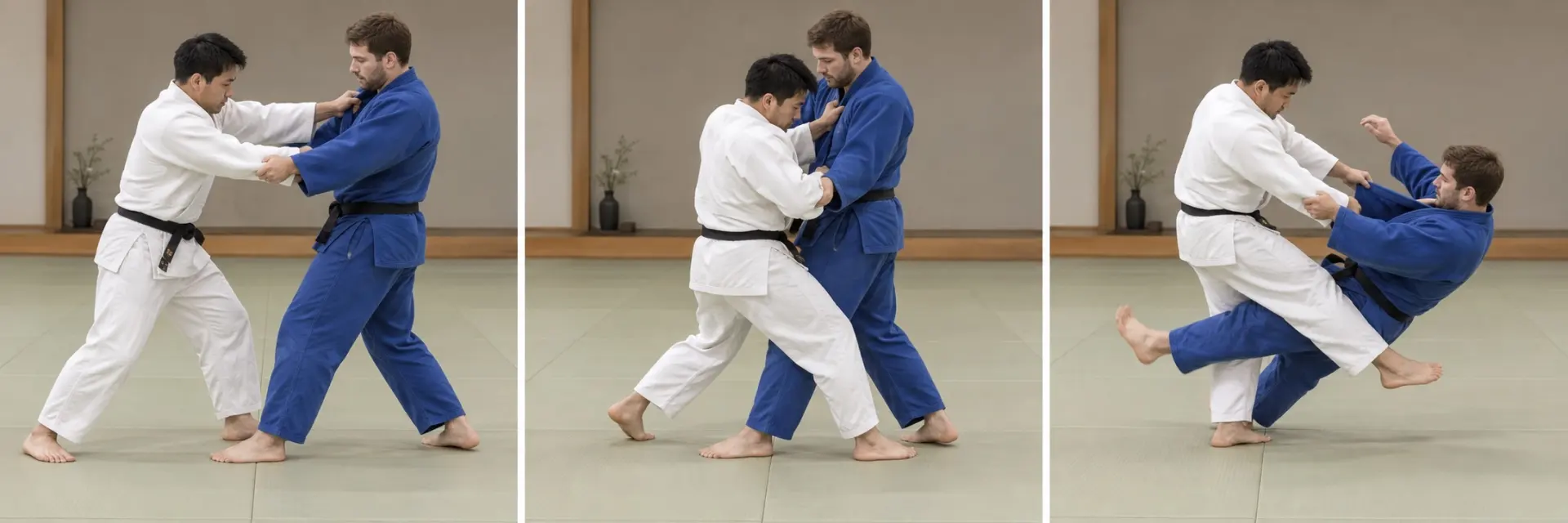
IN SEQUENCE
Three basic phases
- 1Create the imbalance
- 2Enter with control
- 3Complete the action
Original AI-generated educational illustration for TokyoWaltz, 2026. A simplified three-stage concept; practise under qualified instruction.
PLAY WHEN NEEDED
Watch the basic movement slowly
- 1Starting pointCreate the imbalance
- 2Decisive actionEnter with control
- 3CompletionComplete the action
1 / 3Starting point— Create the imbalance
Follow the red line and phase indicator. The guide does not autoplay or loop.
How it works
O-uchi-gari attacks an inside supporting line while directing the opponent backward.
Kuzushi
Create the imbalance
Kuzushi is primarily backward, often with a slight diagonal emphasis toward the attacked leg. The aim is to settle weight where the inside reap can remove support.
Tsukuri
Enter with control
Tsukuri brings the supporting foot and hips close enough for the attacking leg to enter the inside line while the upper body remains connected. The thrower must preserve room for the reaping path rather than simply stepping between the opponent’s feet.
Kake
Complete the action
Kake continues the backward hand-and-trunk action as the attacking leg reaps through the opponent’s leg. The motion removes support and guides the opponent’s back toward the mat under control.
Key points
- Kuzushi is primarily backward, often with a slight diagonal emphasis toward the attacked leg. The aim is to settle weight where the inside reap can remove support.
- Tsukuri brings the supporting foot and hips close enough for the attacking leg to enter the inside line while the upper body remains connected. The thrower must preserve room for…
- Kake continues the backward hand-and-trunk action as the attacking leg reaps through the opponent’s leg. The motion removes support and guides the opponent’s back toward the mat under control.
Similar techniques
| Technique | Japanese name | Key difference |
|---|---|---|
| Ko-uchi-gari | 小内刈 | 小内刈は足元に近い小さな内側の刈りで、大内刈は受の脚の内側へ大きく入って刈ります。 |
| O-uchi-gaeshi | 大内返 | 大内返は大内刈への攻撃に応じて返す別の公式技です。 |
| Ko-soto-gari | 小外刈 | 小外刈は受の足の外側を攻撃し、大内刈は内側から主要な支持脚を刈ります。 |
Technique connections
Countered by
Counters O-uchi-gari
Source: Kodokan
Why this connection?
The Kodokan definition identifies O-uchi-gaeshi as a counter to O-uchi-gari.
Direction: O-uchi-gaeshi → O-uchi-gari
- Kodokan Kodokan Definitions of Judo TechniquesO-uchi-gaeshi definitionVerified: September 3, 2026
Follow-up
O-uchi-gari to Ko-uchi-gari
Source: British Judo Association
Why this connection?
British Judo lists this direction as a renraku-waza example in its Dan-grade skills syllabus.
Direction: O-uchi-gari → Ko-uchi-gari
- British Judo Association Technical Dan Grade Skills Examination FormNage-waza: renraku-waza combinationsVerified: September 3, 2026
View all connections
Set-up
Ko-uchi-gari to O-uchi-gari
Source: British Judo Association
Why this connection?
British Judo lists this direction as a renraku-waza example in its Dan-grade skills syllabus.
Direction: Ko-uchi-gari → O-uchi-gari
- British Judo Association Technical Dan Grade Skills Examination FormNage-waza: renraku-waza combinationsVerified: September 3, 2026
Follow-up
O-uchi-gari to Uchi-mata
Source: British Judo Association
Why this connection?
British Judo lists this direction as a renraku-waza example in its Dan-grade skills syllabus.
Direction: O-uchi-gari → Uchi-mata
- British Judo Association Technical Dan Grade Skills Examination FormNage-waza: renraku-waza combinationsVerified: September 3, 2026
Follow-up
O-uchi-gari to Seoi-nage
Source: Judo Canada
Why this connection?
Judo Canada lists this direction as a transition skill in its national kyu grading syllabus.
Direction: O-uchi-gari → Seoi-nage
- Judo Canada National Kyu Grading Syllabus4th Kyu to 3rd Kyu: transition skillsVerified: September 3, 2026
Reference
Open the detailed source material when you need definitions, technical distinctions, training context, or references.
Official definition
Official definition
The Kodokan representative definition breaks the opponent backward and uses the thrower’s right leg to reap the opponent’s left leg from inside. The opposite-side form reverses this relationship.
The attacked leg is on the opposite side from the reaping leg in this standard description. The upper-body action and direction of instability are part of the definition, not additions to a leg movement.
Technical principle
O-uchi-gari attacks an inside supporting line while directing the opponent backward. The reaping leg travels around and through the opponent’s leg as the hands and trunk prevent a stable recovery step.
The action may finish immediately or make the opponent widen, withdraw, or transfer weight. That second function explains the technique’s importance in combinations even when it does not itself produce the final score.
Name and classification
Overview
| Japanese | 大内刈 |
|---|---|
| Reading | おおうちがり |
| Romanisation | o-uchi-gari; also written ō-uchi-gari |
| Meaning | Major inner reap |
| Martial art | Judo |
| Official classification | Kodokan ashi-waza |
| Gokyō no Waza | Dai-ikkyō |
| Technical authority | Kodokan Judo Institute |
Name and classification
Ō or o (大) means major, uchi (内) means inside, and gari derives from kari (刈), reaping. The name contrasts with ko-uchi-gari (小内刈), the minor inner reap, whose scale and leg relationship differ.
The Kodokan classifies o-uchi-gari as ashi-waza. It is included in Dai-ikkyō of the Gokyō but is not a named technique in Nage-no-kata.
Detailed execution
Kuzushi
Kuzushi is primarily backward, often with a slight diagonal emphasis toward the attacked leg. The aim is to settle weight where the inside reap can remove support.
The opportunity can occur as the opponent steps, stands square, or resists a forward attack. Excessive forward leaning by the thrower can make it easier for the opponent to turn or counter.
Tsukuri
Tsukuri brings the supporting foot and hips close enough for the attacking leg to enter the inside line while the upper body remains connected. The thrower must preserve room for the reaping path rather than simply stepping between the opponent’s feet.
Stance and grip change the exact angle. Same-side and opposite-side situations can both produce o-uchi-gari when the decisive mechanics remain an inside major reap.
Kake
Kake continues the backward hand-and-trunk action as the attacking leg reaps through the opponent’s leg. The motion removes support and guides the opponent’s back toward the mat under control.
A simple hook held in place is not identical to the Kodokan’s reaping description, although competition variations can shorten or modify the visible leg path.
Common variations
O-uchi-gari can be performed from standard sleeve-and-lapel grips, over-the-back grips, and different stance relationships. The entry may be circular, driving, or timed to a step, provided the principal action remains a major inner reap.
Modern contest versions sometimes continue into groundwork when the opponent turns or drops. The transition does not change the standing technique’s classification, but subsequent control belongs to ne-waza rules.
Variations
Relationship with Uchi-mata
O-uchi-gari and uchi-mata attack complementary directions. The inner reap can make the opponent withdraw or lean forward, creating the posture for uchi-mata; a defended uchi-mata can leave weight available for o-uchi-gari.
The connection is especially useful because the two attacks can share early gripping and footwork cues. It remains a responsive combination rather than a guaranteed two-step formula.
Relationship with Ko-uchi-gari
Both techniques attack from inside and are officially ashi-waza. O-uchi-gari makes a major reaping action against the opposite-side leg, whereas ko-uchi-gari uses a smaller inside reap against the corresponding foot or lower leg line.
Their tactical roles can overlap, but the size and direction of the leg action matter when identifying the technique. The English labels “major” and “minor” are technical name elements, not judgments of effectiveness.
Relationship with O-soto-gari
O-uchi-gari attacks from inside while o-soto-gari attacks from outside. Defensive stepping against one can expose the other, and both usually direct the opponent toward a rear corner.
This relationship supports a natural combination cluster for training and analysis. The final classification should follow the leg action that actually removes support.
Training and safety
Training
Training can separate entry distance, reaping path, and upper-body direction before combining them in moving practice. Uchikomi and cooperative movement drills are useful, followed by controlled completions and randori.
Because the feet can become entangled, partners should avoid uncontrolled twisting at the knee and should release failed entries rather than forcing them after alignment is lost.
Competition rules
Competition
O-uchi-gari is legal in IJF competition. The rules researched here are the IJF Sport and Organisation Rules dated 14 August 2026. A score is determined by the landing and general throwing criteria, not merely by identifying the technique.
Current rules on grips, standing-to-ground transitions, and dangerous actions still apply. Youth and domestic organisers may use additional restrictions or modified scoring.
Sources
Sources
- Kodokan Judo Institute, Judo Technique Names.
- Kodokan Judo Institute, Definitions of Judo Techniques, 2022.
- Kodokan Judo Institute, Promotion Examination Text: Kodokan Judo, 2026.
- Study of the Effective Throwing Direction of O-uchi-gari, 2023.
- Landing and Head-motion Analysis of O-soto-gari and O-uchi-gari.
- International Judo Federation, Sport and Organisation Rules, 14 August 2026.