
Ko-uchi-gari
小内刈こうちがり
- Ashi-waza
- Gokyō: Dai-nikyō
Key idea
The defining action works when balance breaking and the reap become one continuous action.
Kodokan official demonstration
Kodokan technique list (opens in a new tab)YouTube (opens in a new tab)
VISUAL GUIDE
How to read the movement
Ko-uchi-gari works when balance breaking and the reap become one continuous action.
- Tori
- the person applying the technique
- Uke
- the person receiving the technique
- Red line
- main direction or point of contact
AT A GLANCE
Classification representative
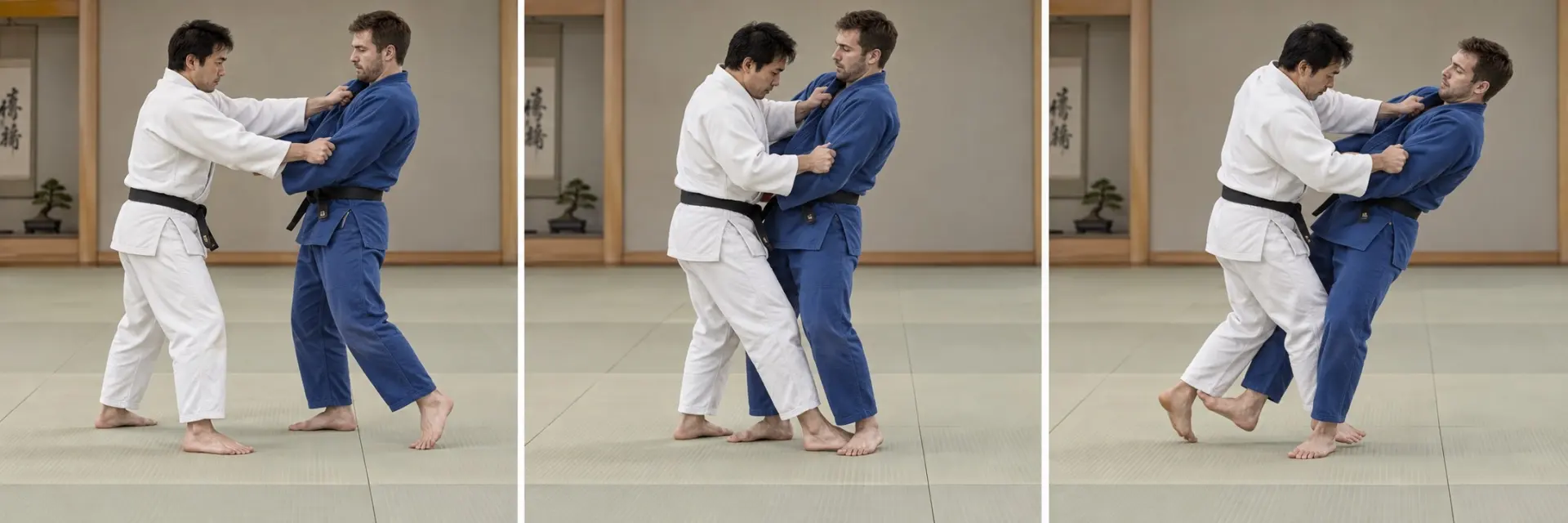
IN SEQUENCE
Three basic phases
- 1Create usable imbalance
- 2Enter and stay connected
- 3Complete the defining action
Original AI-generated educational illustration for TokyoWaltz, 2026. A simplified three-stage concept; practise under qualified instruction.
PLAY WHEN NEEDED
Watch the basic movement slowly
- 1Starting pointCreate usable imbalance
- 2Decisive actionEnter and stay connected
- 3CompletionComplete the defining action
1 / 3Starting point— Create usable imbalance
Follow the red line and phase indicator. The guide does not autoplay or loop.
How it works
Ko-uchi-gari works when balance breaking and the reap become one continuous action.
Kuzushi
Create usable imbalance
Create the imbalance described by the official definition and continue it into the entry. Uke should not be able to recover stable support before the decisive action.
Tsukuri
Enter and stay connected
Enter with stable posture and continuous control. Use the official demonstration to check the required position, contact line, and direction.
Kake
Complete the defining action
Complete the defining action described in the official definition and shown in the demonstration. Maintain control through uke’s fall.
Key points
- Look for uke’s balance moving to the rear or rear corner as the inside of the supporting foot becomes the target.
- The decisive contact is low: tori’s sole reaps or sweeps at the inside of uke’s foot or ankle rather than lifting high on the leg.
- Identify the technique from the coordinated grip, body position, and compact inner reap; a backward landing by itself is not enough.
Similar techniques
| Technique | Japanese name | Key difference |
|---|---|---|
| Ko-soto-gari | 小外刈 | Ko-soto-gari reaps the outside of uke’s near foot as the weight settles backward onto that support; Ko-uchi-gari works when balance breaking and the reap become one continuous action. |
| O-uchi-gari | 大内刈 | O-uchi-gari attacks an inside supporting line while directing the opponent backward; Ko-uchi-gari works when balance breaking and the reap become one continuous action. |
| Ko-soto-gake | 小外掛 | Ko-soto-gake hooks uke’s leg from the outside and lifts or drives through it after taking the balance backward; Ko-uchi-gari works when balance breaking and the reap become one continuous action. |
Technique connections
Countered by
Counters Ko-uchi-gari
Source: Kodokan
Why this connection?
The Kodokan definition identifies Ko-uchi-gaeshi as a counter to Ko-uchi-gari.
Direction: Ko-uchi-gaeshi → Ko-uchi-gari
- Kodokan Kodokan Definitions of Judo TechniquesKo-uchi-gaeshi definitionVerified: September 3, 2026
Set-up
O-uchi-gari to Ko-uchi-gari
Source: British Judo Association
Why this connection?
British Judo lists this direction as a renraku-waza example in its Dan-grade skills syllabus.
Direction: O-uchi-gari → Ko-uchi-gari
- British Judo Association Technical Dan Grade Skills Examination FormNage-waza: renraku-waza combinationsVerified: September 3, 2026
View all connections
Follow-up
Ko-uchi-gari to O-uchi-gari
Source: British Judo Association
Why this connection?
British Judo lists this direction as a renraku-waza example in its Dan-grade skills syllabus.
Direction: Ko-uchi-gari → O-uchi-gari
- British Judo Association Technical Dan Grade Skills Examination FormNage-waza: renraku-waza combinationsVerified: September 3, 2026
Set-up
Uchi-mata to Ko-uchi-gari
Source: British Judo Association
Why this connection?
British Judo lists this direction as a renraku-waza example in its Dan-grade skills syllabus.
Direction: Uchi-mata → Ko-uchi-gari
- British Judo Association Technical Dan Grade Skills Examination FormNage-waza: renraku-waza combinationsVerified: September 3, 2026
Reference
Open the detailed source material when you need definitions, technical distinctions, training context, or references.
Official definition
What this technique is
The Kodokan classifies Ko-uchi-gari as Nage-waza and, more specifically, Ashi-waza. Its defining action is an inside reap against one of uke’s feet while uke’s balance is taken backward. In the right-sided model used by the official definitions, tori’s right foot works against the inside of uke’s right foot. The left-sided version reverses those sides without changing the identity of the technique. The name therefore refers to the decisive foot action and direction of control, not merely to any throw in which uke falls toward the rear.
Core principle
Ko-uchi-gari works when balance breaking and the reap become one continuous action. Tori uses the grip and body movement to make the targeted foot carry weight or become slow to withdraw, then removes that support from the inside. The reaping foot stays close to the mat and acts at the foot or ankle rather than sweeping high up the leg. Because the movement is small, timing and posture matter more than a large swing. The official demonstration is useful for watching how tori remains balanced, keeps control through the fall, and completes the throw without separating the hand action from the foot action.
Detailed execution
Key recognition points
- Look for uke’s balance moving to the rear or rear corner as the inside of the supporting foot becomes the target.
- The decisive contact is low: tori’s sole reaps or sweeps at the inside of uke’s foot or ankle rather than lifting high on the leg.
- Identify the technique from the coordinated grip, body position, and compact inner reap; a backward landing by itself is not enough.
Distinguishing this technique
Ko-uchi-gari and O-uchi-gari are both inner reaps, but the official right-sided descriptions attack different supports. Ko-uchi-gari uses the right foot against the inside of uke’s right foot; O-uchi-gari uses the right leg to reap uke’s left leg from the inside and normally shows a larger reaping path. Ko-soto-gari also attacks uke’s right foot in the standard description, but works from the outside rather than the inside. De-ashi-harai is distinguished by its timing against a foot that is advancing and taking weight. These comparisons are recognition aids, not a claim that every live exchange will have a single fixed grip, step, or visual shape.
Training and safety
Training and safety
Practise Ko-uchi-gari only under a qualified Judo instructor, with adequate space and a partner who can perform ukemi. Begin with controlled entries and agreed movement before adding speed or resistance. Avoid twisting a trapped knee or ankle, kicking the leg, or driving a partner backward without control of the fall. The written description and official video are study aids, not substitutes for supervised instruction. Competition rules and permitted applications can change, so confirm the ruleset used by the relevant event or governing body.