
Uchi-mata
内股うちまた
Inner thigh
- Ashi-waza
- Gokyō: Dai-nikyō
- Nage-no-kata
Key idea
The defining action combines forward imbalance, a turning body, and an upward sweep.
Kodokan official demonstration
Kodokan technique list (opens in a new tab)YouTube (opens in a new tab)
VISUAL GUIDE
How to read the movement
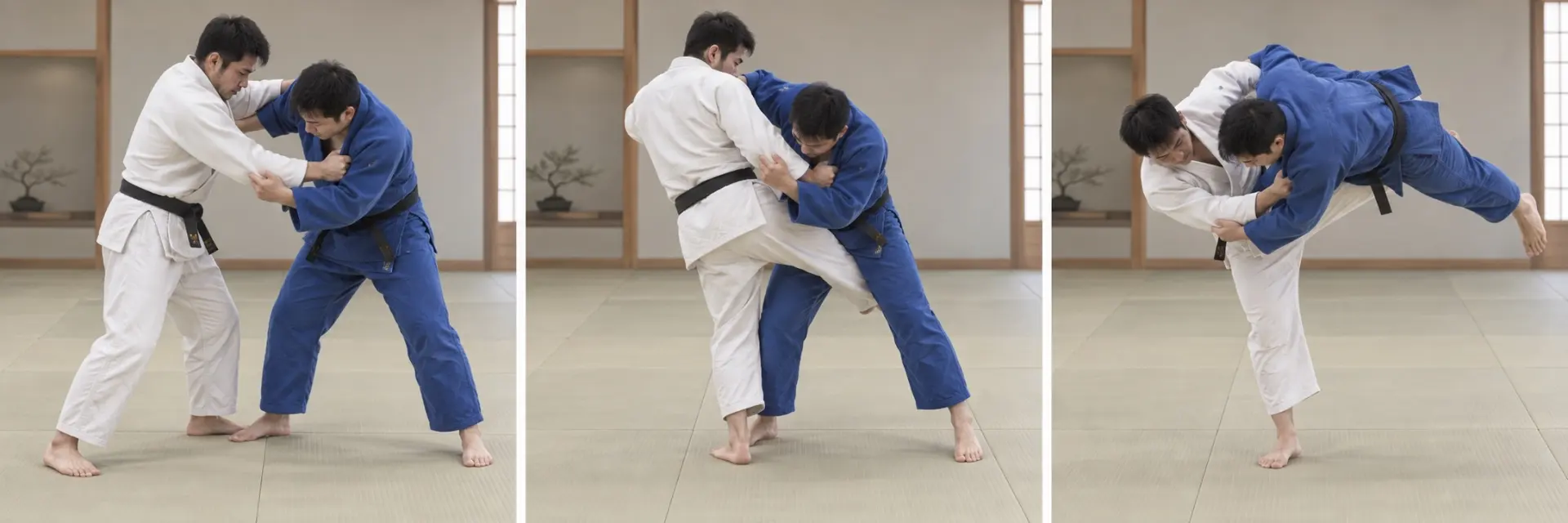
Uchi-mata combines forward imbalance, a turning body, and an upward sweep.
- Tori
- the person applying the technique
- Uke
- the person receiving the technique
- Red line
- main direction or point of contact
AT A GLANCE
Classification representative
IN SEQUENCE
Three basic phases
- 1Create the imbalance
- 2Enter with control
- 3Complete the action
Original AI-generated educational illustration for TokyoWaltz, 2026. A simplified three-stage concept; practise under qualified instruction.
PLAY WHEN NEEDED
Watch the basic movement slowly
- 1Starting pointCreate the imbalance
- 2Decisive actionEnter with control
- 3CompletionComplete the action
1 / 3Starting point— Create the imbalance
Follow the red line and phase indicator. The guide does not autoplay or loop.
How it works
Uchi-mata combines forward imbalance, a turning body, and an upward sweep.
Kuzushi
Create the imbalance
Kuzushi is usually forward or toward the opponent’s front corner. The thrower seeks to make the opponent’s weight and posture vulnerable to an upward-and-rotational action rather than leaving the opponent settled over both feet.
Tsukuri
Enter with control
Tsukuri places the supporting foot, hips, trunk, and grip into a relationship that permits the attacking leg to rise freely. The thrower may enter centrally, more toward the opponent’s hip line, or from an outside angle according to stance and reaction.
Kake
Complete the action
Kake uses the back of the attacking thigh to sweep upward along the opponent’s inner-thigh line as the hands and trunk continue the forward rotation. The thrower balances on the supporting leg and controls the opponent’s descent.
Key points
- Kuzushi is usually forward or toward the opponent’s front corner. The thrower seeks to make the opponent’s weight and posture vulnerable to an upward-and-rotational action rather than leaving the opponent…
- Tsukuri places the supporting foot, hips, trunk, and grip into a relationship that permits the attacking leg to rise freely. The thrower may enter centrally, more toward the opponent’s hip…
- Kake uses the back of the attacking thigh to sweep upward along the opponent’s inner-thigh line as the hands and trunk continue the forward rotation. The thrower balances on the…
Similar techniques
| Technique | Japanese name | Key difference |
|---|---|---|
| Harai-goshi | 払腰 | 払腰は腰技で、腰を中心とした支えと脚の払いを組み合わせます。内股は足技として内股への脚の働きを主要動作とします。 |
| Hane-goshi | 跳腰 | 跳腰は腰技として腰と脚を使い受を跳ね上げます。内股とは公式分類と主要な接触線が異なります。 |
| Ashi-guruma | 足車 | 足車は伸ばした脚を回転の軸として受を越えさせます。内股は内側から脚を働かせます。 |
Technique connections
Countered by
Counters Uchi-mata
Source: Kodokan
Why this connection?
The Kodokan definition identifies Uchi-mata-gaeshi as a counter to Uchi-mata.
Direction: Uchi-mata-gaeshi → Uchi-mata
- Kodokan Kodokan Definitions of Judo TechniquesUchi-mata-gaeshi definitionVerified: September 3, 2026
Countered by
Counters Uchi-mata
Source: Kodokan
Why this connection?
The Kodokan definition identifies Uchi-mata-sukashi as a counter to Uchi-mata.
Direction: Uchi-mata-sukashi → Uchi-mata
- Kodokan Kodokan Definitions of Judo TechniquesUchi-mata-sukashi definitionVerified: September 3, 2026
View all connections
Variation
A named Uchi-mata variation
Source: Kodokan
Why this connection?
The Kodokan definition describes Uchi-mata-makikomi through the application of Uchi-mata with a wrapping action.
Direction: Uchi-mata-makikomi → Uchi-mata
- Kodokan Kodokan Definitions of Judo TechniquesUchi-mata-makikomi definitionVerified: September 3, 2026
Set-up
O-uchi-gari to Uchi-mata
Source: British Judo Association
Why this connection?
British Judo lists this direction as a renraku-waza example in its Dan-grade skills syllabus.
Direction: O-uchi-gari → Uchi-mata
- British Judo Association Technical Dan Grade Skills Examination FormNage-waza: renraku-waza combinationsVerified: September 3, 2026
Follow-up
Uchi-mata to Ko-uchi-gari
Source: British Judo Association
Why this connection?
British Judo lists this direction as a renraku-waza example in its Dan-grade skills syllabus.
Direction: Uchi-mata → Ko-uchi-gari
- British Judo Association Technical Dan Grade Skills Examination FormNage-waza: renraku-waza combinationsVerified: September 3, 2026
Reference
Open the detailed source material when you need definitions, technical distinctions, training context, or references.
Official definition
Official definition
The Kodokan definition describes breaking the opponent forward or toward a front corner and sweeping the inside of the opponent’s thigh upward with the back of the thrower’s thigh. The standard account is right-sided, but the principle applies to the corresponding left-sided form.
The definition allows substantial variation in grip, stance, entry depth, and the exact part of the inner-thigh line contacted. The decisive upward leg action remains the official basis of the name.
Technical principle
Uchi-mata combines forward imbalance, a turning body, and an upward sweep. The thrower positions the supporting leg so that the trunk can incline and rotate without losing the connection established by the grip.
Motion research comparing experienced and less experienced performers has found differences in the timing and magnitude of trunk inclination and hand action. This supports a whole-body explanation: the sweep works with the upper-body connection and support, not after them as an isolated movement.
Name and classification
Overview
| Japanese | 内股 |
|---|---|
| Reading | うちまた |
| Romanisation | uchi-mata; common search form: uchi mata |
| Meaning | Inner thigh |
| Martial art | Judo |
| Official classification | Kodokan ashi-waza |
| Gokyō no Waza | Dai-nikyō |
| Kata | Nage-no-kata, ashi-waza set |
Name and classification
Uchi (内) means inner or inside, and mata (股) refers to the thigh or crotch region. The name identifies the line attacked by the sweeping thigh, not a requirement to make contact at one exact point.
The Kodokan classifies uchi-mata as ashi-waza. It appears in Dai-nikyō of the Gokyō no Waza and is the third technique in the ashi-waza set of Nage-no-kata.
Detailed execution
Place in Ashi-waza
Ashi-waza are the Kodokan throwing techniques in which the leg or foot provides the principal recognised action. Uchi-mata turns around a supporting leg while the attacking thigh rises into the opponent’s inner-thigh line.
The upper body remains essential. The hands direct posture and rotation, while the supporting foot and trunk create a stable axis. Calling uchi-mata a leg technique does not reduce it to a leg swing.
Kuzushi
Kuzushi is usually forward or toward the opponent’s front corner. The thrower seeks to make the opponent’s weight and posture vulnerable to an upward-and-rotational action rather than leaving the opponent settled over both feet.
In moving practice, kuzushi may emerge from circling, a failed grip adjustment, or a preceding attack such as O-uchi-gari. The named combination is common, but the underlying requirement is the opponent’s reaction and posture.
Tsukuri
Tsukuri places the supporting foot, hips, trunk, and grip into a relationship that permits the attacking leg to rise freely. The thrower may enter centrally, more toward the opponent’s hip line, or from an outside angle according to stance and reaction.
Leg length, posture, and grip make legitimate performances look different. An effective entry maintains the upper-body connection while leaving room for the thigh to sweep.
Kake
Kake uses the back of the attacking thigh to sweep upward along the opponent’s inner-thigh line as the hands and trunk continue the forward rotation. The thrower balances on the supporting leg and controls the opponent’s descent.
The exact contact can be nearer one thigh or the centre line depending on the variation. The official classification follows the inner-thigh sweeping action, not a rigid anatomical target.
Common variations
Recognised practice includes hip-dominant and more leg-dominant entries, hopping completions, attacks from standard or over-the-back grips, and versions adapted to opposite stances. Japanese coaching vocabulary may describe these emphases without creating new Kodokan technique names.
A variation should be classified from the action actually performed. If the opponent is loaded onto the rear hip and swept as in harai-goshi, the correct name may change even when the entry first resembles uchi-mata.
Uchi-mata and Harai-goshi
Both throws may use a turning entry, one-leg support, forward kuzushi, and an upward sweeping leg. Their visual similarity is strongest in competition variations where grip and posture depart from the textbook form.
The Kodokan distinction is mechanical. Uchi-mata is ashi-waza: the attacking thigh sweeps the opponent’s inner-thigh line. Harai-goshi is koshi-waza: the opponent is drawn onto the thrower’s rear hip and then swept. The location of loading and the decisive action are more informative than appearance alone.
Uchi-mata counters
Kodokan nomenclature includes several techniques associated with responding to uchi-mata. Uchi-mata-sukashi avoids the sweeping action and redirects the attacker, while uchi-mata-gaeshi counters through a leg action and is classified separately.
Countering safely depends on timing, posture, and control. These names should not be treated as automatic recipes: the official label follows the actual countering mechanism, and forcing a late resistance can increase injury risk.
Training and safety
Training
Uchi-mata is studied in Nage-no-kata, uchikomi, controlled throwing practice, and randori. Drills can develop support-leg balance, coordinated hand action, and entry from both same- and opposite-stance gripping situations.
Because the receiving partner may rotate from height, practice requires reliable ukemi and controlled follow-through. A progressive approach is more useful than forcing maximum sweep height before the supporting posture is stable.
Competition rules
Competition
Uchi-mata is legal in IJF competition and appears in many grip and stance configurations. Under the IJF rules dated 14 August 2026, scoring depends on landing, speed, force, back contact, and skilful control; the declared technique name is not itself a score.
Dangerous head diving during uchi-mata is punished by direct hansoku-make. Grips and transitions must also comply with current standing-action rules. Youth and national regulations can differ from the IJF senior standard.
Sources
Sources
- Kodokan Judo Institute, Judo Technique Names.
- Kodokan Judo Institute, Definitions of Judo Techniques, 2022.
- Kodokan Judo Institute, Promotion Examination Text: Kodokan Judo, 2026.
- Kodokan Judo Institute, Nage-no-kata.
- Hamaguchi et al., Uchi-mata Instruction and Motion Characteristics, 2024.
- Study of the Lower-limb Kinematic Chain in Uchi-mata, Japan Journal of Budo, 2025.
- International Judo Federation, Sport and Organisation Rules, 14 August 2026.