Edo Print & Poetry
Shin-hanga

Image: Hashiguchi Goyō; reproduction supplied by the Walters Art Museum / Wikimedia Commons · Public domain
Shin-hanga
New images through shared craftsmanship.
Shin-hanga (新版画, new prints) was a movement in modern Japanese woodblock printing that became prominent in the early twentieth century. Publishers, especially Watanabe Shōzaburō, worked with artists and specialist craftspeople to renew the collaborative production associated with ukiyo-e. Landscapes, portraits of women, actors, birds and flowers remained important subjects, while treatments of light, atmosphere and naturalistic form gave many prints a modern character. Shin-hanga overlapped in time with sōsaku-hanga, or creative prints, whose advocates emphasised the artist’s direct involvement in carving and printing. The distinction concerns production and artistic ideals, not simply a division between old-looking and new-looking pictures.
Image
Modern light, atmosphere and subjects.
Workshop
Designers, carvers, printers and publishers.
Circulation
Japanese prints reach international audiences.
At a glance
- Japanese name
- 新版画
- English meaning
- New prints
- Main period
- Early to mid-twentieth century
- Key publisher
- Watanabe Shōzaburō
- Production model
- Collaboration among designer, block carver, printer and publisher
01
Renewing printmaking in a changing market
Woodblock publishers faced competition from photography and newer printing technologies. Around 1915, Watanabe developed collaborations that helped define shin-hanga. The enterprise used established skills while seeking images attractive to modern buyers. Its novelty lay partly in this reorganisation of a familiar medium for different aesthetic expectations and markets.
02
Four roles in the making of a print
The designer supplied the image, the carver translated it into printing blocks, and the printer controlled the application of colour and its transfer to paper. The publisher organised production and sales. Individual arrangements varied, but this division of labour explains why the signed designer’s name does not identify everyone responsible for the finished surface.
- Designer
- Composition, drawing and pictorial conception.
- Block carver
- Translating lines and colour areas into carved blocks.
- Printer
- Colour, pressure, registration and gradation on paper.
- Publisher
- Commissioning, coordinating production and reaching buyers.
03
Familiar subjects, modern effects
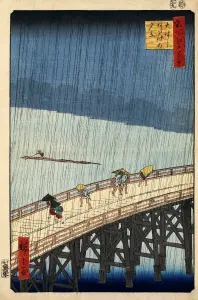
Landscapes could present rain, snow, dusk or electric light through carefully controlled colour and gradation. Images of women, actors and birds retained established subject categories while exploring different treatments of form and atmosphere. A traditional subject does not make a print an unchanged continuation of Edo-period practice; technique, audience and visual expectations all shaped the result.
04
Several routes into the movement
Kawase Hasui’s landscapes drew on travel across Japan. Itō Shinsui became closely associated with images of women, while Yoshida Hiroshi brought experience as a painter to printmaking. Natori Shunsen’s actor portraits and Ohara Koson’s birds and flowers demonstrate the range of subjects. Hashiguchi Goyō’s prints show that the field also included significant work outside a single publisher’s continuing programme.
05
Shin-hanga and sōsaku-hanga
Sōsaku-hanga promoted the ideal that artists should design, carve and print their own works. Shin-hanga generally retained specialist collaboration. These are useful tendencies, not a reliable judgement of quality or a test based on subject alone. Both belonged to modern Japanese print culture and negotiated relationships between artistic authorship, skilled work and reproducible images.
- Shin-hanga
- Renewed images realised through a collaborative workshop.
- Sōsaku-hanga
- Personal expression through the artist’s own making of the print.
06
International circulation and looking closely
Shin-hanga reached overseas audiences, and export demand helped shape the market, including the popularity of bird-and-flower prints. An image of a quiet landscape can therefore be both a view of Japan and an object produced for international circulation. When studying an impression, identify the designer, publisher, date and collection record where available; the quality of printing is as important as the outline of the composition.
Sources
Last updated: