Shinto
Misogi
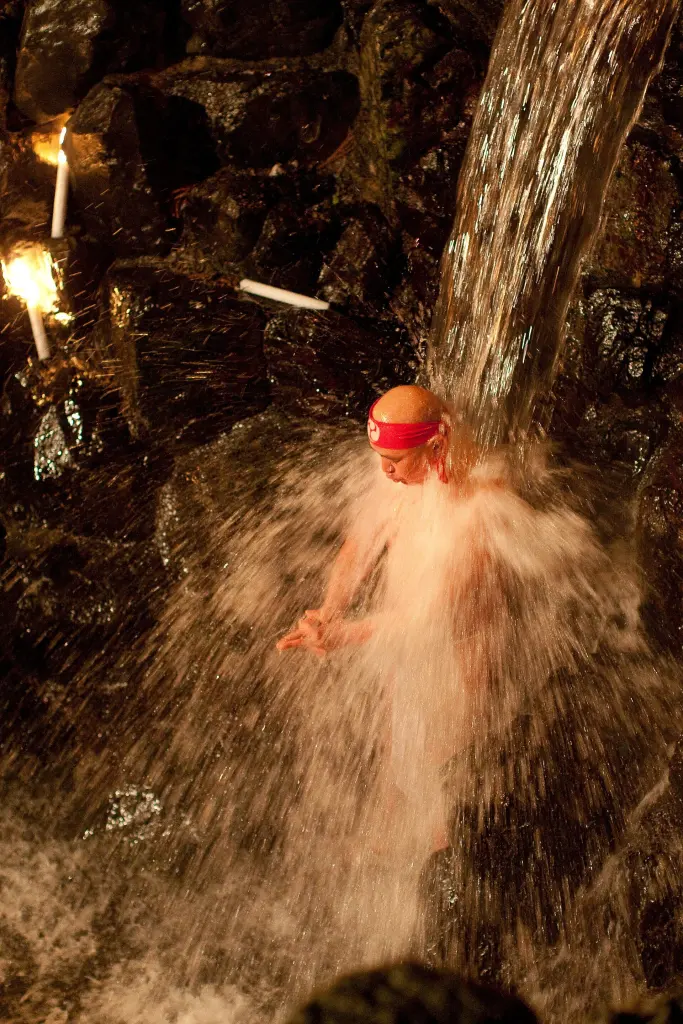
Image: Takashi Ueki / Wikimedia Commons · Creative Commons Attribution-ShareAlike 3.0 Unported
Misogi (禊) is a form of Shinto purification centred on washing or immersing the body in water. Classical mythology provides its best-known model: after returning from Yomi, the realm of the dead, Izanagi washes away its kegare, and kami emerge during the act. Historical and modern practices range from preparatory ablution to organized immersion in a river, the sea, or beneath a waterfall. Misogi is closely related to harae and the compound misogi-harae often joins them, but the terms are not exact synonyms: misogi emphasizes water, while harae covers a wider family of purification rites. Dramatic cold-water austerity is one form of misogi, not a universal requirement for shrine visitors or Shinto practice.
Overview
| Japanese | 禊 |
|---|---|
| Romanization | Misogi |
| Ritual type | Purification by washing or immersion |
| Primary element | Water |
| Mythic precedent | Izanagi's purification after returning from Yomi |
| Related practices | Harae, temizu, kessai, and mizugori |
Definition and range
Misogi literally concerns bodily ablution, but its purpose is ritual rather than simply hygienic. Sources describe full-body washing, sea or river immersion, splashing water, and other preparatory forms. Practice varies by community, institution, season, and the physical condition of participants.
Myth of Izanagi
The Kojiki and Nihon shoki connect purification with Izanagi's return from Yomi after the death of Izanami. At Awagihara he removes garments and washes, producing several kami, including Amaterasu, Tsukuyomi, and Susanoo in familiar versions of the narrative. The episode supplies a mythic charter rather than a single modern ritual manual.
Water and ritual preparation
Water marks a passage from an unsuitable condition toward renewed ritual participation. Misogi may precede shrine service or function as a distinct observance. The water source, clothing, recitations, movements, supervision, and duration differ, so descriptions of one waterfall group cannot define misogi everywhere.
Misogi and harae
Misogi and harae often appear together because both address tsumi and kegare. Misogi specifically uses water or ablution; harae can use priestly recitation, ritual implements, offerings, or symbolic transfer. Their association explains overlapping usage without erasing the distinction.
Temizu and mizugori
At a shrine entrance, temizu is a simplified purification of the hands and mouth before worship. It shares the logic of ablution but is not normally the full-body practice imagined by the word misogi. Cold-water austerity called mizugori, shaped in part by Buddhist and mountain-ascetic traditions, has also become intertwined with some forms of misogi.
Modern practice and safety
Misogi should be distinguished from ordinary Japanese bathing culture, whose home, sento, and onsen practices chiefly concern washing, soaking, warmth, rest, and social convention.
Shrines and religious groups may organize communal misogi with preparatory exercises, prayers, white clothing, and supervised entry into water. Cold, currents, slippery rock, and medical conditions create real risks. Visitors should not imitate waterfall or open-water practice without qualified local guidance, permission, and appropriate safety measures.
Sources
- Association of Shinto Shrines, Matsuri and the order of shrine ritual.
- Ise Jingu, Soul of Japan glossary.
- Meiji Jingu, Kigansai private rite.
- Nanzan Institute for Religion and Culture, Rokujikyōhō in Medieval Japan.
- Kokugakuin University, Encyclopedia of Shinto: Misogi.
- Kokugakuin University, Basic Terms of Shinto: Misogi and Mizugori.
- Ise Jingu, temizu before worship.
Last updated: