Manga
Shōha Shōten!
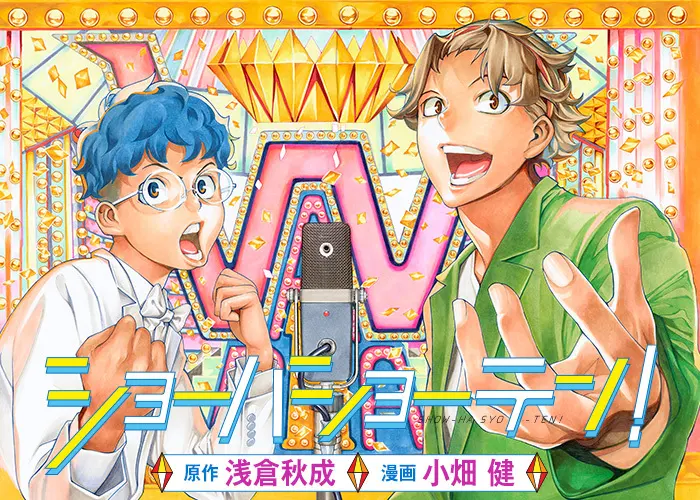
Image: Akinari Asakura and Takeshi Obata; © Shueisha / Jump SQ. official series page · Copyrighted; limited low-resolution identification and critical commentary
Shōha Shōten! (ショーハショーテン!) is a manga written by Akinari Asakura and drawn by Takeshi Obata. Published by Shueisha in Jump SQ., the completed series comprises 11 volumes. It follows shy comedy writer Azemichi Shijima and experienced performer Taiyō Higashikata as they form the duo Tenchō Katamichi Kippu and enter contests for high-school comedians. The work treats manzai as collaborative craft: premises, wording, boke and tsukkomi roles, pauses, audience reading, rehearsal, and live recovery all affect a routine. Rival pairs demonstrate that successful comic dialogue has no single formula. Although the contests and careers are fictional, the manga offers a useful bridge between contemporary youth competition, commercial manga storytelling, and Japan's longer culture of paired verbal comedy.
Overview
| Japanese title | ショーハショーテン! |
|---|---|
| Romanization | Shōha Shōten! |
| Writer | Akinari Asakura |
| Artist | Takeshi Obata |
| Original magazine | Jump SQ. |
| Publisher | Shueisha |
| Collected edition | 11 volumes |
Publication
Shueisha serialized Shōha Shōten! in Jump SQ. and collected the completed story in 11 Jump Comics volumes. The collaboration paired novelist Akinari Asakura with manga artist Takeshi Obata, whose page composition had already explored creative competition in Bakuman.
Premise
Azemichi writes comedy anonymously but hesitates in face-to-face performance. Taiyō has stage experience and competitive ambition. Their partnership makes authorship and delivery inseparable: a line that works on paper can fail without the right voice, pause, reaction, or relationship between performers.
Manzai craft
The manga breaks routines into premise, escalation, role, rhythm, wording, and audience expectation. Boke and tsukkomi are important reference points, but rival duos rearrange or blur them. This reflects manzai's capacity to change with performers and social context rather than a single permanent template.
Performance on the page
Obata represents timing through panel width, repeated viewpoints, lettering, reaction shots, and the visible spread of laughter through a room. Because readers cannot hear the live routine, page turns and spatial composition simulate pace. The result shows how manga can translate a time-based performance without simply transcribing dialogue.
Competition and rivals
The fictional Shō-1 Kōshien gives the series a tournament structure familiar from sports manga. Judging, order of appearance, audience mood, and limited set length make each performance situational. Rival teams embody different theories of comedy, so advancement depends on adaptation as well as technical polish.
Manzai and other verbal arts
Modern manzai usually emphasizes conversational exchange between performers. It differs from Rakugo, where one seated storyteller voices multiple characters, even though both rely on language, timing, and audience inference. The manga focuses on contemporary competitive manzai rather than offering a full history of Japanese comic performance.
Themes and significance
The story asks who owns a joke, whether technique can be taught, and how performers respond when sincere effort does not produce laughter. By giving drafting and rehearsal as much narrative weight as applause, it connects a popular performance form with the collaborative labour and serial pressures of manga itself.
Sources
- National Diet Library, Research Guide to Manga.
- Japan Magazine Publishers Association, Association Outline.
- Japan Arts Council, Manzai: Quick Guide.
- Japan Arts Council, Manzai and the Art of Dialogue.
- Jump SQ., Official Shōha Shōten! Series Page.
- Shueisha, Shōha Shōten! volume 9.
- National Diet Library Search, Shōha Shōten! Bibliographic Records.
Last updated: