Other Martial Arts
Kyudo
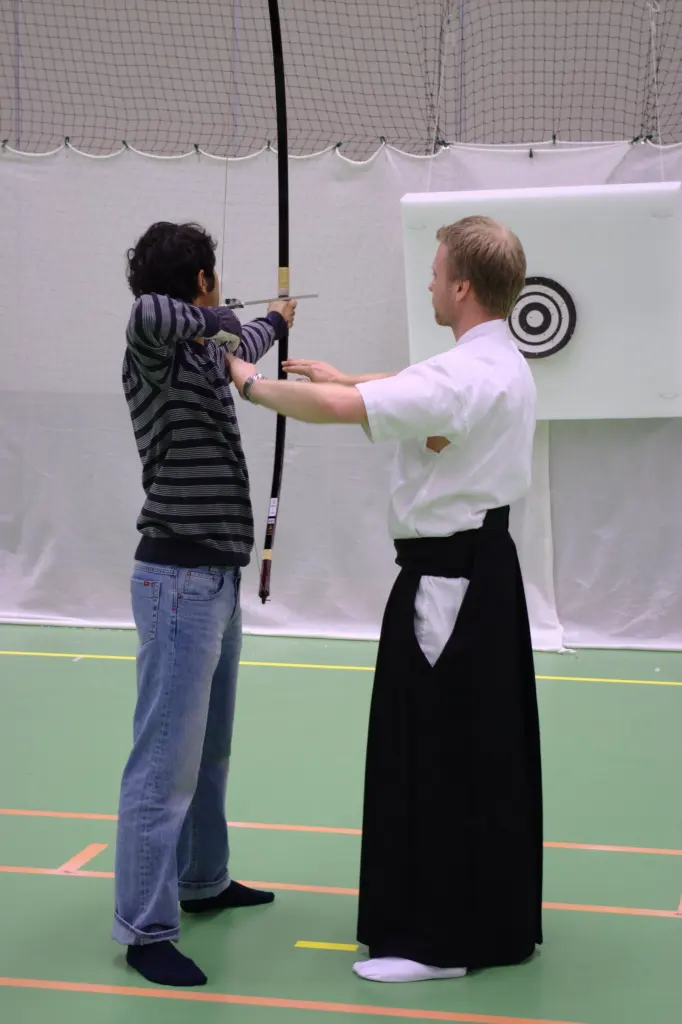
Image: Piotrg / Wikimedia Commons · CC BY-SA 3.0
Overview
Eight stages describe one continuous shot.
Kyudo is a modern Japanese archery discipline rooted in older military, ceremonial, competitive, and recreational bow traditions. Its central learning model, shahō-hassetsu, names eight connected stages from placing the feet to the awareness that remains after release. Accuracy matters, especially in competition, but a hit alone does not describe a well-executed shot: posture, coordinated expansion, safety, etiquette, and the manner of release are studied together. Modern federation standards coexist with distinct lineages, ceremonial forms, and interpretations of shooting, so the eight stages are a shared map rather than proof of one uniform syllabus.
Ashibumi · dōzukuri · yugamae
Uchiokoshi · hikiwake
Kai
Hanare · zanshin
- Japanese
- 弓道
“Way of the bow” - Classification
- Modern budō and archery discipline
- Equipment
- Yumi, ya, tsuru, and yugake
- Core model
- Shahō-hassetsu
eight stages - Japan
- All Nippon Kyudo Federation
- International
- International Kyudo Federation
01Historical frame
Older bow traditions were reorganised—not erased—by modern budō.
Japanese archery has served hunting, warfare, ceremony, display, competition, and education. The term Kyudo belongs to a modern institutional history within that longer field.
- Premodern
Many purposes, several lineages
Mounted and foot archery developed specialised methods. Heki-ryū and Ogasawara-ryū are among the traditions associated with different technical and ceremonial priorities.
- Meiji era
New public frameworks
Older patronage declined while associations, schools, and the Dai Nippon Butoku Kai reorganised archery around modern institutions.
- 1945 onward
Suspension and reconstruction
Postwar organisations rebuilt Kyudo as budō, recreation, competition, education, and cultural practice.
- Today
Federation standards and distinct lineages
National and international federations connect many practitioners, while lineage groups may retain their own authority, ceremony, and technical interpretation.
02Equipment system
The bow, arrow, string, glove, and body must be selected as one system.
Bow strength, arrow length, string condition, draw length, and range procedure are safety questions. Beginners normally learn with an instructor before buying solely from general measurements.
Yumi
An exceptionally long bow held below its midpoint. Bamboo–wood and synthetic constructions are both used.
Ya
Length and specification must suit the archer and the equipment rather than visual preference alone.
Tsuru
Its condition and fit are checked as part of safe preparation and reliable release.
Yugake
A specialised right-hand glove used to hold and release the string according to the practised method.
Practice clothing commonly includes a keikogi or formal kimono with hakama, depending on event, school, and federation convention.
03Shahō-hassetsu
The stages are analytical markers, not eight disconnected poses.
Read them as a continuous relationship among feet, posture, bow, breath, attention, expansion, release, and what remains afterward.
- 01AshibumiFooting
Place the feet and establish the shooting line.
- 02DōzukuriForm the body
Organise posture and balance over the base.
- 03YugamaeReady the bow
Prepare the grip, string hand, and gaze.
- 04UchiokoshiRaise
Lift the bow while preserving the formed body.
- 05HikiwakeDraw apart
Open the bow through coordinated movement.
- 06KaiFull draw
Complete the draw through balanced expansion.
- 07HanareRelease
Let the release emerge from the completed action.
- 08ZanshinRemain
Maintain form and awareness after the arrow leaves.
The All Nippon Kyudo Federation explanation is the primary reference for the standard sequence. Schools and teachers may differ in details such as the path of raising the bow.
04Range & ceremony
Individual technique is learned inside a shared spatial order.
A Kyudo range separates shooting, waiting, target, and retrieval areas. Several archers may share the line, so timing and awareness of the group are safety and etiquette—not decorative additions.
From movement to distance
Beginners may rehearse posture without a bow, use a training aid, then shoot at a close straw target before moving to the standard target distance.
Each step reduces one source of complexity while safe movement and release become more reliable.
Sharei
Entry, movement, kneeling or standing procedure, shooting, and exit form a coordinated presentation.
Ceremony makes composure, spacing, and consideration for the group visible; it is not merely decoration around an isolated shot.
05Evaluation
A hit answers one question; the shot still answers several more.
Competition, instruction, and grading make different observations, but none requires us to choose between technically disciplined form and effective shooting.
Did the arrow hit under the event’s defined procedure?
Were equipment, line discipline, release, and retrieval handled correctly?
Were the stages, movements, and etiquette integrated rather than mechanically displayed?
Did posture, balance, expansion, release, and zanshin support one continuous action?
Which school, grade, event, and federation standard governs the judgement?
06Boundary checks
Do not collapse every Japanese bow practice into Kyudo.
Related histories do not produce identical forms. Name the practice, organisation, lineage, and setting before transferring a claim.
Kyudo
Usually practised on foot in a specialised range, through modern federation or lineage-specific frameworks.
Yabusame
A specialised mounted archery practice commonly presented as a shrine dedication along a riding course.
Kyūjutsu
A broad label for older archery skills and schools; it is not simply an old spelling for every modern Kyudo practice.
Facility access strongly shapes participation: a safe Kyudo range requires more specialised space than many indoor martial arts. Community, school, university, and overseas federation settings therefore vary considerably.
Sources and further reading
- All Nippon Kyudo Federation, English Overview.
- All Nippon Kyudo Federation, History of Kyudo.
- All Nippon Kyudo Federation, Shahō-hassetsu.
- Japanese Academy of Budo, The Japanese Bow: Exploration of Kyudo Culture through Its Equipment.
- Nippon Budokan, Introduction of Budo Disciplines.
- Web Japan, Martial Arts: From Ancient Tradition to Modern Sport.
- Japanese Academy of Budo, An Introductory Study of the History of Budo Technique.
Last updated: