Anime
Genga and Dōga
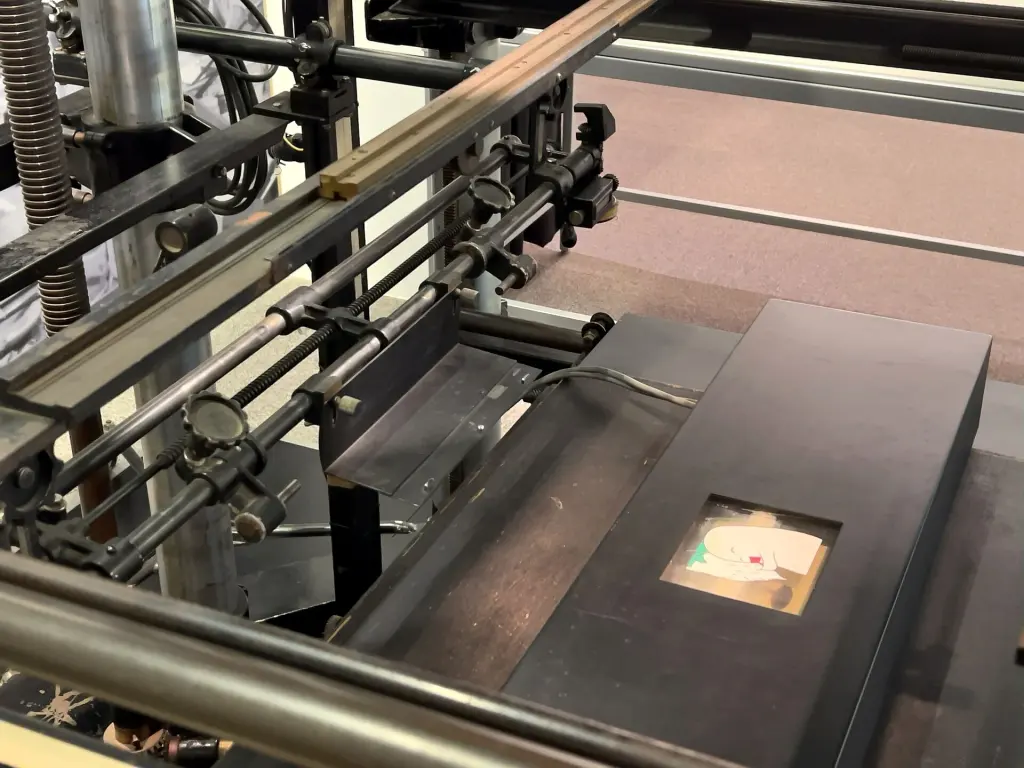
Image: Asanagi / Wikimedia Commons; Nerima Shakujiikoen Furusato Museum · Creative Commons CC0 1.0 Universal Public Domain Dedication
Genga (原画) and dōga (動画) are linked stages in the drawn-animation workflow used by Japanese anime. Genga are key drawings that establish important poses, movement, acting, and instructions for a cut. Dōga staff prepare clean, standardized lines and create the additional drawings needed between approved keys, following timing and movement information. The usual English equivalents—“key animation” and “in-between animation”—are helpful but do not capture every studio's division of labour. Layout, rough and clean key animation, first and second key animation, animation-direction corrections, dōga checking, and digital drawing may be separated differently by project. Dōga also means moving image or animation in other Japanese contexts, so production context matters. Together, these stages turn the visual plan in an e-konte into drawings that can be coloured, composited, and edited.
Overview
| Japanese | 原画・動画 |
|---|---|
| Romanization | Genga and dōga |
| Common English | Key animation and in-between animation |
| Production unit | A cut or shot |
| Genga function | Defines important poses, movement, and timing instructions |
| Dōga function | Cleans lines and supplies drawings between the keys |
Terms and translation
Genga literally means original drawings, but in anime production it refers to drawings that carry key decisions for movement and performance. Dōga literally means moving images and can mean animation generally; within a production credit or workflow it identifies the stage following approved key animation.
English “key frame” can be misleading when borrowed from computer graphics or video compression. A genga sheet is a production drawing, not necessarily one finished screen frame, and its timing is interpreted together with exposure sheets, charts, corrections, and other instructions.
Layout and key drawings
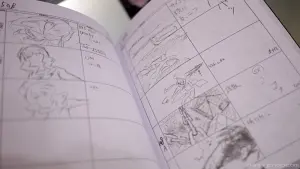
The e-konte establishes the sequence and broad framing. A layout develops a cut's composition, character placement, camera information, background requirements, and movement plan. Depending on the production, the same animator may make both layout and genga or the tasks may pass through separate checks.
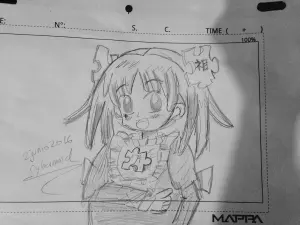
Genga select the poses and transitional information that define how the action works. They can indicate arcs, spacing, effects, mouths, eye blinks, camera moves, and layered elements. The number of keys depends on the motion and intended rhythm rather than one industry-wide formula.
First and second key animation
Some contemporary pipelines distinguish first key animation, which establishes rough motion and essential poses, from second key animation, which turns approved roughs and corrections into more complete key drawings. The Japanese credits dai-ichi genga and daini genga may appear for these tasks.
This division can support specialization and schedule management, but it is not identical across studios. A second key animator may make substantial drawing decisions, and the credit should not be treated as a purely mechanical tracing role.
Animation direction and corrections
Animation directors review layouts and genga for character models, acting, volume, perspective, and the needs of the scene. They may place correction sheets over an animator's work. Chief, action, effects, or mechanical animation directors can add further layers of supervision.
Corrections help coordinate many artists, but they also complicate attribution. The finished image may preserve a key animator's timing while altering drawing, or retain original poses while changing proportions. Production materials are often needed to see this history.
In-betweening, clean-up, and checking
Dōga staff prepare consistent line work and add the drawings required between keys according to timing charts and exposure information. They must understand three-dimensional form and movement so that volumes, details, and trajectories remain coherent through the sequence.
A dōga checker reviews line quality, numbering, registration, missing elements, and the movement between drawings before colour work. Clean-up and in-betweening may be performed by the same person or divided, and parts of the work may be subcontracted inside or outside Japan.
Paper, digital, and hybrid pipelines
Traditional sheets use registration holes, numbered layers, timing notes, and coloured pencils. Drawings can be scanned for digital finishing. Tablet-based production recreates many of these functions through layers, file names, version control, and digital exposure sheets.
A project may combine paper layouts, digital genga, outsourced dōga, three-dimensional reference, and digital compositing. The terms identify functions in the workflow, not one required tool or material.
Credits, training, and preservation
Dōga has historically been an entry point through which artists learn line control, movement, models, and production discipline before advancing to genga, although careers do not follow one fixed ladder. Production credits may list individual artists, studios, or overseas teams and do not always reveal who handled each cut.
Genga, dōga, correction sheets, timesheets, and layouts document how a finished scene was constructed. Archives and exhibitions preserve them as evidence of creative decisions and labour, not merely as collectible illustrations.
Sources
- Association of Japanese Animations, A Manual for TV Anime Series Production Assistants.
- Agency for Cultural Affairs, Animation Production Process Working Group Minutes.
- Ministry of Health, Labour and Welfare, Anime Production Progress Management.
- Agency for Cultural Affairs, Anime Production Career Map and Workflow Report.
- Agency for Cultural Affairs, Peel-Apart TV Anime.
- Agency for Cultural Affairs, Archiving Anime Production Materials.
- Agency for Cultural Affairs, Intermediate Products in Animation.
- Agency for Cultural Affairs, Copyright Policy Committee: Anime Production Workflow Diagram.
- Association of Japanese Animations, Anime Textbook and Key-Animation Materials.
Last updated: