Buddhism
Zen
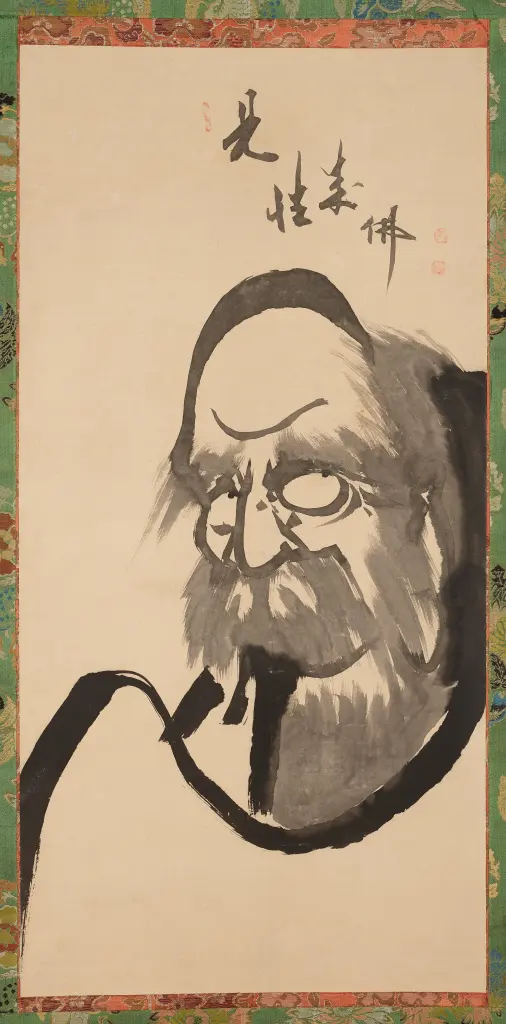
Image: Hakuin Ekaku / Wikimedia Commons; Minneapolis Institute of Art · CC BY 4.0; underlying artwork public domain
Zen (禅) in Japan comprises Buddhist lineages that trace themselves through Chinese Chan and emphasize embodied practice, teacher–student transmission, and forms of meditation. It is not one centralized school. Modern Japanese institutions include Sōtō, multiple Rinzai organizations, Ōbaku, and smaller related bodies. Zazen, or seated meditation, is foundational, but its interpretation and training methods differ: Sōtō teaching often foregrounds shikantaza, while Rinzai training is strongly associated with kōan curricula. Zen temples also conduct chanting, ordination, funerals, memorials, festivals, and lay instruction. Japanese Zen developed through repeated exchanges with China and later became global. Its links with ink painting, gardens, tea, and martial culture are significant but historically varied; describing all minimalist Japanese aesthetics as “Zen” erases other patrons, traditions, and purposes.
Overview
| Japanese | 禅 |
|---|---|
| Historical source | Chinese Chan Buddhism |
| Major Japanese lineages | Rinzai, Sōtō, and Ōbaku |
| Foundational practice | Zazen, or seated meditation |
| Selected training forms | Shikantaza, kōan study, chanting, work, and monastic discipline |
| Institutional form | Multiple denominations and temple networks |
Name and Buddhist context
The Japanese word zen derives through Chinese chan from Sanskrit dhyāna, a term connected with meditation. Zen belongs to Mahayana Buddhism and shares sutras, ethical precepts, ritual forms, and cosmological language with other East Asian traditions. Claims that Zen rejects texts or doctrine entirely are polemical shorthand. Zen literature, commentaries, monastic codes, genealogies, and ritual manuals are extensive.
Transmission to Japan
Meditative teachings existed in Japan before independent Zen institutions. From the late twelfth century, Japanese monks including Eisai and Dōgen studied in Song China, while Chinese monks also taught in Japan. Patrons at court and within warrior governments supported new monasteries. These movements did not create a single founding moment; medieval sources record multiple transmissions, lineages, and institutional alliances.
Rinzai, Sōtō, and Ōbaku
Rinzai developed through several branches whose major temples became connected with courtly and warrior patronage. Sōtō histories place Dōgen and Keizan at the centre of transmission and institutional expansion, including extensive rural temple networks. Ōbaku was established in the seventeenth century by Chinese monks led by Yinyuan Longqi, known in Japan as Ingen Ryūki, and retained distinctive Ming Chinese liturgical and artistic features.
Zazen and training
Zazen means seated meditation, but instructions and doctrinal explanations vary. Sōtō sources describe shikantaza, “just sitting,” as practice not merely a technique for reaching a later goal. Rinzai monasteries are known for systematic kōan work under a teacher, although Rinzai practice also includes seated meditation without continuous verbal analysis. Posture, breathing, attention, interviews, retreats, chanting, study, and communal routine form a wider discipline.
Monastic and lay life
Training monasteries organize intensive schedules around meditation halls, meals, work, services, and instruction. Most Zen-affiliated temples, however, are parish institutions rather than full monasteries. Priests may conduct funerals and memorials, maintain cemeteries, teach lay meditation, and manage local festivals. Lay practitioners participate through temple associations, retreats, home practice, study groups, and international Zen centres.
Art, tea, and gardens
Daitoku-ji provides a specific Kyoto example, connecting Rinzai monastic institutions with subtemple patronage, tea and gardens.
Karesansui are closely associated with medieval Zen temples, although their individual histories and meanings cannot be reduced to one universal Zen doctrine.
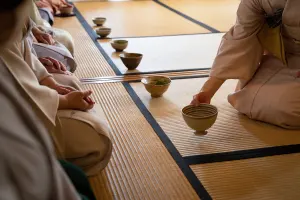
Zen monasteries were important channels for Chinese books, painting, calligraphy, ceramics, architecture, and elite cultural exchange. Monks and patrons helped shape ink painting, poetry, gardens, and the environments in which Japanese tea ceremony developed. Yet these arts also arose from court, Pure Land, Shingon, commercial, and regional contexts. “Zen aesthetic” is most useful when tied to specific institutions and historical relationships.
Modern and global Zen
From the nineteenth century, Japanese teachers and writers presented Zen to international audiences, sometimes emphasizing direct experience and meditation over temple ritual. Migrant communities, missionaries, scholars, and post-war practice centres produced diverse forms outside Japan. Global “Zen” can describe religious communities, secular meditation, design language, or lifestyle branding; these uses should not be treated as equivalent to Japanese institutional Zen.
Common misconceptions
Zen is not synonymous with all Buddhism in Japan, and most Japanese Buddhist temples are not Zen temples. Nor is zazen a single standardized method shared identically by every lineage. Popular statements that Zen alone created tea, gardens, martial arts, or Japanese simplicity compress complex histories into a cultural essence. A careful account identifies the school, temple, teacher, period, and type of evidence involved.
Sources
Last updated: