
Performing Arts
Gagaku
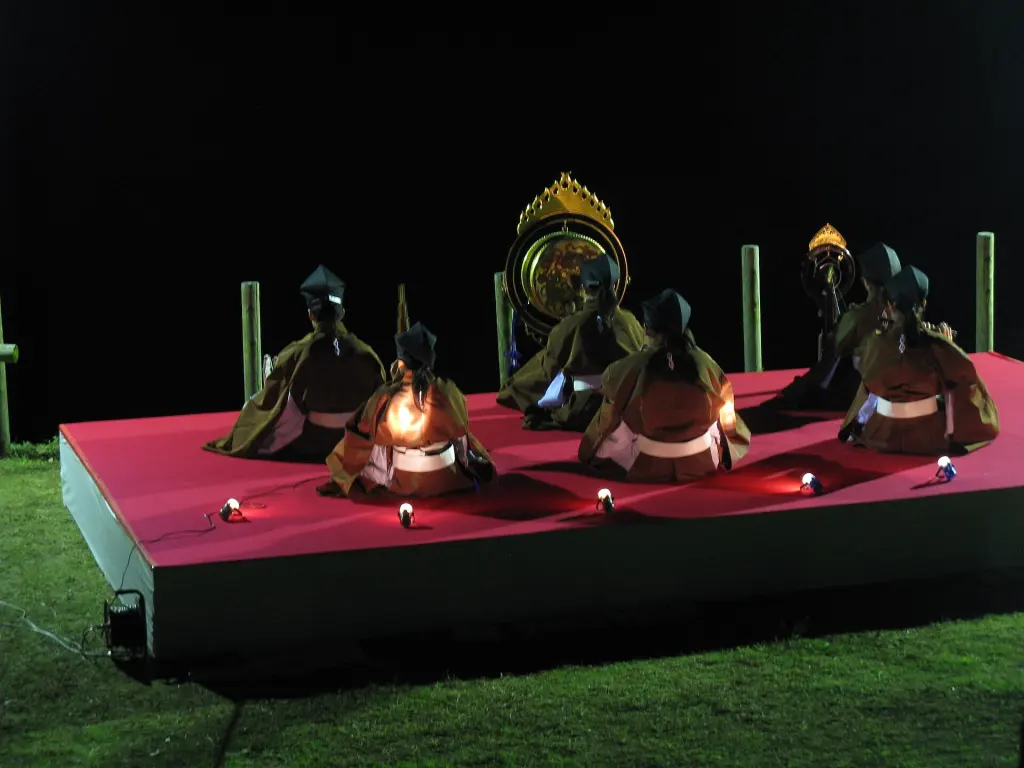
Image: KENPEI / Wikimedia Commons · Creative Commons Attribution-ShareAlike 2.1 Japan
Gagaku (雅楽) is a long-transmitted complex of Japanese court music, song, and dance. Its repertories combine indigenous ceremonial forms with music and dance introduced from the Asian continent and reorganized in Japan, reaching an established artistic form by about the tenth century. Gagaku is often called ancient Japanese court music, but it is neither a single genre nor an unchanged foreign import. It includes native Kuniburi no Utamai, continental-derived Tōgaku and Komagaku, instrumental kangen, dance-centred bugaku, and vocal forms such as saibara and rōei. The Imperial Household Agency’s Music Department is a principal transmitter, while temples, shrines, historical families, and independent ensembles also perform related repertories.
Overview
| Japanese name | 雅楽 |
|---|---|
| Classification | Court music, song, and dance |
| Formation | Established by about the tenth century |
| Main repertory families | Kuniburi no Utamai, Tōgaku, Komagaku, and vocal repertories |
| Principal performance forms | Kangen, bugaku, and kayō |
| International status | Inscribed by UNESCO in 2009 |
Name and scope
Gagaku means elegant or refined music. In present usage it covers several related repertories rather than one fixed ensemble. Some are primarily instrumental, some accompany dance, and others centre on song or chant. Performance context affects instrumentation and sequence.
The term is closely associated with the imperial court, where the tradition has received sustained patronage, but its historical networks also include Buddhist temples, Shinto institutions, and hereditary musician families. Modern public and regional ensembles further broaden where Gagaku can be heard.
Historical formation
Japan already possessed songs and dances such as kagura, Yamato song, and Kume song. From approximately the fifth century, additional music and dance arrived with cultural and religious exchange involving the Korean peninsula and China. Court institutions selected, adapted, and reorganized these materials.
By about the tenth century, during the Heian period, the major system had taken recognizable form. Later political change reduced or redistributed patronage, but court, temple, shrine, and family transmission preserved repertories. Modern reconstruction has also used surviving notation, instruments, and lineages.
Repertory families
Kuniburi no Utamai comprises native-style songs and dances, including court forms connected with ancient Japanese ritual repertories. Tōgaku developed from music associated broadly with China and routes through continental Asia. Komagaku developed from repertories associated with Korea and northeastern Asian transmission.
Saibara sets or adapts Japanese song texts, while rōei chants poetry in Japanese or Chinese. These labels describe historical and musical organization within Japan; they do not mean that present performances reproduce a single foreign original without centuries of Japanese selection and change.
Performance forms
Kangen is instrumental ensemble music. Bugaku joins music with formally patterned dance and vivid costumes; repertory groupings influence the orientation, colour, and musical forces of a dance. Kayō places the voice at the centre through song or chant.
Tempo often unfolds through long cycles and controlled changes rather than a regular Western beat. Entrances, tuning, repeated melodic patterns, percussion signals, and the expansion or contraction of tempo give a piece its shape. Ceremonial purpose may determine which repertory is appropriate.
Instruments and ensemble
Characteristic wind instruments include the shō mouth organ, the hichiriki double-reed, and transverse flutes such as the ryūteki. The shō sustains clustered harmonies, the hichiriki carries a penetrating melodic line, and the flute articulates another melodic layer.
String instruments include the gakusō zither and gaku biwa lute. Percussion can include kakko, taiko, and shōko in Tōgaku, with different combinations used for other repertories. Gagaku texture is produced by these interdependent layers rather than by a conductor-led orchestra in the modern Western sense.
Bugaku dance and costume
Bugaku dancers follow symmetrical routes, poses, and turning patterns across a square platform. Some works use masks, weapons, or implements; others depend on the changing silhouette of long sleeves and layered robes. Costumes visually distinguish repertory groups and roles.
The famous dance Ranryōō uses a richly carved mask and represents a warrior prince, while other dances may be unmasked, paired, or presented by larger groups. Bugaku is one part of Gagaku, so the two terms are related but not interchangeable.
Reading surviving bugaku costumes
Surviving costumes connect textile history with performance. The Nezu Museum describes red as the usual base colour for left-side dances and blue or green tones for right-side dances, while also documenting exceptions: Rinnō-ji preserves both red and green robes for Karyōbin, a left-side dance. Colour is therefore a useful clue, not a sufficient identification on its own.
Material, inscription, garment form, and provenance provide separate evidence. A silk brocade ryōtō now in the Tokyo National Museum bears an inscription recording its donation to the Niu shrine at Kōyasan in 1378. Such records help date a particular surviving garment; they do not date the origin of an entire dance tradition. See the Nezu Museum’s object descriptions for Bugaku Costumes: The Beauty of Inherited Textiles.
Transmission and recognition
The Music Department of the Imperial Household Agency preserves and performs Gagaku for palace ceremonies and public recitals. Its musicians learn multiple repertories through direct instruction, notation, ensemble rehearsal, and dance practice. Other institutions and ensembles maintain related historical lines or modern reconstructions.
Gagaku performed by the court musicians was designated an Important Intangible Cultural Property in 1955. UNESCO inscribed Gagaku on the Representative List in 2009, emphasizing both its long transmission and its synthesis of cultural traditions.
Gagaku in modern culture
Public concerts, recordings, school programmes, and overseas performances have moved Gagaku beyond court ceremony without erasing its ceremonial functions. Independent groups perform old repertory and commission new works for traditional instruments.
Modern composers have drawn on the shō’s sonority, layered timing, and spatialized ensemble sound. Such reception should be distinguished from historical Gagaku itself: influence, newly composed Gagaku, and inherited repertory overlap, but they are not the same category.
Sources
Last updated:
.jpg?width=320)

