Aikido
Yoshinkan Aikido
Image: Asanagi / Wikimedia Commons · CC0 1.0
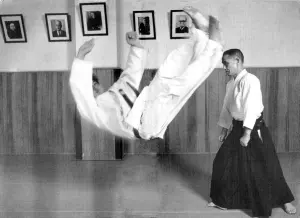
Yoshinkan Aikido is a major school of Aikido founded in Tokyo by Gozo Shioda in 1955. Its curriculum systematises posture, footwork, balance breaking, and paired technique through fundamental movements called kihon dosa. This staged method developed from Shioda's prewar training with Morihei Ueshiba and from the need to teach large groups consistently after the Second World War. Yoshinkan became especially visible through instruction for the Tokyo Metropolitan Police and through demanding instructor courses, but it is also practised in civilian dojo, universities, companies, and international organisations. The school is sometimes characterised as a “hard style”; a more accurate description is that beginners first learn clear forms and stable body alignment before studying freer timing and variation.
Overview
| Japanese name | 養神館合気道 |
|---|---|
| Founder | Gozo Shioda |
| Established | 1955, Tokyo |
| Technical basis | Kihon dosa, paired basic techniques, and applied variations |
| Institutional body | Aikido Yoshinkai Foundation |
| Known for | Police instruction and intensive instructor training |
Name and meaning
Yoshinkan is commonly interpreted as “hall for cultivating the spirit.” The name had been used by Seiichi Shioda, the founder's father, for an earlier Judo dojo and was adopted for the new Aikido organisation.
The term identifies a school and institutional lineage within Aikido. It is not a separate premodern martial tradition, and it should not be confused with the similarly named Yoseikan systems associated with Minoru and Hiroo Mochizuki.
Postwar foundation
Gozo Shioda trained under Morihei Ueshiba at the Kobukan before the war. After resuming public instruction, he gained support following a 1954 demonstration and opened the first Yoshinkan dojo at Tsukudo-Hachiman, Shinjuku, in 1955.
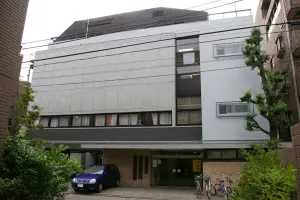
The foundation was part of Aikido's wider postwar revival, but it created an administrative and pedagogical path distinct from Aikikai. The current Aikido Yoshinkai Foundation maintains a headquarters in Takadanobaba, Tokyo.
Kihon dosa
Kihon dosa are fundamental actions used to teach coordinated movement. They include stable stance, forward and turning movement, changes of direction, extension, and the use of the hips and centre to transmit force.
Solo and paired versions allow instructors to diagnose posture before students attempt complex techniques. The exercises are a teaching framework rather than a claim that every encounter should be performed in fixed stages.
Technical curriculum
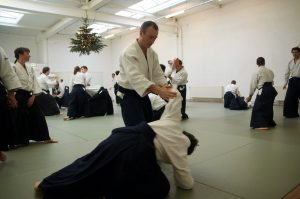
Training combines attacks, entries, throws, joint controls, pins, receiving skills, and selected weapons practice. Basic techniques are commonly organised into first and second forms, which show complementary directions or relationships between partners.
The curriculum values a clear line of balance breaking and a posture that remains composed under pressure. Advanced practice varies distance, rhythm, and resistance while preserving the principles learned through basic form.
Police instruction
Yoshinkan began teaching members of the Tokyo Metropolitan Police in the late 1950s. A formal intensive course developed during the following decade and trained participants through frequent, tightly supervised practice.
The relationship encouraged precise group instruction and contributed to the school's public reputation for physical rigour. It did not turn the civilian curriculum into police arrest training; dojo instruction remains centred on Aikido technique, etiquette, and safe paired practice.
Senshusei and instructor development
Senshusei means specialist or selected trainee. Yoshinkan intensive courses use the term for programmes designed to develop technical competence, conditioning, discipline, and the ability to teach under observation.
International participants helped carry the method abroad. Published accounts of the course have also shaped outside perceptions of Yoshinkan, although ordinary members usually train on schedules suited to civilian life rather than following the full intensive regime.
Organisations and global spread
Yoshinkan Aikido is taught in many countries through organisations descended from Shioda and his senior students. The Aikido Yoshinkai Foundation is a central Japanese institution, but the broader Yoshinkan world includes independent associations with their own leadership and grading relationships.
This plural structure makes technical comparison more useful than assuming complete administrative uniformity. Shared features usually include kihon dosa, recognisable basic forms, and a historical link to Shioda's teaching.
Yoshinkan within Aikido
Yoshinkan shares Aikido's central study of entering, turning, off-balancing, throws, and controls. Its distinctiveness lies chiefly in curriculum design and the visual clarity of early training rather than in an entirely different technical ancestry.
Labels such as “hard” and “soft” can obscure variation within every school. Yoshinkan practice ranges from strongly defined basics to responsive application, while other Aikido lineages also use structured drills and forceful movement.
Sources
Last updated: