other-martial-arts
Tsunatori

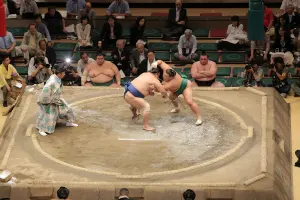
Image: Philbert Ono / Photojpn.org / Wikimedia Commons · CC BY-SA 4.0
Tsunatori
The record behind a bid for the rope.
Tsunatori (綱取り) is the expression used for a bid to reach yokozuna, the highest rank in professional sumo. The tsuna is the rope associated with the yokozuna’s ceremonial appearance. The term usually concerns an ōzeki whose recent results put promotion under consideration. It is neither a separate rank nor a tournament title. The published promotion framework combines outstanding ability and dignity with a benchmark of two consecutive championships at ōzeki, or a performance judged comparable. A strong result matters, but promotion still involves institutional assessment. Reading a tsunatori story therefore requires attention to the wrestler’s rank, the sequence of results and the distinction between expectation, recommendation and an actual decision.
Results
Performance at the rank of ōzeki.
Assessment
Ability, dignity and the recommendation framework.
Promotion
The Association makes the decision.
At a glance
- Japanese
- 綱取り — tsunatori
- Meaning
- A bid for promotion to yokozuna
- Rank under consideration
- Ōzeki
- Principal benchmark
- Two consecutive championships at ōzeki, or comparable performance
- Decision context
- Yokozuna Deliberation Council recommendation and Japan Sumo Association decision
01
The rope gives the expression its meaning
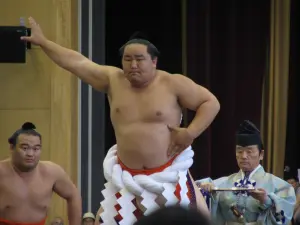
The white rope worn for a yokozuna’s ring-entering ceremony is the visible symbol behind tsunatori. Winning a championship and receiving the right to appear as a yokozuna belong to different systems of recognition. The former records a tournament outcome; the latter marks admission to a rank with continuing responsibilities.
02
A benchmark with a judgement of equivalence
The Japan Sumo Association’s explanation gives two consecutive championships at ōzeki as the principal sporting benchmark, while allowing an equivalent performance. The Council’s published internal rules also place dignity and ability at the centre of the recommendation. The equivalence provision is why discussion cannot be reduced to a universal minimum number of wins in one tournament.
03
Results lead to assessment, then a decision
The stages are connected, but a newspaper description of a promotion bid is not itself an appointment. Reports should distinguish the wrestler’s results from the Council’s recommendation and the Association’s decision.
- Tournament record
- The sporting evidence on which a possible promotion is discussed.
- Council recommendation
- An assessment under the yokozuna recommendation framework.
- Association decision
- The institutional decision that makes promotion official.
04
Championship, promotion and rank
A yūshō is a championship within a division. Yokozuna is a position on the banzuke and is not awarded automatically to each champion. An ōzeki can win a tournament without immediately becoming yokozuna. Conversely, discussion of comparable performance means that the assessment is broader than simply counting trophies in isolation.
05
The modern process has an institutional history
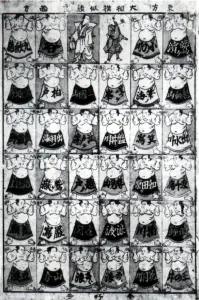
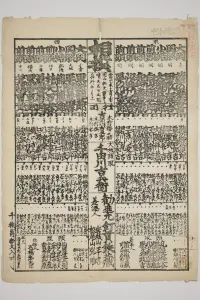
The Sumo Museum’s 2026 Chiyonoyama exhibition explains a 1951 agreement under which the Association would decide promotion, with the certificate ceremony held in Tokyo. Chiyonoyama’s elevation after the May tournament became the first under that arrangement. This history helps distinguish modern administrative procedure from the longer history of yokozuna licences and ceremonial authority.
06
Promotion changes the expectations of a career
Unlike lower ranks, yokozuna is not lost through ordinary demotion after a poor record. The Association’s introductory guide explains the expectation of retirement when a yokozuna can no longer perform adequately. Tsunatori therefore concerns entry into a distinctive responsibility as well as sporting achievement. The clearest reading of any particular bid uses the official decision and its stated reasoning, rather than treating advance predictions as guarantees.
Sources
Last updated: